Choosing between experience management platforms is one of the most consequential technology decisions a CX team makes. ActionXM and Qualtrics take fundamentally different approaches to the same problem: understanding and improving customer experience.
This guide provides an honest, feature-by-feature comparison — including where each platform genuinely excels — so you can make an informed decision for your organization.
The Fundamental Difference
The core question isn’t “which is better” — it’s whether your CX program needs to observe behavior or collect stated feedback (or both). Most modern CX teams need both, which is where the comparison gets interesting.
Head-to-Head Feature Comparison
Behavioral Analytics
This is the most significant differentiator between the two platforms. ActionXM provides native behavioral analytics; Qualtrics does not.
| Feature | ActionXM | Qualtrics |
|---|---|---|
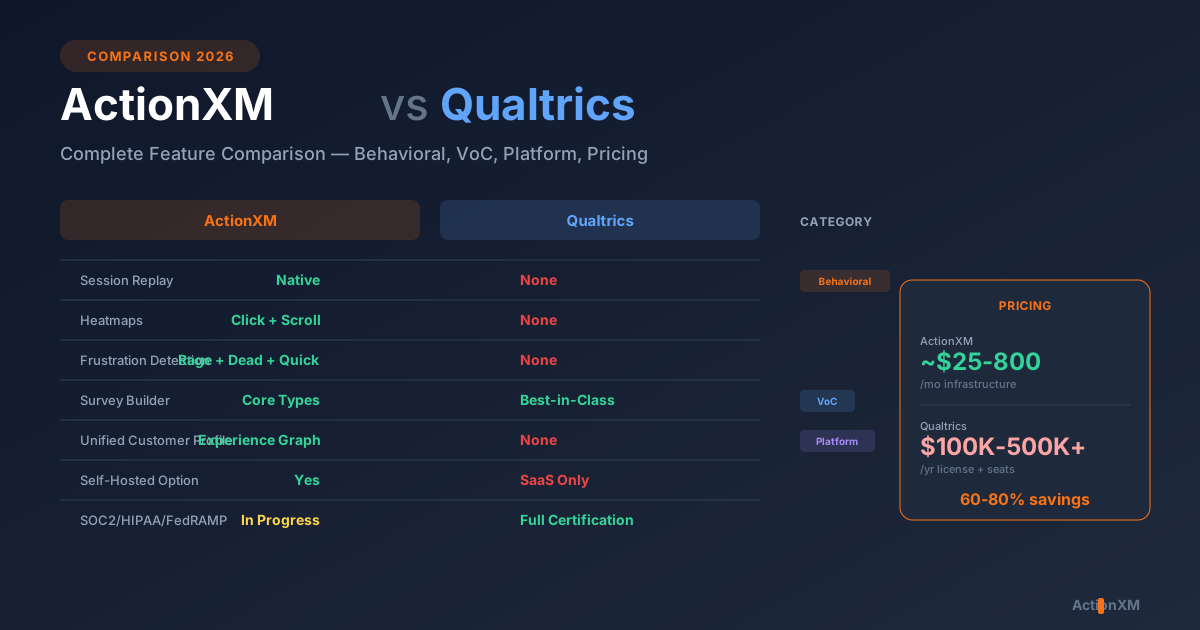
| Session Replay | Native, unlimited | Not available |
| Click Heatmaps | Click + scroll + attention | Not available |
| Rage Click Detection | Automatic, with alerting | Not available |
| Dead Click Detection | Automatic, with case creation | Not available |
| Quick Back Detection | Navigation mismatch tracking | Not available |
| Core Web Vitals Monitoring | Real-time per-page metrics | Not available |
| Frustration Scoring | Granular, multi-signal scoring | Not available |
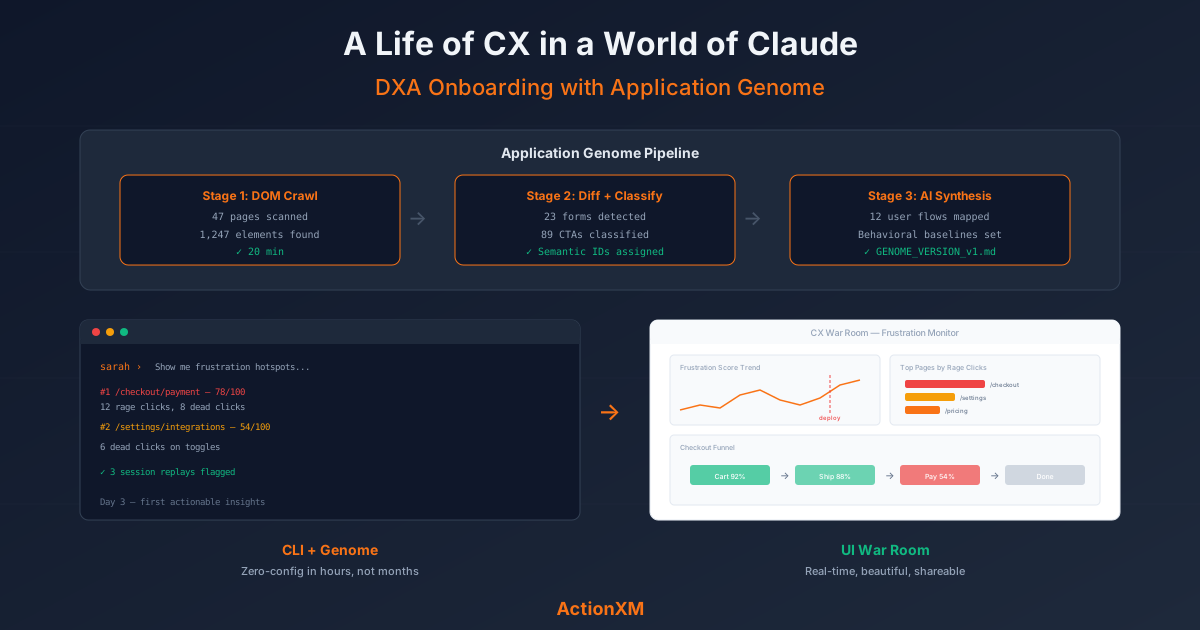
| DOM Auto-Instrumentation | Application Genome | Not available |
Bottom line: If behavioral analytics is important to your CX program, ActionXM is the only choice. Qualtrics users who need session replay must purchase and integrate a separate tool (Fullstory, Contentsquare, or similar), creating data silos and additional cost.
Voice of Customer (Surveys)
Qualtrics’ survey builder is the most sophisticated on the market. ActionXM provides core VoC capabilities with a different approach.
| Feature | ActionXM | Qualtrics |
|---|---|---|
| NPS / CSAT / CES Surveys | Yes | Yes |
| Survey Builder | Streamlined | Advanced (best-in-class) |
| Skip / Branch Logic | Planned | Yes (complex branching) |
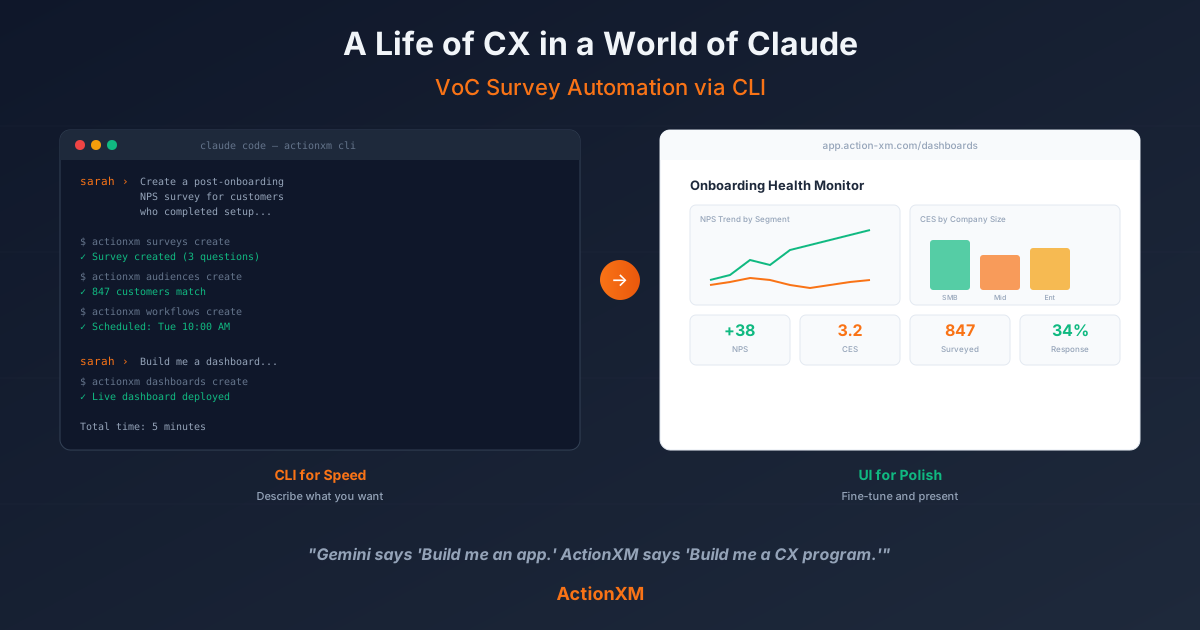
| AI Question Generation | CLI-based | Qualtrics Assist |
| Email Distribution | Yes | Yes |
| SMS Distribution | Planned | Yes |
| Intercept Surveys | Yes (in-app) | Yes (website + app) |
| Text Analytics / NLP | Planned | Yes (Text iQ) |
| Conjoint / MaxDiff | No | Yes |
| A/B Testing (Surveys) | No | Yes |
Bottom line: For pure survey sophistication — complex branching, conjoint analysis, advanced text analytics — Qualtrics is ahead. ActionXM covers the core survey types most teams use (NPS, CSAT, CES) and compensates with behavioral data that surveys can’t capture.
Platform & Intelligence
| Feature | ActionXM | Qualtrics |
|---|---|---|
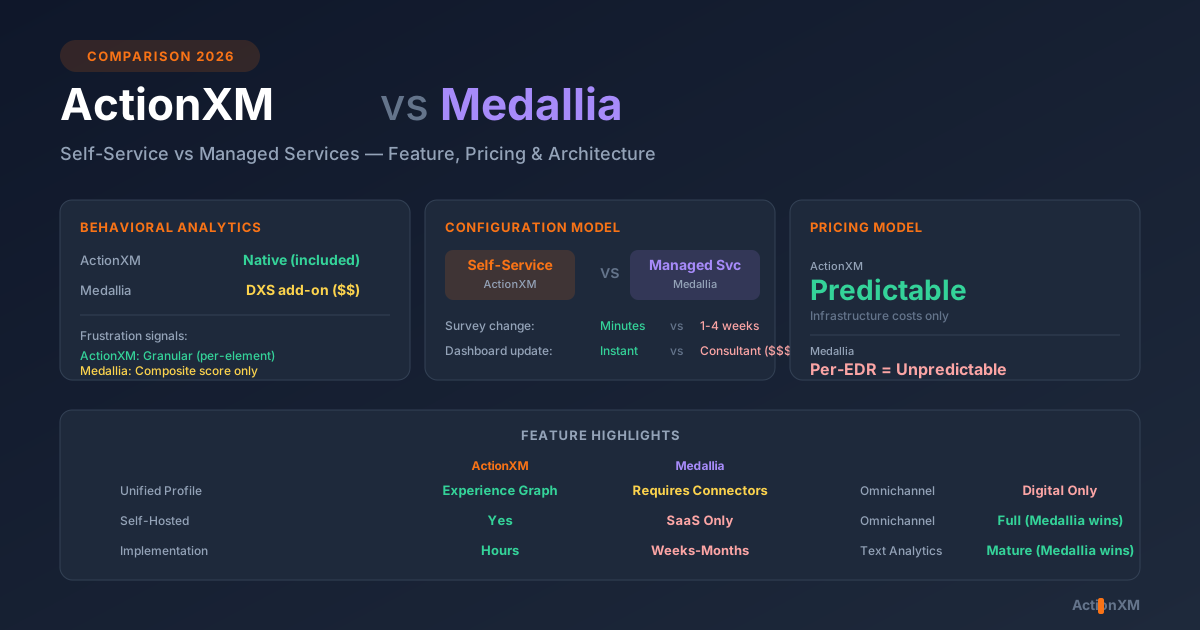
| Unified Customer Profile | Experience Graph (native) | No unified profile |
| Identity Resolution | 7+ signal types | Basic respondent tracking |
| Auto-Instrumentation | Application Genome (zero-config) | Manual implementation |
| Deploy Detection | Automatic, real-time | Not available |
| AI Engine | CX Advisor (proactive) | AI Assist (reactive) |
| Auto-Case Creation | From behavioral triggers | From survey responses |
| Dashboards & Reporting | Yes | Yes (advanced) |
| Role-Based Access | Yes | Yes (granular) |
Bottom line: ActionXM’s unified profile (Experience Graph) links behavioral data with survey responses per customer — something Qualtrics architecturally cannot do without external integration. Qualtrics has more mature reporting and role-based access controls.
Deployment & Compliance
| Feature | ActionXM | Qualtrics |
|---|---|---|
| Self-Hosted Deployment | Yes (full data sovereignty) | No (SaaS only) |
| Cloud Deployment | Yes (AWS, Azure, GCP) | Yes (Qualtrics Cloud) |
| SOC 2 Type II | In progress | Yes |
| HIPAA Compliance | In progress | Yes (BAA available) |
| FedRAMP | No | Yes (Authorized) |
| GDPR Compliance | Yes (data stays on-premises) | Yes (DPA available) |
| ISO 27001 | In progress | Yes |
| Mobile SDK | Not available | Yes (native iOS/Android) |
Bottom line: Qualtrics has significantly more mature compliance certifications, which matters for healthcare, government, and highly regulated industries. ActionXM’s self-hosted model provides a different path to compliance — if the data never leaves your infrastructure, many compliance concerns are eliminated at the architecture level.
Pricing Comparison
Pricing is one of the starkest differences between the platforms.
Unlimited sessions & surveys
No per-response fees
No module add-ons
Predictable, fixed costs
Per-response overage charges
Compliance add-ons ($3K-$8K/yr)
Integration connectors ($200+/mo)
Professional services ($25K+)
Hidden Cost Factors
Organizations often underestimate Qualtrics TCO by 40-60%. Common hidden costs include:
- Per-response overages: Exceeding your plan’s response limit triggers per-response charges
- Premium integration connectors: Each connector costs $200+/month beyond basic integrations
- Compliance modules: HIPAA BAA, advanced security, and data residency add $3K-$8K/year
- Professional services: Implementation typically requires $25K+ in Qualtrics consulting
- Annual price increases: 5-15% annual increases are standard in enterprise contracts
- Training costs: The complex interface requires ongoing training investment
ActionXM’s self-hosted model has a fundamentally different cost structure — you pay for infrastructure (compute and storage), which scales predictably with usage. There are no per-seat, per-response, or module-based charges.
Calculate your savings: Use our Data Sovereignty Cost Calculator to compare 3-year TCO between ActionXM and Qualtrics for your specific usage.
Where ActionXM Wins
1. Behavioral Analytics (No Contest)
ActionXM provides native session replay, heatmaps, rage click detection, dead click detection, and frustration scoring. Qualtrics has no behavioral analytics capabilities at all. Organizations using Qualtrics must purchase and integrate a separate DXA tool (Fullstory, Contentsquare, Hotjar), creating:
- Data silos: Survey data in one platform, behavioral data in another
- No unified profiles: Cannot link a survey respondent’s NPS score to their session replay
- Additional cost: $20K-$200K+ annually for enterprise DXA tools
- Integration maintenance: Ongoing engineering effort to keep systems connected
2. Unified Customer Profiles
ActionXM’s Experience Graph creates a unified profile for each customer, linking behavioral signals (clicks, scrolls, frustration events) with survey responses (NPS, CSAT) and identity signals (cross-session, cross-device). This is architecturally impossible in Qualtrics, which tracks survey respondents but has no concept of behavioral identity.
3. Zero-Config Implementation
ActionXM’s Application Genome automatically instruments every DOM element — no manual tagging, no engineering sprints, no maintenance. Qualtrics requires manual survey deployment and has no page-level instrumentation capability.
4. Pricing Transparency
No per-seat charges, no per-response fees, no module add-ons. ActionXM’s cost scales with infrastructure, not with usage or team size. For organizations with growing teams or high survey volumes, this translates to 60-80% cost savings.
5. Self-Hosted Data Sovereignty
For organizations with data residency requirements, ActionXM can be deployed entirely within your own infrastructure. Customer data never leaves your environment. Qualtrics is SaaS-only, meaning all data is stored in Qualtrics’ cloud.
6. Proactive Intelligence
ActionXM’s CX Advisor proactively identifies issues — deploy regressions, frustration spikes, experience anomalies — before customers complain. Qualtrics’ AI capabilities are reactive, analyzing feedback after it’s submitted.
Where Qualtrics Wins
1. Enterprise Compliance & Certifications
Qualtrics holds SOC 2 Type II, HIPAA, FedRAMP, ISO 27001, and numerous other certifications. For healthcare organizations, government agencies, and enterprises with strict compliance requirements, Qualtrics’ certification portfolio is significantly more mature. ActionXM is working toward these certifications but isn’t there yet.
2. Survey Sophistication
Qualtrics’ survey builder is the gold standard. Complex branching logic, conjoint analysis, MaxDiff, randomization, quotas, and 100+ question types make it the right choice for organizations that need advanced survey methodologies. ActionXM covers core survey types but doesn’t match Qualtrics’ depth.
3. Mobile SDK
Qualtrics offers native mobile SDKs for iOS and Android, enabling in-app surveys and feedback collection. ActionXM currently focuses on web experiences and does not have a mobile SDK.
4. Text Analytics Maturity
Qualtrics Text iQ provides mature natural language processing for open-ended survey responses, with topic detection, sentiment analysis, and trend identification. ActionXM’s text analytics capabilities are still in development.
5. Omnichannel Distribution
Qualtrics supports email, SMS, web intercept, in-app, IVR (phone), and in-person feedback collection. ActionXM currently supports email and web-based surveys, with SMS planned.
6. A/B Testing
Qualtrics includes A/B testing capabilities for surveys and some digital experiences. ActionXM does not currently offer A/B testing.
Who Should Choose ActionXM
Who Should Choose Qualtrics
The Convergence: Why Both Matters
The CX industry is converging toward platforms that combine behavioral analytics with traditional VoC. Surveys alone capture 5-15% of customer experiences. Behavioral data captures 100%. The most effective CX programs use both.
- Qualtrics’ path: Will likely need to build or acquire behavioral analytics capabilities. Their 2024 acquisition of Clarabridge signaled interest in unstructured data, but session replay and behavioral analytics remain absent.
- ActionXM’s path: Continuing to deepen survey capabilities while maintaining behavioral analytics as the foundation.
For organizations evaluating today, the question is: do you start with behavioral analytics and add surveys (ActionXM), or start with surveys and add behavioral analytics via integration (Qualtrics + DXA tool)?