When SurveyGizmo rebranded to Alchemer in October 2020, the company signaled a strategic shift from approachable survey tool to enterprise-focused feedback platform. For many longtime users, that shift brought more than just a new name—it brought new pricing, new complexity, and questions about whether Alchemer still fits their needs.
If you’re evaluating alternatives, you’re likely experiencing one of these scenarios:
- Pricing shock: Annual renewals keep climbing, with some teams reporting increases from under $1,000 to nearly $8,000 for the same user count
- Feature-tier frustration: Essential capabilities locked behind premium plans you didn’t need before
- Complexity overload: A platform that’s become more powerful but harder to use for everyday surveys
- Support concerns: Response times that don’t match the urgency of your research timelines
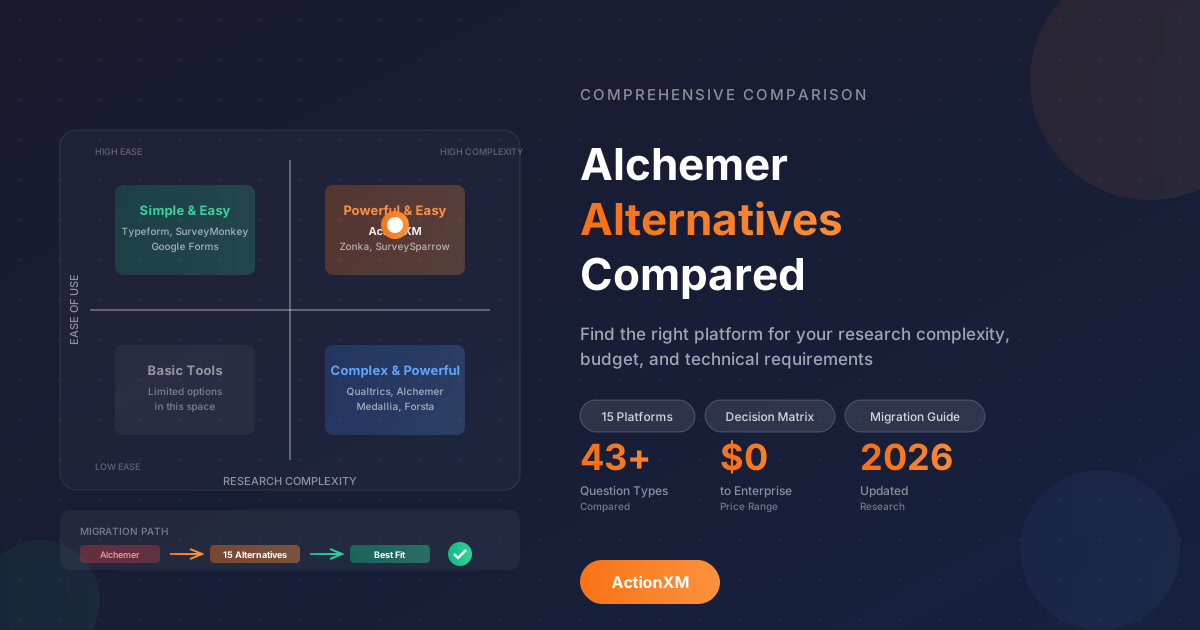
This guide compares 15 Alchemer alternatives across the dimensions that matter most: research flexibility, ease of use, pricing transparency, and the ability to grow with your needs.
Understanding Alchemer: Strengths and Limitations
Before exploring alternatives, let’s establish what makes Alchemer distinctive and where it falls short.
What Alchemer Does Well
Alchemer earned its reputation through genuine strengths that still matter:
| Capability | Why It Matters |
|---|---|
| 43+ question types | Supports complex research including MaxDiff, conjoint analysis, and custom scripting |
| Advanced logic | Sophisticated branching, piping, and skip logic for dynamic surveys |
| Unlimited responses | No per-response fees on standard plans—predictable costs at scale |
| Direct integrations | Native connections to Tableau, Salesforce, Google Sheets, and 100+ platforms |
| Research-grade features | SPSS export, randomization, quotas, and statistical controls |
For market research teams needing maximum survey flexibility, Alchemer remains a capable tool.
The Alchemer Pricing Reality
However, pricing has become a significant friction point. Based on current pricing and user reports:
| Tier | Monthly Cost | Key Limitations |
|---|---|---|
| Collaborator | $55/user | 75K responses/account, basic support, no advanced reports |
| Professional | $165/user | 100K responses, offline mode, phone support |
| Full Access | $275/user | Advanced SPSS analysis, all question types |
| Enterprise | Custom quote | Required for SSO, compliance features, API access |
The hidden costs: Custom domains, API access, SSO, and compliance features require Enterprise tier. Per-seat pricing compounds quickly—a 5-person team on Professional pays $9,900/year before any add-ons.
Common Alchemer Frustrations
Based on Capterra and G2 reviews, users consistently report:
| Pain Point | User Feedback |
|---|---|
| Price increases | ”The price keeps increasing each renewal—it’s becoming hard to justify.” |
| Interface complexity | ”The interface feels dated and overwhelming for beginners.” |
| Support delays | ”Support can be slow to resolve technical issues—sometimes weeks.” |
| Feature lockouts | ”Some essential features like custom domains are locked behind premium plans.” |
| Manual processes | ”You have to close surveys manually—can’t auto-close at a set date.” |
Finding Your Ideal Alternative: A Decision Framework
Not every team needs the same capabilities. Before comparing platforms, clarify your requirements:
Team Complexity Profile
Your research complexity determines which features matter most:
| Profile | Characteristics | Priority Features | Budget Range |
|---|---|---|---|
| Simple Surveys | Standard NPS/CSAT, basic logic, 1-3 users | Ease of use, templates, quick setup | $0-100/month |
| Growing Teams | Multiple survey types, integrations needed, 3-10 users | Collaboration, CRM sync, moderate analytics | $100-500/month |
| Research Operations | Complex methodology, advanced analysis, statistical rigor | MaxDiff/conjoint, SPSS, quotas | $300-1,000/month |
| Enterprise Scale | Compliance requirements, multiple departments, governance | SSO, permissions, audit trails, API | $1,000+/month |
Decision Criteria Weighted Matrix
Different organizations weight criteria differently. Here’s a framework for prioritizing:
| Criteria | Weight for Simple | Weight for Growing | Weight for Research | Weight for Enterprise |
|---|---|---|---|---|
| Ease of use | High | High | Medium | Medium |
| Question variety | Low | Medium | High | High |
| Analytics depth | Low | Medium | High | High |
| Integration ecosystem | Low | High | Medium | High |
| Price predictability | High | High | Medium | Medium |
| Support quality | Medium | High | High | High |
| Compliance/security | Low | Low | Medium | High |
Quick Comparison: 15 Alchemer Alternatives
| Platform | Best Fit | Starting Price | Key Differentiator |
|---|---|---|---|
| ActionXM | Growing to Enterprise | Transparent | AI insights + research depth |
| SurveyMonkey | Quick surveys | $30/user/mo | Universal familiarity |
| Qualtrics | Complex research | $1,500+/yr | Maximum methodology |
| Typeform | Engaging forms | $29/mo | Beautiful UX |
| SurveySparrow | High response rates | $19/mo | Conversational format |
| QuestionPro | Value-conscious research | $129/mo | Full features, fair price |
| Zonka Feedback | CX automation | $79/mo | Closed-loop workflows |
| Google Forms | Zero budget | Free | Sheets integration |
| Jotform | Form flexibility | $34/mo | 10,000+ templates |
| LimeSurvey | Self-hosted control | Free (open-source) | Complete data ownership |
| Formstack | Enterprise forms | $83/mo | Workflow automation |
| Survicate | Product feedback | Free tier | In-app surveys |
| Medallia | Enterprise CX | Custom | Omnichannel scale |
| InMoment | AI-driven insights | Custom | Predictive intelligence |
| Forsta | Market research | $500+/mo | Qual + quant combined |
Platform Capability Matrix
This matrix shows which platforms excel in specific areas. Use it to match capabilities to your requirements:
Research Methodology Features
| Platform | MaxDiff | Conjoint | Quotas | Randomization | SPSS Export | Custom Script |
|---|---|---|---|---|---|---|
| Alchemer | ● | ● | ● | ● | ● | ● |
| ActionXM | ● | ● | ● | ● | ● | ● |
| Qualtrics | ● | ● | ● | ● | ● | ● |
| QuestionPro | ● | ● | ● | ● | ● | △ |
| Forsta | ● | ● | ● | ● | ● | ● |
| SurveyMonkey | △ | · | ● | ● | △ | · |
| Typeform | · | · | · | ● | · | · |
| SurveySparrow | · | · | ● | ● | · | · |
| Google Forms | · | · | · | ● | · | · |
● Full support △ Partial/Limited · Not available
Analytics and Intelligence Features
| Platform | AI Sentiment | Theme Detection | Cross-Tabs | Trend Analysis | Benchmarks | Predictive |
|---|---|---|---|---|---|---|
| Alchemer | △ | · | ● | ● | · | · |
| ActionXM | ● | ● | ● | ● | ● | ● |
| Qualtrics | ● | ● | ● | ● | ● | ● |
| Medallia | ● | ● | ● | ● | ● | ● |
| InMoment | ● | ● | ● | ● | ● | ● |
| QuestionPro | ● | △ | ● | ● | △ | △ |
| Zonka Feedback | ● | ● | ● | ● | △ | △ |
| SurveyMonkey | △ | △ | ● | ● | ● | · |
| Typeform | · | · | △ | △ | · | · |
Integration and Technical Features
| Platform | Salesforce | HubSpot | Slack | API Access | SSO | Offline |
|---|---|---|---|---|---|---|
| Alchemer | ● | ● | ● | ● | △ | ● |
| ActionXM | ● | ● | ● | ● | ● | ● |
| Qualtrics | ● | ● | ● | ● | ● | ● |
| SurveyMonkey | ● | ● | ● | ● | ● | △ |
| QuestionPro | ● | ● | ● | ● | ● | ● |
| Typeform | ● | ● | ● | ● | △ | · |
| SurveySparrow | ● | ● | ● | ● | △ | ● |
| Zonka Feedback | ● | ● | ● | ● | ● | ● |
Detailed Alternative Reviews
1. ActionXM — Best Balance of Research Depth and Usability
Why consider it: ActionXM delivers the research flexibility power users expect from Alchemer with modern AI capabilities and a significantly gentler learning curve. Teams can run sophisticated research programs without requiring dedicated methodology experts.
What sets it apart:
| Dimension | ActionXM Approach | Alchemer Approach |
|---|---|---|
| Setup | 5-minute survey creation | Steeper initial learning curve |
| Analytics | AI-powered insights included | Manual analysis, add-on costs |
| Pricing | Transparent, no per-seat penalties | Per-user, tier-locked features |
| Support | Dedicated success team | Tiered by spend |
| Unification | CX + EX in one platform | Survey-focused only |
Key strengths:
- Advanced question types (MaxDiff, conjoint) with guided setup
- AI sentiment and theme detection built-in
- Unified customer and employee experience measurement
- Real-time dashboards that non-analysts can interpret
Pricing: Clear, transparent pricing without per-response fees or user penalties. Request a custom quote →
Best for: Organizations wanting Alchemer’s research capabilities without the complexity overhead.
2. SurveyMonkey — Best for Universally Accessible Surveys
Overview: SurveyMonkey remains the world’s most recognized survey brand. The Enterprise tier adds security, admin controls, and analytics that business teams need.
Comparison to Alchemer:
| Factor | SurveyMonkey | Alchemer |
|---|---|---|
| Learning curve | Minutes | Hours to days |
| Question types | ~25 | 43+ |
| Research features | Basic to moderate | Advanced |
| Brand recognition | Universal | Niche |
| Template library | 250+ | 40+ |
Strengths:
- Anyone can create surveys without training
- AI Survey Builder generates surveys from prompts
- 200+ integrations including Salesforce and Slack
- Strong enterprise security (SOC 2, HIPAA-eligible)
Limitations:
- Lacks advanced research features (no conjoint, limited MaxDiff)
- Per-seat pricing accumulates quickly
- Analytics less sophisticated for complex analysis
Pricing: Team Advantage at $30/user/month, Team Premier at $92/user/month, Enterprise custom.
Best for: Teams prioritizing ease of use over research methodology depth.
3. Qualtrics — Best for Maximum Research Sophistication
Overview: Qualtrics represents the enterprise standard for experience management, offering unmatched depth in survey methodology, analytics, and organizational scale.
When to choose Qualtrics over Alchemer:
| Scenario | Qualtrics Advantage |
|---|---|
| Academic research | Gold standard methodology, extensive validation |
| Complex statistical analysis | Regression, cluster analysis, significance testing |
| Multi-department deployment | Governance, permissions, brand management |
| Predictive analytics | AI-powered churn prediction, intent modeling |
Trade-offs:
- Significantly higher cost (median $27,293/year per Vendr analysis)
- Longer implementation timeline (weeks to months)
- Steeper learning curve for full utilization
- May be overkill for straightforward feedback needs
Pricing: Custom enterprise pricing. Contact for quote.
Best for: Research-intensive organizations with budget and bandwidth for full enterprise deployment.
4. Typeform — Best for Respondent Experience
Overview: Typeform pioneered conversational surveys that display one question at a time. The approach dramatically improves completion rates for customer-facing surveys.
Alchemer vs. Typeform trade-off:
| Dimension | Typeform Wins | Alchemer Wins |
|---|---|---|
| Visual design | ● | |
| Completion rates | ● | |
| Mobile experience | ● | |
| Question variety | ● | |
| Research features | ● | |
| Analytics depth | ● | |
| Long surveys | ● |
Pricing structure:
| Plan | Price | Responses | Best For |
|---|---|---|---|
| Free | $0 | 10/month | Testing |
| Basic | $29/mo | 100/month | Light use |
| Plus | $59/mo | 1,000/month | Growing teams |
| Business | $99/mo | 10,000/month | Marketing teams |
Best for: Customer-facing surveys where design and completion rates matter more than research complexity.
5. SurveySparrow — Best for Survey Fatigue Reduction
Overview: SurveySparrow combines conversational interfaces with NPS and employee experience features, positioning itself as a platform that boosts response rates by 40%.
Standout features:
- Chat-like and traditional survey formats
- Recurring surveys for pulse feedback
- NPS with automated follow-up
- 360-degree assessments built-in
- Offline survey capability
Pricing: Starts at $19/month for Basic. Business plans from $79/month with flat pricing (not per-user).
Best for: Organizations struggling with survey fatigue who need both CX and EX capabilities.
6. QuestionPro — Best Research Value
Overview: QuestionPro offers enterprise-level research features—including MaxDiff, conjoint, and advanced analytics—at mid-market pricing.
Feature-to-price comparison:
| Feature | QuestionPro | Alchemer Equivalent Tier |
|---|---|---|
| 80+ question types | Essentials ($129/mo) | Full Access ($275/user/mo) |
| Advanced analytics | Advanced ($199/mo) | Enterprise (custom) |
| 24/7 support | All paid plans | Professional+ only |
| MaxDiff/Conjoint | Research ($299/mo) | Full Access |
Notable strengths:
- Offline data collection with mobile app
- Panel management for respondent access
- Academic discounts available
- 350+ survey templates
Best for: Research teams needing Alchemer-level features at better price points.
7. Zonka Feedback — Best for CX Automation
Overview: Zonka Feedback emphasizes closed-loop feedback workflows, ensuring survey responses trigger appropriate actions rather than sitting in reports.
Automation capabilities:
| Trigger | Automated Action |
|---|---|
| Detractor response (NPS 0-6) | Alert to manager, create ticket |
| Low CSAT | Escalation workflow |
| Specific theme mentioned | Route to relevant team |
| Score change over time | Trend notification |
Strengths:
- AI sentiment and theme detection included
- Multi-channel: email, SMS, WhatsApp, web, in-app, kiosks
- Regional data hosting (US, Europe, Australia, India)
- 100+ ready-to-use templates
Pricing: Starts at $79/month billed annually.
Best for: CX teams focused on acting on feedback, not just collecting it.
8. Google Forms — Best for Zero Budget
Overview: Google Forms provides completely free survey creation with native Google Sheets integration. For basic internal surveys, it’s hard to beat free.
Honest assessment:
| What Works | What Doesn’t |
|---|---|
| Completely free | Basic question types only |
| Google Sheets sync | No branching logic |
| Collaborative editing | No analytics beyond counts |
| Unlimited responses | No templates |
| Mobile-friendly | Unprofessional appearance |
| Quick setup | No integrations |
Best for: Internal polls, event RSVPs, or quick feedback where brand and analysis don’t matter.
9. Jotform — Best for Template Variety
Overview: Jotform offers 10,000+ templates covering virtually any form or survey use case, plus a drag-and-drop builder that balances power with accessibility.
Template ecosystem:
| Category | Templates Available |
|---|---|
| Customer feedback | 500+ |
| Employee surveys | 300+ |
| Event registration | 400+ |
| Healthcare forms | 600+ |
| Education | 800+ |
| Lead generation | 1,000+ |
Key strengths:
- Visual report builder
- Payment integration (Stripe, PayPal, Square)
- E-signature collection
- PDF generation from responses
- HIPAA-compliant option available
Pricing: Free (5 forms, 100 submissions), Bronze at $34/month, Silver at $39/month, Gold at $99/month.
Best for: Organizations needing diverse form types beyond surveys.
10. LimeSurvey — Best for Self-Hosted Control
Overview: LimeSurvey is the leading open-source survey platform, offering complete data ownership and customization for organizations with technical resources.
Self-hosted vs. cloud trade-offs:
| Factor | Self-Hosted | LimeSurvey Cloud |
|---|---|---|
| Data control | Complete ownership | LimeSurvey servers |
| Setup effort | Significant | Minutes |
| Maintenance | Your responsibility | Managed |
| Customization | Unlimited | Plan-limited |
| Cost | Hosting only | $29-149/month |
Best for: Organizations requiring complete data sovereignty or heavy customization.
11. Formstack — Best for Workflow Automation
Overview: Formstack goes beyond surveys to offer form-based workflow automation, document generation, and e-signatures in an integrated platform.
Workflow capabilities:
| Capability | Business Value |
|---|---|
| Conditional logic | Route submissions based on responses |
| Approval workflows | Multi-step review processes |
| Document generation | Auto-create contracts, reports |
| E-signature collection | Complete agreements digitally |
| CRM integration | Sync data automatically |
Pricing: Starts at $83/month for Forms. Workflows require additional licensing.
Best for: Organizations needing surveys integrated with broader business process automation.
12. Survicate — Best for Product Feedback
Overview: Survicate specializes in embedding lightweight feedback collection into digital products—websites, apps, and email—without disrupting user experience.
Collection methods:
| Method | Use Case |
|---|---|
| Website widgets | Visitor feedback, exit intent |
| In-product surveys | Feature feedback, NPS |
| Email surveys | Post-purchase, relationship |
| Mobile SDK | App experience |
| Link surveys | Broader distribution |
Strengths:
- Quick implementation (minutes, not hours)
- AI-powered response categorization
- 40+ native integrations
- Generous free tier (25 responses/month)
Pricing: Free plan available. Paid plans at $89/month (Good), $134/month (Better), $224/month (Best).
Best for: Product teams wanting continuous feedback without separate survey campaigns.
13. Medallia — Best for Enterprise Omnichannel
Overview: Medallia competes with Qualtrics for enterprise experience management, with particular strength in real-time omnichannel feedback collection.
When Medallia exceeds Alchemer:
| Capability | Medallia Level |
|---|---|
| Channel coverage | Email, web, SMS, contact center, social, in-app, IoT |
| Real-time alerts | Sub-second notification |
| AI (Athena) | Automatic insight discovery |
| Industry expertise | Deep hospitality, retail, financial services knowledge |
| Scale | Handles millions of interactions |
Trade-off: Enterprise pricing ($100K+ annually) and 3-6 month implementations.
Best for: Large enterprises with established CX programs needing omnichannel unification.
14. InMoment — Best for Predictive Intelligence
Overview: InMoment positions itself as an “experience improvement” platform, emphasizing AI that predicts customer behavior rather than just measuring it.
AI capabilities:
| Feature | Business Application |
|---|---|
| Sentiment analysis | Understand emotional tone at scale |
| Intent prediction | Identify likely churners before they leave |
| Theme detection | Auto-categorize open-ended responses |
| Impact scoring | Prioritize improvements by revenue effect |
| Trend forecasting | Anticipate satisfaction shifts |
Best for: Organizations prioritizing predictive analytics over survey methodology flexibility.
15. Forsta — Best for Combined Qual + Quant
Overview: Forsta (formed from Confirmit, FocusVision, and Dapresy merger) uniquely combines quantitative surveys with qualitative research tools like focus groups and in-depth interviews.
Research breadth:
| Quantitative | Qualitative |
|---|---|
| Online surveys | Video focus groups |
| Mobile surveys | In-depth interviews |
| Offline collection | Ethnographic research |
| Panel management | Community management |
| Advanced analytics | Qualitative coding |
Pricing: Enterprise pricing starting around $500-1,000/month per SelectHub.
Best for: Market research teams needing both survey data and qualitative insights in one platform.
Migration Planning: Leaving Alchemer
If you’ve selected an alternative, here’s how to ensure a smooth transition.
Data Export Checklist
Before canceling Alchemer, export everything you’ll need:
| Data Type | Export Method | Priority |
|---|---|---|
| Survey templates | Copy/recreate manually | High |
| Response data (raw) | CSV export per survey | Critical |
| Reports and dashboards | Screenshot/recreate | Medium |
| Integration configurations | Document settings | High |
| User permissions | Document structure | Medium |
| Custom question library | Export/screenshot | High |
Migration Timeline by Complexity
| Migration Type | Timeline | Key Tasks |
|---|---|---|
| Simple (1-5 surveys, basic logic) | 1-2 weeks | Recreate surveys, export data, test |
| Moderate (10-20 surveys, integrations) | 3-4 weeks | Plus integration setup, user training |
| Complex (50+ surveys, custom logic) | 6-8 weeks | Plus phased migration, parallel running |
| Enterprise (governance, compliance) | 8-12 weeks | Plus security review, documentation |
Common Migration Pitfalls
| Pitfall | Prevention |
|---|---|
| Losing historical data | Export all response data before cancellation |
| Breaking integrations | Document and test all connections |
| Survey logic differences | Manually test complex branching |
| User adoption resistance | Involve key users in platform selection |
| Rushing the timeline | Run parallel for 2-4 weeks when possible |
Frequently Asked Questions
Why did SurveyGizmo change its name to Alchemer?
SurveyGizmo rebranded to Alchemer in October 2020 to reflect its evolution from a survey tool to an enterprise feedback platform. As the company explained, the “gizmo” name didn’t convey the mission-critical nature of their customers’ work. The rebrand came with new pricing tiers and a shift toward enterprise features.
Is Alchemer the same as SurveyGizmo?
Yes, Alchemer is the renamed version of SurveyGizmo. The core survey building functionality remains similar, but the company has added enterprise features, changed pricing structures, and repositioned toward larger organizations since the 2020 rebrand.
What’s the cheapest Alchemer alternative with similar features?
QuestionPro offers the closest feature parity at better price points, with MaxDiff, conjoint, and advanced analytics available at $129-299/month. SurveySparrow provides good research features starting at $19/month. For free options, LimeSurvey (self-hosted) includes advanced features at no software cost.
Which alternative has the best AI capabilities?
ActionXM, InMoment, and Medallia lead in AI-powered analytics including sentiment analysis, theme detection, and predictive insights. Zonka Feedback offers strong AI at mid-market pricing. Alchemer itself has limited native AI capabilities.
Can I import my Alchemer surveys into another platform?
Most alternatives require manual recreation of surveys rather than direct import. However, you can export response data (CSV) from Alchemer and import it into most platforms for historical analysis. Complex logic and custom scripting will need recreation regardless of platform.
Which alternative is best for market research?
Qualtrics and Forsta offer the deepest market research methodology. QuestionPro provides strong research features at better pricing. ActionXM balances research depth with usability for teams without dedicated methodologists.
Does Alchemer offer a free plan?
No, Alchemer doesn’t offer a free plan. They provide a 7-day free trial with full feature access, but credit card is required upfront. For free alternatives, consider Google Forms (basic), LimeSurvey (self-hosted), or Survicate/SurveySensum (free tiers with limits).
The Bottom Line
Alchemer remains a capable survey platform for teams that need maximum question type flexibility and advanced research methodology. Its 43+ question types, sophisticated logic, and research-grade features serve market research teams well.
However, the platform’s evolution toward enterprise pricing and complexity has created gaps for many organizations:
If you want research depth with modern simplicity: ActionXM delivers advanced methodology, AI-powered insights, and intuitive interfaces without the complexity tax.
If you want maximum research flexibility: Qualtrics or QuestionPro offer comparable or superior research features, with Qualtrics for unlimited budget and QuestionPro for value.
If you want simplicity over depth: SurveyMonkey, Typeform, or SurveySparrow trade research complexity for dramatically easier workflows.
If you want specialized capabilities: Zonka Feedback for CX automation, Survicate for product feedback, or Forsta for combined qualitative and quantitative research.
The best Alchemer alternative depends on where your team falls on the complexity-vs-usability spectrum—and whether your budget aligns with your methodology requirements.
Ready to Find Your Fit?
ActionXM helps organizations capture sophisticated feedback and turn it into action—without requiring survey methodology certification to use effectively.
Explore your options:
Switching from Alchemer? Contact us for migration support and a custom assessment of your survey program needs.