The automotive industry is in the middle of its biggest customer experience transformation in a century. Electric vehicles, direct-to-consumer sales models, AI-powered showrooms, and software-defined cars are fundamentally reshaping how customers research, buy, and own vehicles.
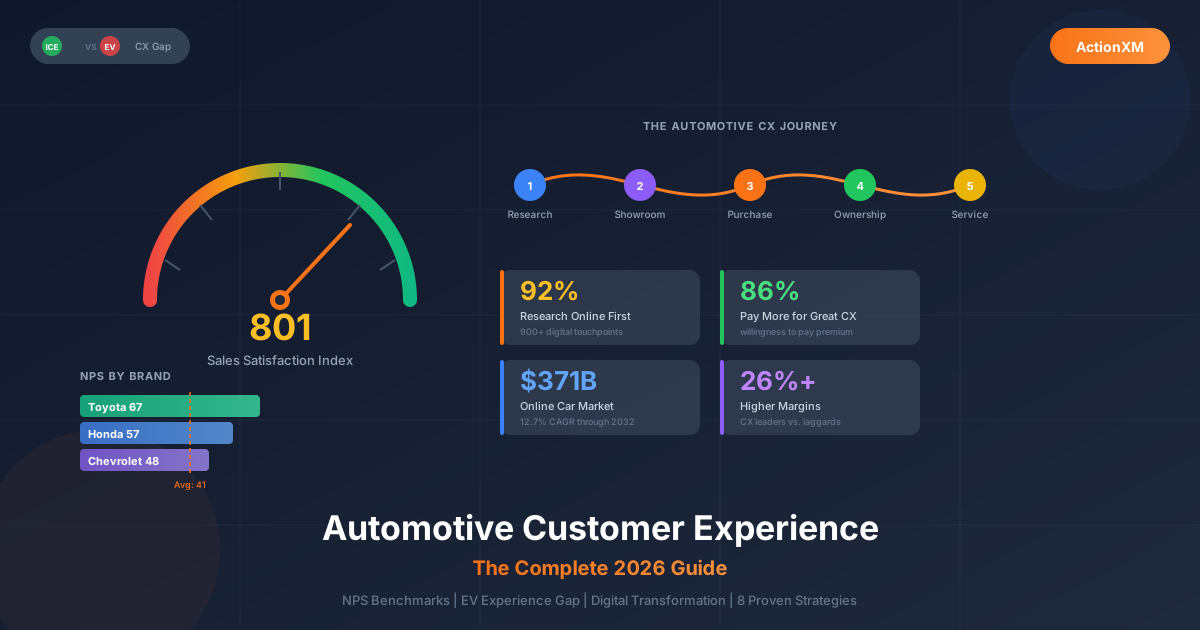
Yet the data tells a complicated story. Overall purchase satisfaction hit 801 out of 1,000 in the J.D. Power 2025 Sales Satisfaction Index—while EV service satisfaction lags ICE vehicles by 51 to 57 points. The industry average NPS of 41 masks a 48-point gap between the best and worst-performing brands.
This guide covers the full automotive customer experience landscape in 2026: where the industry stands, what top-performing brands do differently, and how to build a CX strategy that drives loyalty, revenue, and competitive advantage.
The Automotive Customer Journey: 5 Stages That Define Loyalty
Unlike most industries, the automotive customer journey spans months (or years) and involves the second-largest purchase most consumers ever make. Every touchpoint matters—buyers engage with over 900 individual digital interactions and spend an average of 6 hours 41 minutes researching online before ever setting foot in a showroom.
Stage 1: Research — Where 92% of Journeys Begin
The research phase has fundamentally shifted online. Shoppers visit an average of 4.9 websites, with 77% visiting dealership websites, 73% using search engines, and 65% consulting third-party review sites. Watch time for “test drive” videos has grown 65% in the past two years.
What separates top performers: brands that offer transparent pricing, interactive configurators, and real-time inventory visibility dramatically reduce the friction of this stage. According to the Cox Automotive 2025 Car Buyer Journey Study, 84% of shoppers who use AI-powered online tools report high satisfaction with their research experience.
Stage 2: The Showroom — Physical Meets Digital
Despite the digital shift, only 1% of purchases are completed entirely online (CDK Global, January 2026). The showroom remains critical, but its role has evolved from “information center” to “experience confirmation.”
J.D. Power’s 2025 SSI study identifies six satisfaction factors in order of importance:
- Delivery process (the handoff moment)
- Dealer personnel (knowledge, friendliness, respect)
- Working out the deal (transparency, fairness)
- Paperwork completion (speed, clarity)
- Dealership facility (comfort, amenities)
- Dealership website (accuracy, ease of use)
The biggest CX failure point—what Cox Automotive calls the “channel break”—occurs when a customer’s online research progress is lost upon entering the dealership. Eliminating this friction is the number one omnichannel priority for 2026.
Stage 3: Purchase — Where Trust Is Won or Lost
Price negotiation remains the most disliked part of car buying. 69% of consumers prefer transparent pricing processes, and 55% prefer buying directly from brands versus retailers (Bain & Company). This is why Tesla’s non-negotiable pricing model has become a benchmark across the industry.
CDK Global data from January 2026 shows that while 72% still complete the entire deal in person, 27% do significant pre-work online. The most satisfied buyers blend digital efficiency with in-person trust-building.
Stage 4: Ownership — The Longest CX Touchpoint
Ownership is where automotive CX diverges most from other industries. The average vehicle ownership period spans 5+ years, creating an ongoing relationship that either builds loyalty or erodes it.
Key ownership expectations:
- 79% consider digital communication tools essential throughout ownership
- 77% prefer proactive maintenance alerts via app notifications
- 73% want post-purchase follow-up communications
- 22% want a follow-up feature explanation from the dealership a few weeks after purchase
Connected vehicle technology is transforming this stage. McKinsey projects that 90%+ of vehicles sold in 2030 will be connected, up from 50% today. OTA subscription revenue is projected to reach $57 billion by decade’s end.
Stage 5: Service — The Loyalty Multiplier
After-sales service is the single most underrated driver of automotive CX. 65% of customers choose brands based on after-sales service quality, and 65% would switch brands following poor service experiences.
The J.D. Power 2025 Customer Service Index study found that 4 of the top 10 most influential service KPIs are communication-related: focusing on customer needs, keeping customers informed, greeting customers immediately upon arrival, and contacting customers after service.
NPS Benchmarks: How Top Automotive Brands Compare
The automotive industry average NPS sits at 41 (QuestionPro, Q1 2025)—ranking 2nd among seven major industries. But the brand-level spread reveals dramatic differences in customer loyalty.
The 48-point gap between Toyota (67) and Nissan (19) isn’t random. It directly reflects differences in product quality, service consistency, and the customer experience strategies outlined in this guide.
Premium Segment: Sales Satisfaction Rankings
In the premium segment, Porsche leads J.D. Power’s Sales Satisfaction rankings for the third consecutive year at 855/1,000, followed by Land Rover (838) and Infiniti (835). In mass market, Buick leads at 827, with Subaru (823) and Chevrolet (821) close behind.
The EV Experience Gap: The Industry’s Biggest CX Challenge
Electric vehicles are simultaneously the industry’s greatest growth opportunity and its most pressing customer experience problem. While EV technology generates excitement, the ownership experience still lags behind traditional powertrains.
Despite these challenges, EV momentum is undeniable: 94% of BEV owners would consider purchasing another BEV, and only 12% would consider switching back to ICE. EV NPS improved from 24 to 33 points year-over-year in the uScale 2025 EV Satisfaction Study.
Top-Performing EVs by Customer Satisfaction
The EV satisfaction leaders demonstrate that the experience gap is solvable:
Premium EVs (J.D. Power 2025 EVX Ownership):
- BMW iX: 790/1,000
- BMW i4: 783/1,000
- Rivian R1S: 770/1,000
Mass Market EVs:
- Hyundai IONIQ 6: 751/1,000
- Kia EV6: 743/1,000
- Chevrolet Equinox EV: 737/1,000
The common thread among EV satisfaction leaders: strong dealer support networks, comprehensive EV technician training, and transparent communication about charging infrastructure.
What Top-Performing Brands Do Differently
Five brands stand out as CX leaders in 2026, each with a distinct strategic approach worth studying.
The pattern across all five leaders: they invest in the full journey—not just the sale. Product quality and post-purchase communication are the common denominators.
Digital Transformation: Technology Reshaping Automotive CX
The automotive digital transformation is accelerating on multiple fronts simultaneously. The global online car buying market reached $370.7 billion in 2025 with a projected CAGR of 12.7% through 2032.
AI: The Biggest CX Lever in 2026
BCG projects that AI early movers in automotive could see 20% revenue upside, while laggards risk a 15% decline. The applications span the entire customer journey:
Connected Vehicles: From Product to Platform
The software-defined vehicle represents a fundamental shift in automotive CX. Instead of a depreciating asset, cars are becoming platforms that improve over time through software updates, new features, and personalized experiences.
Deloitte’s 2026 Global Automotive Consumer Study (28,500 consumers across 27 countries) found that consumers most value connected features for safety and security: anti-theft tracking (61%), pedestrian detection (59%), and emergency assistance (58%). Personalization features are also gaining traction: 55% of owners already use customizable vehicle profiles.
The Omnichannel Imperative
The data makes the case for omnichannel investment compelling:
- 43% of recent car buyers used an omnichannel approach
- 71% expect to use omnichannel in the future
- 89% customer retention for companies with strong omnichannel engagement vs 33% for weak omnichannel
- Dealerships with omnichannel: 67% positive impact on gross profit and 80% higher close rates
- Mobile app users are 73% more likely to purchase and spend 7% more
The key lesson: customers don’t think in “online” vs “in-person” channels. They expect a unified experience where their research, preferences, and financing pre-approvals carry seamlessly across every touchpoint.
Dealership vs. Direct-to-Consumer: The Models Converging
One of the most significant CX debates in automotive is the sales model itself. Tesla’s direct-to-consumer approach eliminated the dealership entirely—and customers consistently report high satisfaction ratings with non-negotiable pricing, online ordering, and OTA updates, achieving industry-leading loyalty (until recently).
The most satisfied buyers don’t fall neatly into either camp. They start online—researching, configuring, securing financing—then finalize in person for the trust and tangibility that a physical handshake and test drive provide. The brands winning this race are those removing friction between channels, not forcing customers into one model.
The Top 10 Customer Pain Points in Automotive CX
Understanding what frustrates automotive customers is the first step to fixing it. Here are the most persistent pain points ranked by impact:
8 Strategies to Transform Automotive Customer Experience
Based on what the data tells us and what leading brands demonstrate, here are eight strategies that drive measurable improvement in automotive CX.
1. Eliminate the Channel Break
The single biggest quick win. Ensure your CRM carries customer configuration preferences, financing pre-approvals, and trade-in data seamlessly from digital channels to the showroom floor. When a customer walks in after spending 6+ hours researching online, the sales associate should already know their shortlist, preferred trim, and budget range.
Measuring success: Track the percentage of showroom visits where the sales associate references the customer’s prior digital activity. Best-in-class dealers achieve 80%+.
2. Adopt Transparent Pricing
Whether you go full Tesla (fixed, non-negotiable) or implement fee transparency, clear pricing builds trust. The data is unambiguous: 69% of consumers prefer transparent pricing, and brands with fixed pricing see higher satisfaction scores in the “working out the deal” category.
3. Invest in EV Technician Training
With EV service satisfaction running 51-57 points below ICE, this is an urgent gap. The root cause is straightforward: insufficient EV-trained technicians. Brands like BMW and Hyundai are winning EV satisfaction precisely because they’ve invested heavily in service readiness before scaling EV sales.
4. Build a Communication-First Service Culture
Four of the top 10 service satisfaction drivers are communication-related. The playbook:
- Greet immediately upon service arrival (no waiting in line)
- Keep customers informed of service status in real time
- Focus completely on customer needs during intake
- Follow up after service to ensure satisfaction
These aren’t technology investments—they’re cultural commitments. And they’re the highest-ROI moves available in service CX.
5. Go Mobile-First
With 70%+ of automotive shoppers using mobile devices during the buying journey and mobile app users converting 73% more often, mobile is the primary channel. Ensure your inventory, pricing, financing tools, and service scheduling are optimized for mobile—not just responsive, but mobile-first.
6. Deploy AI at Scale
Start with the highest-impact, lowest-risk applications:
- AI chatbots for 24/7 inquiry handling (57% satisfaction uplift)
- AI-powered search and configuration tools (84% high satisfaction)
- Predictive maintenance alerts via connected car data
- Sentiment analysis on service feedback to identify systemic issues
BCG estimates that AI early adopters can see 20% revenue upside—while laggards risk a 15% decline.
7. Personalize the Ownership Experience
81% of automotive consumers say personalized offers influence purchasing decisions, and 55% want more personalized marketing communications. Connect CRM data, vehicle telemetry, and behavioral signals to deliver:
- Service reminders based on actual driving patterns (not arbitrary mileage)
- Feature tutorials tailored to features the owner hasn’t discovered
- Trade-in offers timed to ownership lifecycle
- Relevant accessories and service packages
8. Measure What Matters—Continuously
The leading automotive CX programs go beyond annual surveys. They measure across the journey in real time:
| Touchpoint | Metric | Benchmark |
|---|---|---|
| Research phase | Website engagement, configurator completion rate | 40%+ configurator completion |
| Showroom visit | J.D. Power SSI, time-to-greeting | Under 2 minutes greeting |
| Purchase | NPS at point of sale, deal transparency score | NPS 50+ at point of sale |
| Delivery | Delivery experience satisfaction | 90%+ satisfaction |
| Ownership (Year 1) | Feature adoption rate, app engagement | 60%+ app activation |
| Service visit | CSI score, first-visit fix rate | 88%+ first-visit fix |
| Loyalty | Repurchase intent, NPS, referral rate | 55%+ repurchase intent |
Building an automotive CX measurement program? Request a demo to see how ActionXM helps dealers and OEMs capture feedback across every touchpoint—from showroom to service bay.
The Customer Expectation Shift: What Buyers Want in 2026
Consumer expectations continue to accelerate. Generation Y now values CX 3x more than vehicle design (McKinsey)—a seismic shift for an industry historically defined by engineering and aesthetics.
Key expectations shaping 2026:
- 66% want quick responses during purchase inquiries
- 63% want messaging app updates during purchases and service
- 81% say personalized offers influence purchasing decisions
- 70% desire eco-friendly vehicle options
- 60% expect digital channels to enhance the buying journey
- 78% say recent experiences significantly influence future purchases
The implication: automotive brands that can’t deliver fast, personalized, digitally-enhanced experiences across every touchpoint will lose customers—not to competitors, but to the expectations set by other industries.
Measuring Automotive CX ROI
For CX leaders making the business case, the financial impact is well-documented:
Frequently Asked Questions
What is the automotive industry average NPS?
The automotive industry average NPS is 41 as of Q1 2025 (QuestionPro), ranking 2nd among seven major industries. Individual brands range from 19 (Nissan) to 67 (Toyota). Problem-free vehicles achieve NPS scores as high as 90-91.
How does EV customer satisfaction compare to ICE vehicles?
EV satisfaction (73/100 ACSI) currently lags ICE and hybrid vehicles (80/100 each). The primary gap is in service—BEV service satisfaction runs 51-57 points below ICE equivalents, driven primarily by a shortage of trained EV technicians and less mature service infrastructure.
What is the most important factor in automotive purchase satisfaction?
According to J.D. Power’s 2025 Sales Satisfaction Index, the delivery process ranks as the most important satisfaction factor, followed by dealer personnel quality, deal transparency, paperwork completion, dealership facility, and dealership website.
How much do customers research online before buying a car?
92% of consumers use digital channels for research, spending an average of 6 hours 41 minutes online. They visit approximately 4.9 websites and engage with over 900 individual digital interactions throughout the purchase journey.
What percentage of car purchases happen entirely online?
Only about 1% of purchases are completed entirely online (CDK Global, January 2026). However, 27% of buyers do significant pre-work digitally, and 43% use an omnichannel approach blending online and in-person interactions.
How does after-sales service impact brand loyalty?
After-sales service has a profound impact: 65% of customers choose brands based on service quality, 65% would switch brands after poor service, and 78% say recent service experiences significantly influence their next purchase decision.
Building Your Automotive CX Roadmap
Transforming automotive customer experience isn’t a single initiative—it’s an ongoing program. Here’s a prioritized roadmap:
Quick wins (0-90 days): Fix communication gaps in service. Implement real-time service status updates. Ensure showroom staff can access customers’ online research history. Deploy post-service follow-up surveys.
Foundation (3-6 months): Unify customer data across digital and physical touchpoints. Deploy AI chatbots for 24/7 inquiry handling. Launch mobile-first service scheduling. Establish NPS and CSAT measurement at each journey stage.
Acceleration (6-12 months): Implement predictive maintenance alerts for connected vehicles. Build personalized ownership communication programs. Deploy VR/AR showroom experiences. Create a closed-loop feedback system that routes customer insights to frontline teams.
Scale (12+ months): Build a software-defined vehicle experience strategy. Develop OTA feature update roadmaps informed by customer data. Create omnichannel loyalty programs. Establish an automotive CX center of excellence.
Ready to accelerate your automotive CX program? ActionXM helps automotive brands measure and improve customer experience across every stage—from first click to service bay. Explore the platform or talk to our team.
Sources
- J.D. Power 2025 U.S. Sales Satisfaction Index (SSI) Study
- ACSI Automobile Study 2025
- CDK Global: Huge Rebound in Customer Experience Kicks Off 2026
- Cox Automotive 2025 Car Buyer Journey Study
- QuestionPro: NPS in the Automotive Industry 2025
- J.D. Power 2025 U.S. Customer Service Index (CSI) Study
- J.D. Power 2025 U.S. Electric Vehicle Experience (EVX) Ownership Study
- J.D. Power 2025 U.S. APEAL Study
- Deloitte 2026 Global Automotive Consumer Study
- BCG: The AI-First Automotive Company
- J.D. Power 2025 U.S. Brand Loyalty Study
- uScale EV Satisfaction Study 2025
- DemandLocal: Omnichannel Marketing Automotive Statistics
- SurveySparrow: Automotive Customer Experience 2025
- Coherent Market Insights: Online Car Buying Market