Customer Satisfaction Score (CSAT) is the heartbeat of customer experience measurement—a direct pulse check on how your customers feel about specific interactions with your brand. Unlike broader metrics that measure loyalty or effort, CSAT captures satisfaction in the moment, making it invaluable for identifying issues before they compound.
Yet despite its apparent simplicity, most organizations underutilize CSAT. They calculate the number but miss the insights. They collect responses but fail to close the loop. They benchmark against industry averages without understanding what drives their own scores.
This guide goes beyond the basics. You’ll learn not just how to calculate CSAT, but how to design surveys that get meaningful responses, interpret scores in context, and build a measurement system that actually drives improvement.
What Is CSAT and Why It Matters
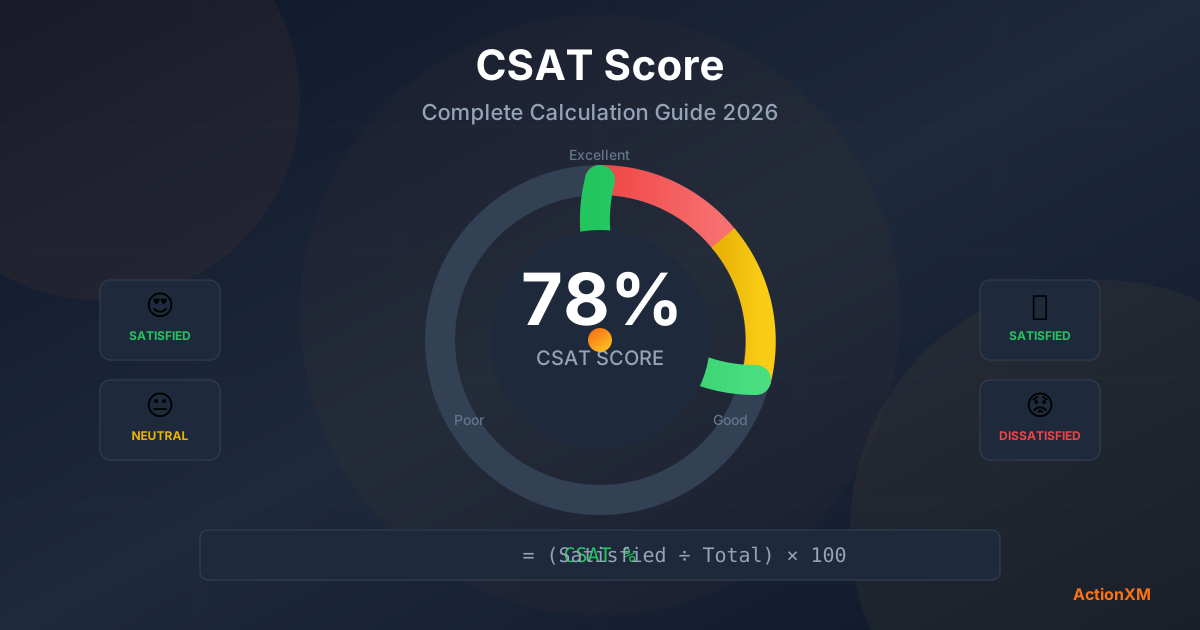
Customer Satisfaction Score (CSAT) measures how satisfied customers are with a specific interaction, product, or service. It’s a transactional metric—capturing feedback at defined touchpoints rather than measuring overall brand loyalty.
Why CSAT Remains Essential in 2026
Despite the rise of NPS and CES, CSAT holds a unique position in the CX measurement toolkit:
| Metric | What It Measures | Best For |
|---|---|---|
| CSAT | Immediate satisfaction | Specific touchpoint feedback |
| NPS | Loyalty and advocacy | Long-term brand health |
| CES | Effort to complete task | Process optimization |
85% of major international companies use CSAT as part of their customer feedback program. Here’s why it persists:
- Intuitive for customers: Everyone understands satisfaction ratings
- Actionable for teams: Easy to tie scores to specific interactions or agents
- Flexible application: Works for products, services, support, onboarding—any touchpoint
- Benchmark availability: Extensive industry data exists for comparison
How to Calculate CSAT: The Formula
The standard CSAT formula counts only positive responses as satisfied customers:
Calculation Example
Let’s say you received 200 survey responses:
| Response | Count | Category |
|---|---|---|
| 5 - Very Satisfied | 80 | ✓ Satisfied |
| 4 - Satisfied | 60 | ✓ Satisfied |
| 3 - Neutral | 35 | Not counted |
| 2 - Dissatisfied | 15 | Not counted |
| 1 - Very Dissatisfied | 10 | Not counted |
| Total | 200 | — |
Calculation: (80 + 60) ÷ 200 × 100 = 70% CSAT
Alternative Calculation: Average Score Method
Some organizations prefer to report the average score instead of the percentage:
Both methods are valid. The percentage method is more common and easier to communicate (“We have 70% satisfied customers”). The average method captures more nuance but requires context (“Our average is 3.93 out of 5”).
CSAT Survey Scale Options
The scale you choose affects how respondents interpret and answer your questions.
Which Scale Should You Use?
| Scenario | Recommended Scale | Why |
|---|---|---|
| Industry benchmarking | 5-point | Matches most published benchmarks |
| Academic research | 7-point | Better statistical properties |
| In-app quick feedback | Binary or Emoji | Minimal friction, high completion |
| Email surveys | 5-point | Familiar format, easy to answer |
| Physical kiosks | Emoji | Works across languages |
Critical rule: Once you choose a scale, use it consistently. Mixing scales makes trend analysis impossible.
Industry Benchmarks: What’s a Good CSAT Score?
CSAT scores vary significantly by industry. A score that’s excellent in telecommunications might be below average in hospitality. Context matters.
Source: ACSI Q4 2024, Fullview Industry Research
Interpreting Your CSAT Score
| Score Range | Rating | What It Means |
|---|---|---|
| 90%+ | Exceptional | Top-tier performance, strong competitive advantage |
| 80-89% | Excellent | Customers are genuinely happy, keep doing what works |
| 75-79% | Good | Solid performance with room for targeted improvements |
| 60-74% | Needs Attention | Gap between expectations and delivery—investigate drivers |
| Below 60% | Critical | Significant issues requiring immediate action |
Important: A “good” score depends on context. A 75% CSAT might be:
- Excellent for a budget airline (low expectations, low prices)
- Concerning for a luxury hotel (high expectations, premium prices)
Always benchmark against your specific industry and competitors, not generic averages.
When to Measure CSAT: Touchpoint Strategy
CSAT works best when measured at specific moments—not randomly. The timing affects both response rates and actionability.
Timing Best Practices
| Touchpoint | Optimal Timing | Response Rate Impact |
|---|---|---|
| Post-purchase | 24-48 hours after delivery | Highest while experience is fresh |
| Post-support | Within 1 hour of resolution | 40% higher than delayed surveys |
| Post-onboarding | 7-14 days after signup | Captures initial experience fully |
| In-app | Immediately after action | Contextual relevance boosts responses |
| Email surveys | Tuesday-Thursday, 10am-2pm | 15-20% higher open rates |
CSAT Survey Best Practices
The quality of your CSAT data depends on survey design. Poor surveys generate poor data—regardless of how sophisticated your analysis tools are.
Survey Length and Structure
- 10+ questions in one survey
- Ask for demographics first
- Use leading questions
- Mix multiple scales
- Skip the follow-up "why"
- 3-5 questions maximum
- Lead with the rating question
- Use neutral phrasing
- Stick to one scale type
- Always ask "What could we improve?"
Response Rate Benchmarks by Channel
| Survey Channel | Average Response Rate | Tips to Improve |
|---|---|---|
| SMS | 40-50% | Keep to 1-2 questions, send within 1 hour |
| In-App (modal) | 36-43% | Center screen placement, triggered by action |
| In-App (sidebar) | 20-30% | Less intrusive but lower visibility |
| 15-25% | Personalize subject line, mobile-optimize | |
| Link surveys | 5-15% | Use with engaged customers only |
Multi-channel boost: Using two channels (email + SMS reminder 48 hours later) increases response rates by approximately 10%.
The Perfect CSAT Survey Structure
- Rating Question (Required): “How satisfied were you with [specific experience]?”
- Follow-up Question (Required): “What’s the main reason for your score?”
- Improvement Question (Optional): “What could we do better?”
- Permission Question (Optional): “May we contact you about your feedback?”
Time to complete: Under 60 seconds. Surveys exceeding 3 minutes see 15% drop-off; those over 9 minutes see 40%+ abandonment.
CSAT vs NPS vs CES: When to Use Each
These three metrics serve different purposes. Using the wrong one wastes resources and generates misleading insights.
The CES Loyalty Insight
Research from Gartner reveals a compelling case for CES alongside CSAT:
- 96% of customers with high-effort experiences become more disloyal
- Only 9% with low-effort experiences become disloyal
- CES is 1.8x more predictive of customer loyalty than CSAT
- CES is 2x more predictive of loyalty than NPS
Recommendation: Use CSAT for satisfaction tracking and CES for process optimization. They complement each other—CSAT tells you if customers are happy, CES tells you if you’re making them work too hard.
When to Use Each Metric
| Scenario | Use This | Why |
|---|---|---|
| After support ticket closed | CSAT | Measures satisfaction with resolution |
| After self-service interaction | CES | Measures ease of finding solution |
| Quarterly brand check | NPS | Tracks overall loyalty trends |
| Post-purchase | CSAT | Captures buying experience satisfaction |
| After onboarding | CSAT + CES | Both satisfaction and ease matter |
| Before renewal | NPS | Predicts retention likelihood |
10 Common CSAT Mistakes (And How to Avoid Them)
Even experienced CX teams make these errors. Avoiding them dramatically improves data quality and actionability.
AI and the Future of CSAT (2024-2026)
Artificial intelligence is transforming how organizations measure and act on customer satisfaction. The shift from reactive to predictive CSAT is already underway.
Predictive CSAT: Measuring Without Asking
Traditional CSAT relies on surveys—but surveys only capture 5-15% of interactions. AI-powered predictive CSAT analyzes 100% of customer interactions to estimate satisfaction without asking.
Source: Tethr Predictive CSAT, Dialpad AI Research
Key AI Capabilities Transforming CSAT
| Capability | Traditional Approach | AI-Enabled Approach |
|---|---|---|
| Analysis | Manual review of verbatims | Auto-categorization and theme detection |
| Coverage | 5-15% via surveys | 100% interaction analysis |
| Speed | Days/weeks for insights | Real-time sentiment tracking |
| Prediction | None—reactive only | Identify at-risk customers before they churn |
| Personalization | One-size-fits-all | Tailored interactions based on history |
Business Impact Statistics
- McKinsey: AI in customer care raises productivity by 30-45%
- Unity case study: 8,000 tickets deflected, 83% faster response, 93% CSAT, $1.3M saved
- iOPEX clients: 30% CSAT increase, 25% churn reduction, 40% CLV boost
2026 Predictions
- AI accountability will take center stage with quarterly “model P&L” reviews
- Agentic AI will handle multi-step customer service tasks with auditable reasoning
- Proactive engagement will become standard—solving issues before customers report them
- High-risk interactions will maintain human checkpoints with execution SLAs
AI is expected to power 95% of customer interactions by 2025—but the best implementations use AI to augment human judgment, not replace it.
How Leading Companies Use CSAT
Amazon: Relentless Customer Obsession
Amazon maintains 80%+ CSAT through:
- Fast, reliable delivery as the foundation
- Easy returns that remove friction
- Continuous feedback integration into operations
- Proactive communication on order status
Apple: Feedback-Driven Product Development
Apple integrates CSAT data into:
- Retail and support training programs
- Product release decisions
- Premium pricing justification through satisfaction
Netflix: Personalization at Scale
Netflix achieves 85% CSAT through:
- Personalized recommendations based on viewing data
- Responsive customer support
- Content decisions informed by satisfaction metrics
- Platform improvements driven by feedback
Best Practices from Top Performers
- Track multiple metrics: CSAT, NPS, and CES together
- Regular monitoring: Monthly/quarterly value reviews
- Data-driven improvements: 25% more likely to retain customers
- AI integration: Faster, more accurate data interpretation
- Close the feedback loop: Act on insights, communicate changes
Companies regularly monitoring CX metrics are 20% more likely to experience revenue growth (Forrester).
Building a CSAT Measurement System
Effective CSAT measurement isn’t about the survey—it’s about the system around it.
The CSAT Flywheel
Implementation Checklist
Phase 1: Foundation (Week 1-2)
- Select CSAT scale (recommend 5-point)
- Identify 3-5 key touchpoints to measure
- Create survey templates for each touchpoint
- Configure distribution triggers
Phase 2: Launch (Week 3-4)
- Deploy surveys to 1-2 touchpoints
- Monitor response rates and adjust timing
- Set up real-time alerting for low scores
- Train team on closed-loop process
Phase 3: Optimize (Month 2+)
- Expand to remaining touchpoints
- Enable AI text analysis for verbatims
- Build dashboards for trend monitoring
- Establish review cadence (weekly/monthly)
Phase 4: Scale (Month 3+)
- Integrate with CRM for customer context
- Correlate CSAT with business outcomes
- Benchmark against industry standards
- Automate closed-loop workflows
Frequently Asked Questions
What’s the difference between CSAT and NPS?
CSAT measures satisfaction with a specific interaction (transactional). NPS measures overall loyalty and likelihood to recommend (relational). Use CSAT for touchpoint feedback; use NPS for brand health tracking.
What’s considered a good CSAT score?
75-85% is generally good across industries. However, benchmarks vary significantly: 80% might be excellent in telecom but below average in hospitality. Always compare against your specific industry.
How often should I survey customers?
For transactional CSAT, survey after each relevant interaction (support, purchase, onboarding). Implement throttling to prevent survey fatigue—no customer should receive more than one survey per month unless they initiate multiple interactions.
Should I include neutral responses in CSAT calculation?
No. Standard methodology counts only top-2 box scores (4 and 5 on a 5-point scale) as satisfied. Including neutrals (3s) artificially inflates your score and doesn’t reflect true satisfaction.
How do I improve low CSAT scores?
- Analyze verbatim feedback to identify root causes
- Close the loop with dissatisfied customers immediately
- Address systemic issues in processes or training
- Track improvement over time, not single scores
- Celebrate and reinforce behaviors that drive high scores
Can AI replace traditional CSAT surveys?
AI can predict CSAT from interaction analysis (achieving ~87% accuracy), but surveys still provide explicit customer voice and verbatim feedback that AI infers. Best practice: use AI for comprehensive coverage, surveys for depth and validation.
The Bottom Line
CSAT remains one of the most valuable metrics in customer experience—when used correctly. The formula is simple, but the system around it determines whether you generate actionable insights or just numbers.
Key takeaways:
- Use the standard formula: (Satisfied / Total) × 100, counting only 4s and 5s
- Benchmark contextually: Compare against your industry, not generic averages
- Survey strategically: Right touchpoint, right timing, right length
- Act on feedback: Close the loop with dissatisfied customers within hours
- Combine metrics: CSAT + NPS + CES together reveal the complete picture
- Embrace AI: Predictive CSAT enables 100% coverage without survey fatigue
The organizations winning on customer experience don’t just measure CSAT—they build systems that turn feedback into action, action into improvement, and improvement into competitive advantage.
Start Measuring What Matters
ActionXM makes CSAT measurement effortless—from survey creation to AI-powered analysis to automated closed-loop workflows. Stop collecting data and start driving improvement.
Take the next step:
Ready to transform how you measure customer satisfaction? Contact us for a custom consultation.
Sources
- IBM - What is CSAT
- Retently - CSAT Definition & Calculation
- SurveySparrow - How to Calculate CSAT
- Fullview - CSAT Benchmarks by Industry
- ACSI - American Customer Satisfaction Index Q4 2024
- Sprig - Ultimate Guide to CSAT Surveys
- Gartner - CES Research and Customer Effort
- SuperAGI - AI Revolutionizing CSAT
- Tethr - Predictive CSAT Score
- McKinsey - AI in Customer Care
- Clootrack - Survey Response Rates 2025