Every customer who leaves takes more than their subscription fee—they take the investment you made to acquire them, the potential lifetime value they would have generated, and often, they leave with insights about what you could be doing better. Understanding how to calculate and reduce customer churn isn’t just a metrics exercise—it’s a survival skill for subscription businesses.
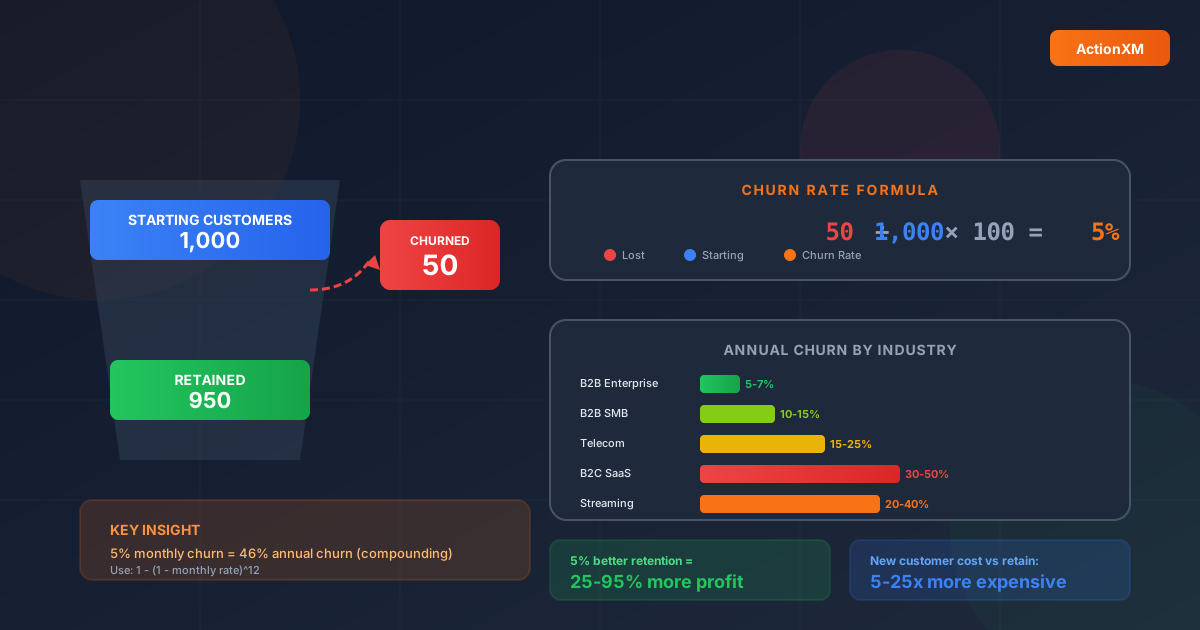
According to research by Bain & Company, a 5% increase in customer retention can increase profits by 25-95%. Yet many organizations still treat churn as a lagging indicator rather than a predictable, preventable outcome.
This guide provides everything you need to master churn rate calculation: the formulas that matter, the benchmarks to target, and the strategies that actually move the needle.
What Is Customer Churn Rate?
Customer churn rate (also called customer attrition rate) measures the percentage of customers who stop using your product or service during a specific time period. It’s the inverse of retention rate and one of the most critical health metrics for any subscription or recurring revenue business.
Why Churn Rate Matters More Than You Think
The financial impact of churn extends far beyond the lost subscription revenue:
The Customer Churn Rate Formula
The basic churn rate formula is straightforward:
Step-by-Step Calculation
Let’s walk through a complete example:
Important: What Counts as “Lost”?
Not all customer departures are equal. Define your churned customers clearly:
| Include as Churned | Exclude from Churn |
|---|---|
| Active cancellations | Seasonal pauses (if they return) |
| Failed payment terminations | Account mergers |
| Contract non-renewals | Plan downgrades (track separately) |
| Accounts marked inactive | Duplicate account closures |
Customer Churn vs. Revenue Churn
Here’s where things get nuanced. Customer churn and revenue churn often tell different stories—and both matter.
Why They Can Differ Dramatically
Net Revenue Churn: The Complete Picture
Net Revenue Churn (also called Net Revenue Retention when expressed as its inverse) accounts for expansion revenue from existing customers:
Example: If you lost $10,000 MRR but gained $15,000 in upsells from existing customers, your net revenue churn is -5% (you actually grew from existing customers).
Converting Monthly Churn to Annual Churn
A common mistake: assuming 5% monthly churn equals 60% annual churn. It doesn’t—it’s actually worse.
Customer Lifetime from Churn Rate
Your churn rate directly determines average customer lifetime:
Churn Rate Benchmarks by Industry
Not all industries are created equal when it comes to churn. Context matters enormously when evaluating your performance.
What Drives Industry Differences?
| Factor | Lower Churn | Higher Churn |
|---|---|---|
| Contract length | Annual/multi-year | Monthly/no contract |
| Switching costs | High (data migration, training) | Low (easy alternatives) |
| Customer segment | Enterprise | Consumer/SMB |
| Product stickiness | Core workflow integration | Nice-to-have feature |
| Price point | Higher consideration | Impulse subscription |
Voluntary vs. Involuntary Churn
Understanding why customers churn is as important as knowing how many. The solutions differ dramatically.
Key insight: Involuntary churn can account for 20-40% of total churn for subscription businesses. These are often the easiest losses to recover—customers didn’t want to leave.
The Hidden Cost of Churn: Impact Calculator
Understanding churn’s financial impact helps prioritize retention investments.
8 Proven Strategies to Reduce Customer Churn
1. Identify At-Risk Customers Early
Don’t wait for cancellation requests. Build early warning systems.
2. Nail the First 90 Days
Most churn is decided in the first few months. Invest heavily in onboarding.
| Day Range | Focus Area | Success Metric |
|---|---|---|
| Days 1-7 | Quick win / “Aha moment” | First core action completed |
| Days 8-30 | Habit formation | Weekly active usage established |
| Days 31-60 | Value realization | Key outcome achieved |
| Days 61-90 | Expansion opportunity | Additional features adopted |
3. Build a Customer Health Score
Combine multiple signals into a single predictive metric:
4. Close the Feedback Loop
Collecting feedback without action accelerates churn. Customers who feel ignored leave faster.
- Respond within 24-48 hours to negative feedback
- Share what you’ve fixed based on customer input
- Follow up personally with detractors who gave specific feedback
5. Implement Smart Dunning for Involuntary Churn
For subscription businesses, optimize your failed payment recovery:
| Tactic | Impact |
|---|---|
| Multiple retry attempts over 7-14 days | Recovers 10-15% of failures |
| In-app card update prompts | Higher update rates than email |
| Pre-expiry card reminders | Prevents 30%+ of card failures |
| Account updater services | Automatic card info refresh |
| Alternative payment options | Catches customers who can’t use cards |
6. Create Switching Costs (Ethically)
Make your product stickier through value, not lock-in:
- Data depth: The more historical data in your platform, the harder to leave
- Integrations: Deep connections to other tools increase switching costs
- Team adoption: Multiple users = multiple stakeholders who’d need to agree to switch
- Custom configurations: Tailored setups take time to recreate elsewhere
7. Proactive Customer Success
Don’t wait for problems—anticipate them:
- Usage-triggered outreach: “We noticed you haven’t used X feature—here’s why it might help”
- Renewal preparation: Begin conversations 90+ days before renewal, not 30
- Quarterly business reviews: Regular check-ins to ensure ongoing value alignment
- Executive sponsorship: Connect your leadership with their leadership
8. Win-Back Campaigns for Recent Churners
Not all churned customers are gone forever:
| Timing | Approach | Typical Win-Back Rate |
|---|---|---|
| 0-30 days | ”What could we have done better?” + offer | 5-10% |
| 31-90 days | ”Here’s what’s new since you left” | 3-7% |
| 91-180 days | Re-engagement with major update | 1-3% |
Measuring Churn: Best Practices
Choose the Right Time Period
| Business Type | Recommended Period | Why |
|---|---|---|
| Monthly subscriptions | Monthly churn | Matches billing cycle, quick signal |
| Annual contracts | Annual churn | Reflects actual renewal patterns |
| Mixed contracts | Both | Different insights from each |
| High-volume B2C | Weekly cohort analysis | Faster iteration cycles |
Track Cohort Churn, Not Just Aggregate
Aggregate churn can mask important patterns. Track churn by:
- Acquisition date cohort: Are newer customers churning faster?
- Customer segment: Do enterprise customers retain better than SMB?
- Acquisition channel: Are some sources bringing lower-quality customers?
- Price point: Does churn vary by plan tier?
Set Realistic Targets
Common Churn Calculation Mistakes to Avoid
Frequently Asked Questions
What’s a good churn rate for SaaS?
For B2B SaaS, target 5-7% annual churn for enterprise and 10-15% for SMB. For B2C SaaS, 5% monthly (equivalent to ~46% annual) is common, though lower is better. Context matters—compare against your specific segment and business model.
How do I calculate churn rate for annual contracts?
For annual contracts, measure churn at renewal points. Divide customers who didn’t renew by total customers up for renewal in that period. Don’t annualize monthly churn—track actual renewal rates.
What’s the difference between gross and net churn?
Gross churn counts all lost revenue. Net churn subtracts expansion revenue (upsells, cross-sells) from churned customers. Negative net churn means existing customers generate more revenue growth than you lose to churn.
Should I count downgrades as churn?
Track revenue churn from downgrades separately from customer churn (complete departures). Both matter, but they require different interventions. A customer who downgrades might be saveable; one who cancels entirely is harder to win back.
How often should I measure churn?
Monthly measurement is standard for operational decisions. Quarterly and annual views provide strategic perspective. For high-volume B2C, weekly cohort analysis can enable faster iteration.
What causes most churn?
Research consistently shows the top churn drivers are: 1) Poor onboarding/didn’t achieve value, 2) Product didn’t meet expectations, 3) Found a better alternative, 4) Price increase or perceived value decrease, 5) Champion/advocate left the company.
The Bottom Line
Customer churn rate isn’t just a metric—it’s a mirror reflecting your product-market fit, customer experience quality, and business sustainability. Understanding how to calculate it correctly is the first step; taking action to reduce it is what separates thriving businesses from struggling ones.
Key takeaways:
- Know your formulas: Customer churn, revenue churn, and net revenue churn tell different stories
- Benchmark thoughtfully: Compare against your industry and business model, not generic averages
- Separate voluntary from involuntary: Different problems require different solutions
- Track cohorts, not just aggregates: Understand which customers churn and why
- Invest in prevention: The first 90 days determine most churn outcomes
- Close the loop: Feedback without action accelerates churn
Every point of churn you prevent is revenue you don’t have to replace, customers you don’t have to re-acquire, and growth you can compound rather than restart.
Start Reducing Churn Today
ActionXM helps you understand why customers leave—before they do. From predictive health scoring to AI-powered feedback analysis, get the insights you need to prevent churn and grow retention.
Take the next step:
Ready to turn churn insights into retention results? Contact us to see how leading companies use ActionXM to reduce churn by 15-30%.
Sources
- Wall Street Prep - Churn Rate Formula
- Salesforce - How to Calculate Customer Churn Rate
- Amplitude - Churn Rate Formula
- Totango - Customer Churn Ultimate Guide
- Bain & Company - The Value of Customer Retention
- Cobloom - Customer Churn vs Revenue Churn
- Grow.com - Calculating Customer Revenue Churn Rates
- Zendesk - Churn Rate