What if the secret to customer loyalty isn’t delighting customers—but simply making their lives easier?
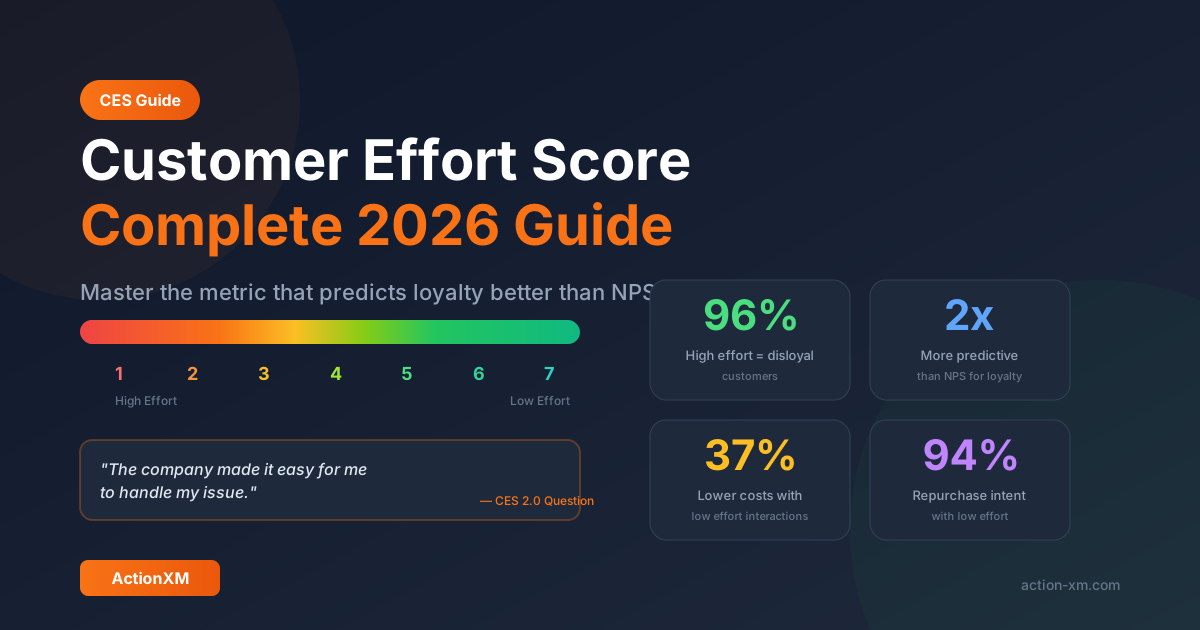
In 2010, researchers from the Corporate Executive Board (now part of Gartner) challenged a fundamental assumption about customer experience. After studying 97,000 customers across hundreds of organizations, they discovered something counterintuitive: reducing customer effort predicts loyalty far better than exceeding expectations.
This insight gave birth to the Customer Effort Score (CES)—a metric that has fundamentally changed how leading organizations think about customer experience. This guide covers everything you need to know about CES: what it measures, how to calculate it, when to use it, and how to act on the insights it reveals.
What is Customer Effort Score?
Customer Effort Score (CES) measures how much effort a customer had to exert to accomplish a specific task—whether that’s resolving a support issue, completing a purchase, or using a product feature.
Unlike Net Promoter Score (NPS), which measures overall brand loyalty, or Customer Satisfaction (CSAT), which measures happiness with an interaction, CES focuses specifically on friction—the invisible force that drives customers away.
The Science Behind Effort
The foundational research comes from “The Effortless Experience” by Matthew Dixon, Nick Toman, and Rick DeLisi. Their study of 125,000+ customers revealed a paradigm-shifting finding:
This 87-point difference in disloyalty rates demonstrates why reducing effort isn’t just a nice-to-have—it’s a business imperative.
The CES Formula: How to Calculate Your Score
Calculating Customer Effort Score is straightforward. After collecting responses on your chosen scale, apply this formula:
Step-by-Step Calculation Example
Let’s walk through a real calculation. Imagine you received 10 responses on a 7-point scale:
A CES of 6.0 on a 7-point scale indicates customers generally find it easy to interact with your company—a strong result.
Understanding CES Scales and Scoring
CES 2.0: The Modern Standard
The original CES (launched in 2010) asked customers to rate their effort on a 5-point scale. CES 2.0, introduced later, refined the approach with a 7-point Likert scale and improved wording that reduces bias.
What’s a Good CES Score?
Benchmarks vary by scale and industry, but here are general guidelines:
| Scale | Poor | Needs Improvement | Good | Excellent |
|---|---|---|---|---|
| 1-5 Scale | Below 3.0 | 3.0-3.5 | 3.5-4.0 | Above 4.0 |
| 1-7 Scale | Below 4.0 | 4.0-5.0 | 5.0-6.0 | Above 6.0 |
| Percentage | Below 60% | 60-70% | 70-80% | Above 80% |
CES vs. NPS vs. CSAT: When to Use Each
Understanding when to deploy each metric is crucial for building a comprehensive voice-of-customer program.
The Key Insight
Research from Gartner reveals that CES is the strongest predictor of customer behavior:
CES Benchmarks by Industry
While a “good” CES score depends on your scale and methodology, understanding industry benchmarks provides valuable context.
What Drives Industry Differences?
| High-CES Industries | Why They Excel |
|---|---|
| E-commerce | One-click purchasing, self-service returns, real-time tracking |
| SaaS | In-app guidance, instant chat support, extensive knowledge bases |
| Digital Banking | Mobile-first design, 24/7 availability, streamlined processes |
| Lower-CES Industries | Common Friction Points |
|---|---|
| Healthcare | Complex billing, scheduling difficulties, fragmented systems |
| Telecommunications | Contract complexity, hold times, channel switching |
| Government | Paper-based processes, limited hours, bureaucratic procedures |
20 CES Survey Questions for Every Touchpoint
The right question at the right moment unlocks actionable insights. Here are proven CES questions organized by use case:
Post-Support Interaction
- "How easy was it to get the help you needed today?"
- "To what extent do you agree: The support team made it easy to resolve my issue."
- "How much effort did you personally have to put forth to handle your request?"
- "How easy was it to interact with our customer service team?"
- "The company made it simple to get my question answered. (Agree/Disagree)"
Post-Purchase/Transaction
- "How easy was it to complete your purchase today?"
- "The checkout process was straightforward and simple. (Agree/Disagree)"
- "How much effort did it take to find what you were looking for?"
- "How easy was it to compare options before making your decision?"
- "The payment process was seamless and hassle-free. (Agree/Disagree)"
Product/Feature Usage
- "How easy was it to set up [Product/Feature]?"
- "How easy is it to use [Feature] to accomplish your goals?"
- "The instructions provided were easy to follow. (Agree/Disagree)"
- "How much effort did it take to learn how to use our product?"
- "Finding the information I needed within the product was effortless. (Agree/Disagree)"
Website/Self-Service
- "How easy was it to navigate our website to find what you needed?"
- "Finding our customer service contact information was straightforward. (Agree/Disagree)"
- "How easy was it to find answers in our help center?"
- "The self-service options met my needs without requiring assistance. (Agree/Disagree)"
- "How much effort did it take to complete your task using our app/website?"
Best Practices for CES Questions
- Keep it focused: One question about effort, plus one optional follow-up
- Be specific: Reference the exact interaction or task
- Time it right: Send immediately after the interaction (within minutes to hours)
- Avoid leading language: Don’t use words like “excellent” or “amazing”
- Include open-ended follow-up: “What made this [easy/difficult]?” reveals actionable insights
The Business Impact of Reducing Customer Effort
Reducing effort isn’t just about making customers happy—it directly impacts your bottom line.
The Compound Effect of Effort Reduction
Operational Impact
Gartner’s research quantifies the operational benefits of reducing effort:
| Metric | Improvement |
|---|---|
| Repeat calls reduced | 40% |
| Escalations reduced | 50% |
| Channel switching reduced | 54% |
| Employee intent to stay increased | 17% |
| NPS improvement | +65 points (low vs. high effort companies) |
7 Strategies to Reduce Customer Effort
Improving CES requires systematic effort reduction across touchpoints. Here are proven strategies:
When to Send CES Surveys
Timing is critical. Send CES surveys too early, and customers haven’t fully experienced the effort. Too late, and they’ve forgotten the details.
Channels for CES Collection
| Channel | Response Rate | Best For |
|---|---|---|
| In-app/embedded | 10-25% | Product usage, feature feedback |
| SMS | 15-30% | Post-support, transactions |
| 5-15% | Onboarding, follow-up | |
| Post-call IVR | 30-50% | Phone support |
| Chat widget | 20-40% | Chat support, website actions |
Analyzing and Acting on CES Data
Collecting CES is only valuable if you act on what you learn. Here’s a framework for turning scores into action.
Segment Your Analysis
Don’t just track overall CES—segment by:
- Touchpoint: Support vs. purchase vs. onboarding
- Channel: Phone vs. chat vs. email vs. self-service
- Customer segment: New vs. existing, high-value vs. standard
- Issue type: Billing vs. technical vs. account changes
- Agent/team: Individual and team performance
The CES Action Framework
- Personal outreach within 24 hours
- Root cause investigation
- Service recovery protocol
- Executive visibility
- Review open-ended feedback
- Identify improvement opportunities
- Track for patterns
- Follow up if issues surface
- Analyze what went right
- Document best practices
- Share with team
- Replicate success patterns
CES Implementation Checklist
Ready to launch your CES program? Here’s your implementation roadmap:
Frequently Asked Questions
What’s the difference between CES 1.0 and CES 2.0?
CES 1.0 (2010): Asked “How much effort did you personally have to put forth to handle your request?” on a 5-point scale from “Very Low Effort” to “Very High Effort.”
CES 2.0 (current): Uses a statement format—“[Company] made it easy to handle my issue”—with a 7-point Likert agreement scale. This wording reduces bias and improves clarity.
Should I use CES or NPS?
Use both, for different purposes:
- CES after specific interactions to measure operational friction
- NPS periodically to measure overall brand loyalty
They’re complementary. Strong CES typically leads to strong NPS over time.
What response rate should I expect?
CES response rates vary by channel:
- Post-call IVR: 30-50%
- SMS: 15-30%
- In-app: 10-25%
- Email: 5-15%
Response rates below these ranges suggest timing or survey fatigue issues.
How quickly can I expect to see CES improvements?
With focused effort:
- Quick wins (process simplification, self-service improvements): 2-4 weeks
- Moderate improvements (training, tool enhancements): 2-3 months
- Systemic changes (platform overhauls, cultural shifts): 6-12 months
Expect 0.5-1.0 point improvement per quarter with consistent effort.
Is CES relevant for B2B companies?
Absolutely. B2B customers face the same friction—complex onboarding, convoluted support processes, difficult-to-navigate portals. In fact, B2B often has more friction due to multiple stakeholders and longer processes.
The Bottom Line
Customer Effort Score measures something fundamental: how hard it is to do business with you. The research is unequivocal—reducing effort drives loyalty, retention, and revenue more effectively than trying to exceed expectations.
The most important insights from this guide:
Stop trying to wow customers. Start making their lives easier.
Start Measuring Customer Effort Today
Understanding customer effort is the first step toward reducing it. ActionXM helps organizations measure CES across every touchpoint, identify friction points automatically, and take action that drives measurable improvement.
Ready to make your customer experience effortless?
Questions about implementing CES in your organization? Contact us for a personalized consultation.
Sources
- Gartner - Effortless Experience Research
- Gartner - Customer Effort Score Best Practices
- Qualtrics - Customer Effort Score Guide
- Zonka Feedback - Ultimate Guide to CES
- SurveyMonkey - How to Use Customer Effort Score
- HubSpot - Customer Effort Score Guide
- Zendesk - Customer Effort Score Simplified
- CustomerGauge - NPS vs CES vs CSAT
- Fullview - CES Benchmarks and Calculator
- Help Scout - High Effort Customer Experiences
- InMoment - Customer Effort Score Measurement
- Retently - What is Customer Effort Score