Customer Lifetime Value (CLV) is the most important metric you’re probably not measuring correctly. While 89% of executives agree CLV is crucial for business success, only 42% of companies can accurately calculate it. This gap between recognition and execution represents billions in missed revenue optimization.
The companies that get CLV right—Amazon, Apple, Starbucks—don’t just measure it. They build entire business strategies around maximizing it. They know that a 5% increase in customer retention can boost profits by 25-95%, and they’ve structured their operations accordingly.
This guide goes beyond the basic formula. You’ll learn multiple CLV calculation methods, understand when to use each, see real-world benchmarks by industry, and discover the strategies top performers use to systematically increase lifetime value.
What Is Customer Lifetime Value?
Customer Lifetime Value (CLV) represents the total revenue a business can expect from a single customer account throughout their entire relationship. It’s a forward-looking metric that transforms how you think about customer acquisition, retention, and service investment.
Why CLV Matters More Than Ever
The economics of customer acquisition have fundamentally shifted. According to recent research:
| Metric | Finding | Impact |
|---|---|---|
| CAC Increase | 222% rise over 8 years | Acquiring new customers is increasingly expensive |
| Retention vs. Acquisition | 5-25x cost difference | Keeping customers far cheaper than finding new ones |
| Retention Profit Impact | 5% increase → 25-95% profit boost | Small retention gains compound dramatically |
| Revenue from Existing | 76% of B2B revenue | Most revenue comes from current customers, not new |
Sources: Bain & Company, Focus Digital, Genesys Growth Research
The math is unforgiving: brands now lose an average of $29 for every new customer acquired, up from $19 a decade ago. Understanding CLV isn’t optional—it’s the foundation of sustainable growth.
CLV Formulas: From Simple to Sophisticated
Multiple CLV calculation methods exist because different business models require different approaches. Here’s when to use each.
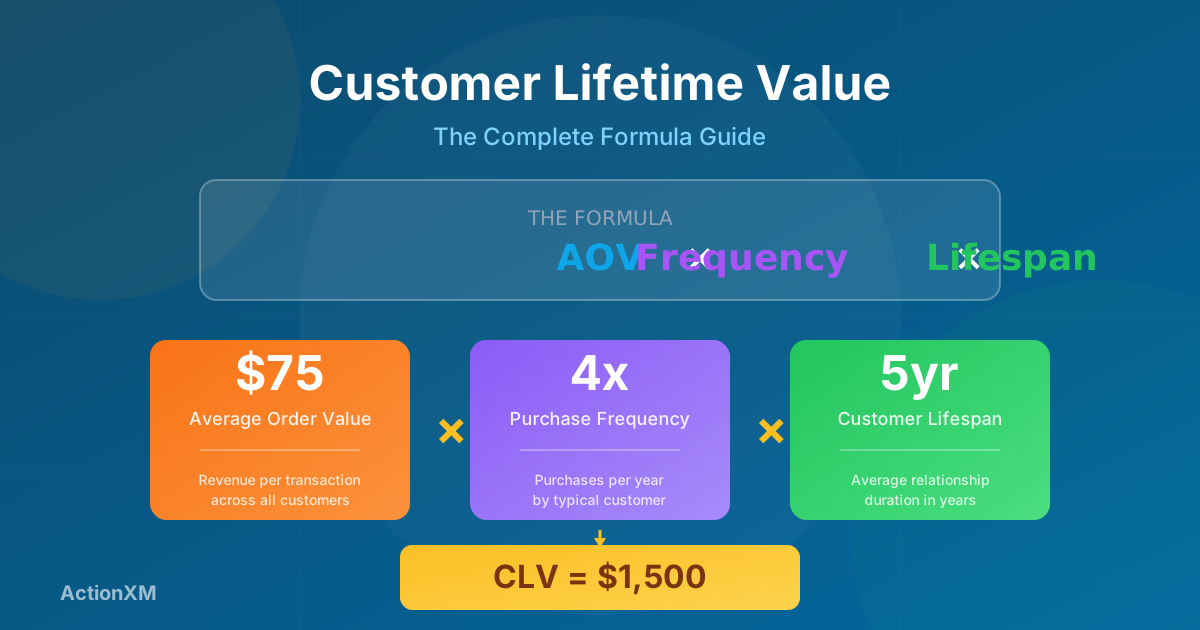
1. Simple CLV Formula (Best for Quick Estimates)
Example Calculation:
- Average Order Value: $75
- Purchase Frequency: 4 times per year
- Average Customer Lifespan: 5 years
CLV = $75 × 4 × 5 = $1,500
Best for: Quick estimates, non-subscription businesses, initial planning
2. Traditional CLV Formula (Includes Profit Margins)
The simple formula ignores profitability. This version factors in what you actually keep:
Example with Margin:
- AOV: $75, Frequency: 4/year, Lifespan: 5 years
- Gross Margin: 40%
CLV = ($75 × 4 × 0.40) × 5 = $600
Notice the dramatic difference: $600 vs. $1,500. The traditional formula reveals actual profit, not just revenue.
3. SaaS CLV Formula (Subscription Businesses)
For recurring revenue models, the calculation simplifies:
SaaS Example:
- Monthly ARPU: $100
- Gross Margin: 80%
- Monthly Churn Rate: 2%
CLV = ($100 × 0.80) ÷ 0.02 = $4,000
4. Predictive CLV Formula (Accounts for Time Value)
For sophisticated financial planning, discount future cash flows:
This formula acknowledges that $100 received today is worth more than $100 received in 3 years. Use it when making long-term investment decisions.
Which Formula Should You Use?
| Business Type | Recommended Formula | Why |
|---|---|---|
| E-commerce (new) | Simple | Quick baseline, easy data |
| E-commerce (mature) | Traditional | Factor in actual margins |
| SaaS / Subscription | SaaS Formula | Built for recurring revenue |
| Enterprise B2B | DCF / Predictive | Large contracts, long cycles |
| High-frequency retail | Traditional + Cohort | Track segments over time |
CLV Industry Benchmarks (2025-2026)
CLV varies dramatically by industry due to differences in purchase patterns, margins, and customer relationships.
Customer Acquisition Cost by Industry (2025)
Understanding CLV requires context—specifically, what you’re paying to acquire those customers:
| Industry | Average CAC | CLV Target (3:1 ratio) |
|---|---|---|
| Fintech | $1,450 | $4,350+ |
| Insurance | $1,280 | $3,840+ |
| B2B SaaS | $702 | $2,106+ |
| Commercial Real Estate | $660 | $1,980+ |
| B2B E-commerce | $471 | $1,413+ |
| Higher Education | $432 | $1,296+ |
| E-commerce (General) | $70 | $210+ |
| Arts & Entertainment | $21 | $63+ |
Source: First Page Sage, Phoenix Strategy Group, 2025
The CLV:CAC Ratio: The Ultimate Health Metric
The relationship between Customer Lifetime Value and Customer Acquisition Cost determines business viability. This ratio is arguably more important than either metric alone.
Industry-Specific CLV:CAC Benchmarks
| Industry | Target Ratio | CAC Payback Period |
|---|---|---|
| SaaS | 3:1 to 5:1 | 12-18 months |
| Commercial Insurance | 5:1 | 24+ months |
| E-commerce | 3:1 | 3-6 months |
| Subscription Businesses | 5:1 to 6:1 | 6-12 months |
| Enterprise Software | 3:1+ | 18-24 months |
Critical insight: The private SaaS average CAC payback is 23 months—meaning it takes nearly two years to recoup acquisition costs. This makes retention and CLV optimization essential, not optional.
Real-World CLV Case Studies
Starbucks: The $25,000 Customer
Starbucks exemplifies CLV-focused business design:
More CLV Success Stories
| Company | Strategy | Result |
|---|---|---|
| Adidas adiClub | 240M member loyalty program | Members have 2x CLV of non-members |
| Amazon Prime | Subscription + ecosystem | Prime members spend $1,340/year vs. $790 non-members |
| Dropbox | Referral program | Referred customers have 16% higher CLV |
| Astrid & Miyu | Loyalty program | Members spend 220% more annually |
Customer Segmentation by CLV
Not all customers are equal. Segmenting by lifetime value enables targeted strategies that maximize returns.
RFM Analysis for CLV Segmentation
RFM (Recency, Frequency, Monetary) analysis provides a data-driven framework:
| Segment | RFM Profile | CLV Potential | Strategy |
|---|---|---|---|
| Champions | Recent, frequent, high spend | Highest | Reward loyalty, request referrals |
| Loyal Customers | Frequent, good spend | High | Upsell, loyalty programs |
| Potential Loyalists | Recent, moderate frequency | Medium-High | Engagement campaigns, incentives |
| At-Risk | Previously active, now quiet | Medium | Win-back campaigns, personal outreach |
| Hibernating | Long-ago purchase, low engagement | Low | Re-activation offers or let go |
10 Common CLV Calculation Mistakes
Even sophisticated organizations make these errors. Avoiding them dramatically improves accuracy.
7 Strategies to Increase Customer Lifetime Value
1. Loyalty Programs That Actually Work
The data is clear: well-designed loyalty programs dramatically increase CLV.
| Program | Impact |
|---|---|
| Starbucks Rewards | 41% of sales from members |
| Adidas adiClub | Members shop 50% more often |
| Amazon Prime | $550 additional annual spend |
| Astrid & Miyu | 6x more likely to repeat purchase |
Keys to success: Make rewards achievable, personalize offers, create emotional connection beyond transactions.
2. Strategic Onboarding
Poor onboarding causes 23% of customer churn. First impressions compound over the lifetime relationship.
- Reduce time-to-value aggressively
- Provide proactive guidance, not reactive support
- Set clear expectations and milestones
- Celebrate early wins with customers
3. Personalization at Scale
McKinsey research shows personalization leaders generate 40% more revenue than competitors:
- AI-driven product recommendations (Amazon generates 35% of revenue from recommendations)
- Behavioral email targeting
- Dynamic pricing based on customer value
- Customized service levels by segment
4. Proactive Customer Success
Don’t wait for problems—anticipate them:
- Monitor usage patterns for churn signals
- Reach out before renewal decisions
- Provide value beyond the core product
- Create customer health scores that trigger intervention
5. Upselling and Cross-Selling
Can generate 10%+ additional monthly revenue when done well:
- Recommend based on usage data, not assumptions
- Time offers around value realization moments
- Focus on genuine customer benefit, not quota
- Use AI to identify optimal expansion opportunities
6. Reduce Friction Everywhere
Every friction point erodes CLV:
- Simplify account management
- Make support easy to access
- Remove unnecessary steps in key flows
- Measure and reduce Customer Effort Score (CES)
7. Build Community and Ecosystem
Create switching costs through value, not lock-in:
- User communities and peer connections
- Educational content and certification
- Integrations that increase stickiness
- Partner ecosystems that expand use cases
AI and the Future of CLV (2025-2026)
Predictive CLV Models
Machine learning is transforming CLV from backward-looking calculation to forward-looking prediction:
- Segment averages
- Historical data only
- Static calculations
- Reactive decisions
- Individual predictions
- Real-time behavioral signals
- Dynamic recalculation
- Proactive intervention
Source: SuperAGI CLV Research, M Accelerator ML Guide
AI-Driven CLV Capabilities
| Capability | Business Impact |
|---|---|
| Predictive Churn Scoring | Identify at-risk customers before they leave |
| Next-Best-Action Recommendations | Optimize every customer interaction |
| Dynamic Segmentation | Real-time customer value classification |
| Automated Personalization | Scale 1:1 experiences efficiently |
| Revenue Forecasting | More accurate financial planning |
Real-World AI CLV Applications
- Stitch Fix: Deep learning predicts individual CLV to optimize styling and marketing
- Verizon: ML models identify churn risk and trigger retention strategies
- Citi: Personalized financial services based on predicted customer value
- Quantzig: ML framework achieved 20% retention increase, 15% CLV boost
Frequently Asked Questions
What’s the difference between CLV and LTV?
CLV (Customer Lifetime Value) and LTV (Lifetime Value) are used interchangeably. Some organizations use “CLV” for individual customer calculations and “LTV” for segment or company-wide averages, but there’s no universal distinction.
How often should I recalculate CLV?
Quarterly for most businesses. Monthly if you’re in a high-velocity environment (e-commerce, mobile apps) or making significant strategic changes. The key is consistency—use the same methodology each time for valid trend analysis.
What’s a good CLV:CAC ratio?
3:1 is the standard benchmark—you earn $3 in customer lifetime value for every $1 spent on acquisition. Below 3:1 suggests unsustainable economics. Above 5:1 might indicate you’re underinvesting in growth. Industry context matters: subscription businesses typically target 5:1+.
Should I calculate CLV with or without discounting?
With discounting for long-term contracts, enterprise deals, or strategic planning. Without discounting for quick estimates, short customer lifespans, or operational decisions. The discount rate (typically 10-15%) accounts for the time value of money and risk.
How do I calculate CLV for a new business with no historical data?
Start with industry benchmarks and cohort analysis of your earliest customers. Use conservative assumptions for customer lifespan. As data accumulates, refine your model. Focus first on establishing data collection infrastructure for accurate future calculations.
Can negative CLV customers exist?
Yes. High-maintenance customers who require excessive support, return products frequently, or drain resources without corresponding revenue can have negative CLV. Identifying these customers is valuable—you may need to adjust service levels or pricing, or in extreme cases, exit the relationship.
The Bottom Line
Customer Lifetime Value isn’t just a metric—it’s a lens for viewing every business decision. When you truly understand CLV:
- Acquisition decisions become investment decisions with clear ROI expectations
- Retention efforts get funded appropriately (because you know the payoff)
- Customer service becomes a profit center, not a cost center
- Product development prioritizes features that increase lifetime engagement
The companies winning on CLV—Amazon, Apple, Starbucks—don’t just measure it. They’ve restructured their entire organizations around maximizing it. They know that a customer isn’t a transaction; a customer is a relationship worth optimizing over years or decades.
Key takeaways:
- Choose the right formula for your business model (SaaS vs. e-commerce vs. B2B)
- Target a 3:1+ CLV:CAC ratio as your baseline for sustainable economics
- Segment customers by value and allocate resources accordingly
- Invest in retention because 5% improvement can mean 25-95% profit increase
- Avoid common mistakes like using revenue instead of profit or ignoring variable costs
- Leverage AI for predictive CLV that enables proactive intervention
Start Maximizing Customer Lifetime Value
Ready to transform how you measure and grow customer relationships? ActionXM combines CLV analytics with customer feedback, predictive churn scoring, and automated engagement—giving you the complete picture of customer value and the tools to increase it.
Take the next step:
Have questions about calculating or improving CLV? Contact us—we help organizations of all sizes build customer-centric growth engines.
Sources
- Bain & Company - The Loyalty Effect
- Harvard Business Review - The Value of Keeping the Right Customers
- CustomerGauge - Average Customer Lifetime Value by Industry
- Prefinery - CLV to CAC Ratio Guide 2024
- First Page Sage - LTV to CAC Ratio Benchmark
- Genesys Growth - CLV Statistics 2025
- Focus Digital - Customer Acquisition Cost Trends
- Barilliance - Customer Lifetime Value Guide
- M Accelerator - CLV Case Studies
- WPLoyalty - Starbucks Loyalty Program Case Study
- SuperAGI - Future of CLV with AI 2025
- Slash Experts - Hidden Truths About CLV
- McKinsey - The Value of Personalization
- CleverTap - RFM Analysis Guide