Here’s a sobering reality: only 31% of U.S. employees are engaged at work—the lowest level in a decade. Globally, the picture is even bleaker, with roughly 79% of workers either “not engaged” or “actively disengaged.” That’s not just an HR problem. It’s costing the global economy $8.8 trillion annually in lost productivity.
The challenge isn’t that organizations don’t care about engagement. It’s that most measure it poorly—or don’t measure it at all. An employee engagement score transforms vague sentiment into actionable intelligence, revealing exactly where your workforce is thriving and where intervention is needed.
This guide covers everything you need to build a measurement system that works: the calculation formulas, proven frameworks like Gallup Q12 and eNPS, industry benchmarks, and the strategies that actually move the needle on engagement.
What Is an Employee Engagement Score?
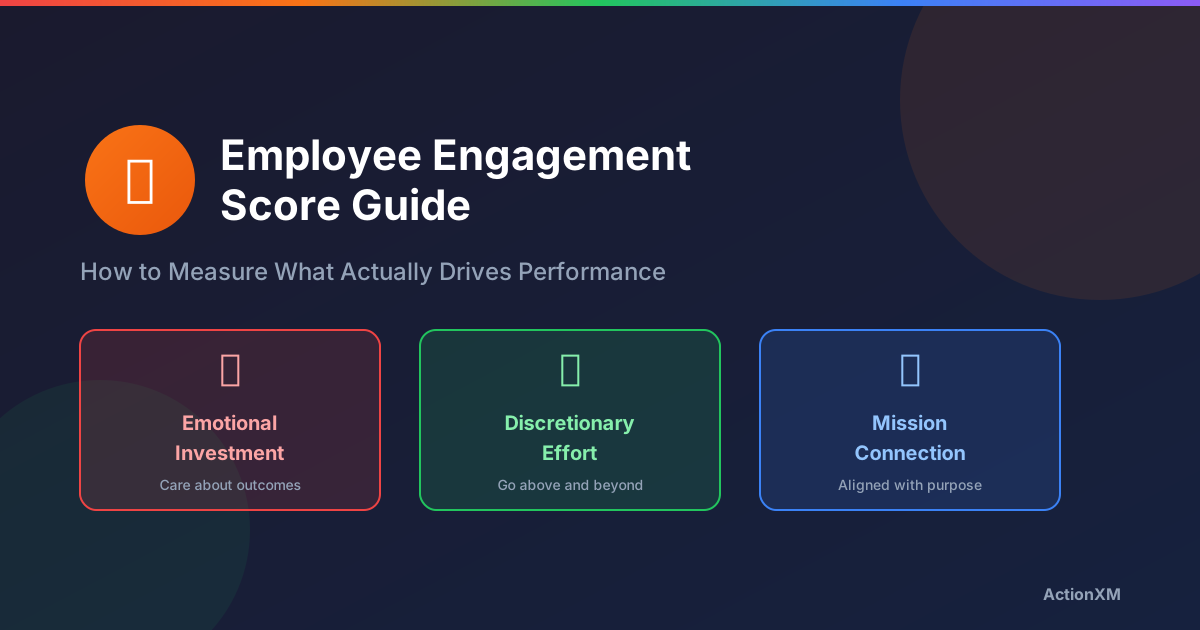
An employee engagement score is a composite metric that quantifies how emotionally invested, committed, and enthusiastic employees are about their work and organization. It measures not just satisfaction (whether employees like their job) but genuine engagement—whether they bring discretionary effort, feel connected to organizational goals, and actively contribute to success.
Think of engagement as the difference between an employee who clocks in, does the minimum, and clocks out versus one who actively looks for ways to improve processes, mentors colleagues, and advocates for the organization. Both might report being “satisfied”—but only one is truly engaged.
Satisfaction vs. Engagement: The Critical Distinction
| Dimension | Satisfaction | Engagement |
|---|---|---|
| What it measures | Contentment with job conditions | Emotional commitment to work |
| Behavioral indicator | Shows up, does the job | Brings extra effort, innovation |
| Organizational impact | Retention baseline | Performance multiplier |
| Question type | ”Are you happy here?" | "Do you recommend us as a workplace?” |
| Predictive power | Moderate for retention | High for performance + retention |
Why Employee Engagement Scores Matter
The business case for measuring engagement isn’t theoretical—it’s backed by decades of research linking engagement to every metric that matters.
The Manager Factor
Here’s a striking finding: managers account for 70% of the variance in employee engagement scores. That means the difference between a highly engaged team and a disengaged one usually comes down to their direct manager—not company policies, perks, or compensation. This research-backed insight explains why organization-wide engagement initiatives often fail while manager-level interventions succeed.
The Cost of Disengagement
The flip side is equally dramatic. According to Gallup, disengaged employees cost the global economy $8.8 trillion annually—equivalent to 9% of global GDP. At the company level, McKinsey estimates the median S&P 500 company loses approximately $282 million annually from disengagement and attrition combined.
Four Proven Methods to Calculate Engagement Scores
There’s no single “right” way to measure engagement—but some methods are more rigorous than others. Here are the four most widely adopted approaches.
Method 1: Employee Net Promoter Score (eNPS)
The simplest and fastest engagement metric, eNPS borrows from customer experience methodology to measure workforce advocacy.
eNPS benchmarks:
- +50 to +100: Excellent
- +10 to +50: Good
- 0 to +10: Needs improvement
- Below 0: Concerning
Pros: Single question, easy to benchmark, tracks trends quickly Cons: Lacks diagnostic depth—tells you that there’s a problem but not what the problem is
Method 2: The Gallup Q12 Framework
The gold standard for comprehensive engagement measurement, Gallup’s Q12 is a research-validated set of 12 questions that measure the core elements of workplace engagement.
Pros: Research-validated, diagnostic depth, industry benchmarks available Cons: More complex to administer, requires licensed access
Method 3: Employee Engagement Index (EEI)
A flexible composite score calculated from your own survey questions, weighted by importance.
Method 4: Utrecht Work Engagement Scale (UWES)
Developed by Wilmar Schaufeli and colleagues, the UWES is the most academically validated engagement instrument, measuring three distinct dimensions of work engagement.
Pros: Strong academic validation, measures engagement at psychological level, cross-cultural reliability Cons: More clinical/research-oriented, less focused on actionable organizational factors
Engagement Benchmarks: What “Good” Looks Like
Context matters when interpreting engagement scores. Here’s how current benchmarks break down.
Score Interpretation Guide
| Score Range | Interpretation | Action Required |
|---|---|---|
| 75-100% | High engagement — strong culture | Maintain, expand what’s working |
| 60-74% | Moderate engagement — room to grow | Identify and address weak areas |
| 50-59% | Below average — intervention needed | Focus groups, action planning |
| Below 50% | Critical — urgent attention required | Executive priority, systemic review |
How Often Should You Measure Engagement?
The debate between annual surveys and continuous feedback has shifted decisively toward more frequent, lighter-touch measurement—but the right cadence depends on your organizational context.
From Score to Action: The Feedback Loop
Measuring engagement is pointless without action. Research shows employees are 12× more likely to be engaged when they see their feedback turn into meaningful change. Here’s how to close the loop.
What Actually Works: Intervention Effect Sizes
Not all engagement interventions are equally effective. Research quantifies what moves the needle:
Job crafting—where employees redesign aspects of their own roles to better fit their strengths and interests—shows particularly strong results. It’s also low-cost compared to structural interventions.
The Communication Timeline
Speed matters. Employees should hear back soon after completing surveys—silence breeds cynicism.
| Milestone | Timeline | Communication |
|---|---|---|
| Survey closes | Day 0 | Thank participants, share response rate |
| Initial results | Week 1-2 | High-level findings, what stood out |
| Deep analysis | Week 3-4 | Detailed breakdown by theme, department |
| Action plan | Week 4-6 | Specific initiatives with owners and timelines |
| Progress update | Monthly | Status on committed actions |
| Re-measure | Quarterly | Pulse check on focus areas |
8 Common Engagement Measurement Mistakes
Even well-intentioned programs go wrong. Here’s what to avoid.
The Gen Z Challenge: Engagement Is Changing
A notable shift is happening in workforce engagement patterns—and it’s generational. Understanding these dynamics is critical for future-proofing your engagement strategy.
The data reveals a critical insight: Gen Z employees can be engaged—motivated, invested, bringing discretionary effort—while simultaneously planning to leave. Traditional engagement measures that assume engaged = staying miss this entirely.
AI and the Future of Engagement Measurement
Artificial intelligence is transforming how organizations understand and respond to engagement signals—moving from periodic surveys to continuous, passive measurement.
Frequently Asked Questions
What’s the difference between employee engagement and employee satisfaction?
Satisfaction measures whether employees are content with their working conditions—pay, benefits, work environment. Engagement measures emotional commitment—whether employees bring discretionary effort, care about outcomes, and feel connected to the organization’s mission. You can have satisfied employees who aren’t engaged (they like the job but won’t go above and beyond) or engaged employees who aren’t fully satisfied (they love the work but want better compensation).
How many survey questions is too many?
For annual comprehensive surveys, 40-60 questions is standard. For pulse surveys, keep it under 10—ideally 5. Research shows response rates drop significantly past 15 minutes of survey time. The key is consistency: better to ask fewer questions regularly than many questions once a year.
Should engagement surveys be anonymous?
Yes, with caveats. Anonymity increases honesty, especially for sensitive topics. However, complete anonymity prevents follow-up and targeted action. Best practice: confidential (individual responses protected) rather than anonymous (no identification at all), with demographic cuts for team-level insights while protecting small group identities.
How quickly should we see improvement after action?
Engagement doesn’t move overnight. Expect:
- 2-3 months: Early indicators (participation in new initiatives, anecdotal feedback)
- 6 months: Measurable pulse survey improvements
- 12 months: Significant engagement score gains (8-15% improvement realistic)
What’s a good response rate for engagement surveys?
70%+ is considered strong. Below 60% suggests trust or communication issues. Response rate itself can be an engagement indicator—disengaged employees often don’t bother participating.
How do we benchmark against our industry?
Several options: purchase benchmarking data from providers like Gallup, Culture Amp, or Glint; participate in industry surveys; or focus on internal trends (improving your own score over time) rather than external comparison. Internal benchmarking is often more actionable.
Can you measure engagement without surveys?
Partially. AI tools can analyze communication patterns, collaboration networks, and work rhythms for passive signals. Exit interview data provides retrospective insight. However, surveys remain the most direct way to understand employee perception and give employees voice in the process.
The Bottom Line
An employee engagement score isn’t just a number—it’s a window into organizational health. When measured correctly and acted upon consistently, it predicts performance, retention, and profitability with remarkable accuracy.
Key principles to remember:
- Choose the right methodology: eNPS for simplicity, Gallup Q12 for depth, custom EEI for flexibility
- Measure at the right cadence: Annual for strategy, pulse for trends—ideally both
- Act visibly on feedback: Employees who see change are 12× more likely to stay engaged
- Segment your analysis: Company-wide averages hide team-level reality
- Watch the Gen Z dynamic: Engagement no longer guarantees retention
- Leverage AI thoughtfully: Technology can complement but not replace direct employee voice
The organizations that excel at engagement don’t just measure—they create a continuous conversation with their workforce. They treat engagement data not as a compliance exercise but as strategic intelligence that shapes decisions, investments, and culture.
Build Your Engagement Intelligence
ActionXM provides the complete toolkit for measuring, analyzing, and improving employee engagement—from pulse surveys that detect trends in real-time to AI-powered sentiment analysis that reveals what employees are really feeling. Unified dashboards connect engagement data to business outcomes, so you can see the ROI of every improvement initiative.
Ready to transform your engagement strategy?
Want to build an engagement measurement system tailored to your organization? Contact our team for a personalized consultation.
Sources
- Gallup - Global Indicator: Employee Engagement
- Gallup - State of the Global Workplace 2024
- Qualtrics - Employee Engagement Definition & Guide
- Vantage Circle - The Real Cost of Disengaged Employees
- Culture Amp - Employee Pulse Survey Best Practices
- Gallup - Q12 Employee Engagement Survey
- Zoom - Hybrid Work Statistics 2025
- Owl Labs - State of Hybrid Work 2025
- Deloitte - 2025 Gen Z and Millennial Survey
- Gallup - The New Challenge of Engaging Younger Workers
- Quantum Workplace - Employee Engagement Action Planning
- Cerkl - AI in Employee Engagement 2025
- Schaufeli & Bakker - Utrecht Work Engagement Scale (UWES)
- Gallup - First, Break All the Rules (Manager Engagement Impact)
- Journal of Occupational Health Psychology - Job Crafting Interventions