What does your workforce actually think about their jobs? Not what they say in meetings or exit interviews, but the unvarnished truth about their daily experience?
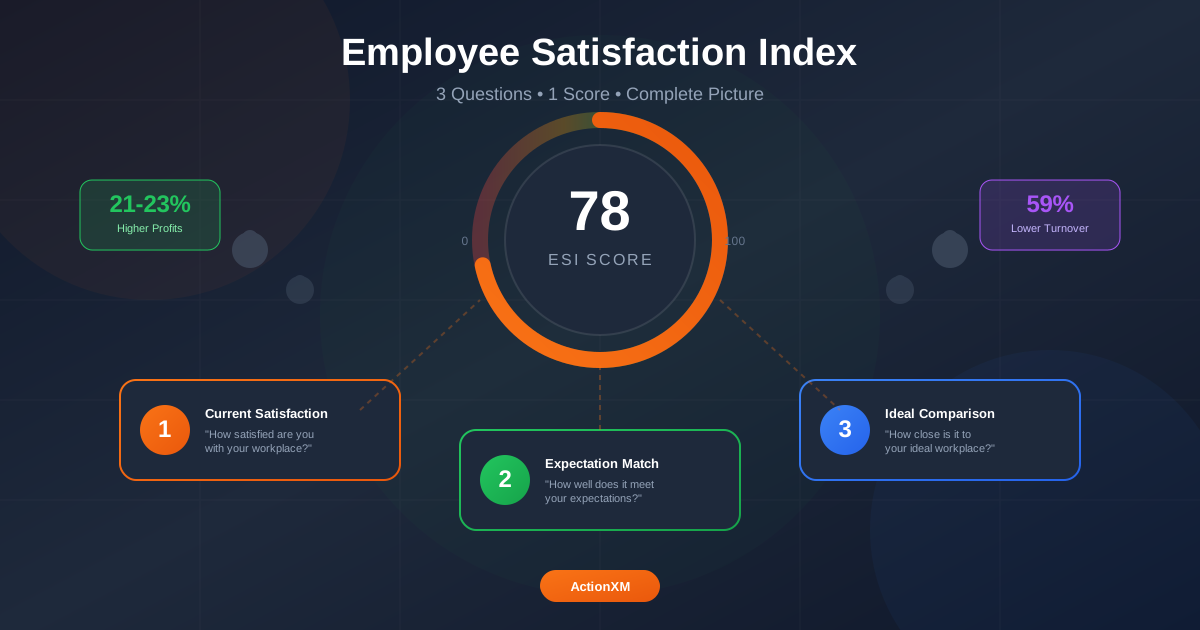
The Employee Satisfaction Index (ESI) answers this question with precision. Unlike sprawling engagement surveys that take 30 minutes to complete, ESI distills employee sentiment into a single, trackable number using just three questions. It’s the metric that tells you whether your workplace is somewhere people want to be—or somewhere they’re planning to escape.
According to Gallup’s 2025 State of the Global Workplace, global employee engagement has dropped to just 21%—the lowest in years. Only 18% of U.S. workers report being “very satisfied” with their jobs. In this climate, organizations that can accurately measure and improve employee satisfaction gain a significant competitive advantage in retention, productivity, and ultimately, business results.
This guide covers everything you need to implement ESI effectively: the formula, interpretation guidelines, benchmarks, how it compares to other metrics, and practical strategies for turning ESI insights into action.
What Is the Employee Satisfaction Index?
The Employee Satisfaction Index (ESI) is a standardized metric that quantifies how content employees are with their roles, workplace environment, and overall company experience. Think of it as a pulse check on your workforce’s happiness—a numerical snapshot that reveals whether your organization is meeting employee expectations.
What makes ESI powerful is its simplicity. While comprehensive engagement surveys can include 50+ questions and take weeks to analyze, ESI provides a consistent, comparable metric that can be tracked over time with minimal survey fatigue. It answers the fundamental question: “Are our employees satisfied?”
The Three Core ESI Questions
ESI is built on three standardized questions, each rated on a 1-10 scale:
These three questions work together to capture different dimensions of satisfaction. The first measures the present state. The second reveals whether the organization is delivering on its promises. The third uncovers aspirational gaps—how far the current experience falls short of an ideal.
How to Calculate the Employee Satisfaction Index
The ESI formula transforms the three question responses into a single score between 0 and 100.
Interpreting Your ESI Score
What does your ESI number actually mean? Use this interpretation guide to understand where your organization stands.
Why Employee Satisfaction Matters: The Business Impact
Employee satisfaction isn’t just a “nice to have”—it’s a business imperative with measurable financial impact.
Sources: Gallup, MIT CISR, SHRM
The Employee-Customer Connection
Research consistently shows that employee satisfaction directly impacts customer experience—what’s often called the “Service-Profit Chain.”
According to MIT CISR research, organizations in the top quartile for employee experience achieve:
- 2× the innovation of bottom-quartile companies
- 2× customer satisfaction levels
- 25% higher profits than industry peers
- $87 revenue per person-hour vs. $57 for bottom quartile
ESI vs. eNPS: Understanding the Difference
Organizations often confuse ESI with employee Net Promoter Score (eNPS). While both measure employee sentiment, they answer fundamentally different questions.
When to Use Each Metric
Use ESI when you want to:
- Understand how happy employees are with their current situation
- Track satisfaction trends over time
- Identify gaps between expectations and reality
- Get a quick pulse on workplace contentment
Use eNPS when you want to:
- Benchmark against industry standards
- Measure willingness to act as an employer advocate
- Understand loyalty and referral potential
- Compare across different organizations
The ideal approach: Use both. ESI tells you how satisfied employees are; eNPS tells you whether they’d recommend your organization. An employee can be satisfied but not an advocate (they like their job but wouldn’t tell friends to work there), or an advocate but not fully satisfied (they believe in the company despite personal frustrations).
ESI Benchmarks by Industry and Company Size
What’s a “good” ESI score? Context matters. Benchmarks vary by industry, company size, and regional factors.
Source: Hive HR Q1 2025 Engagement Benchmarks, BambooHR
The Company Size Factor
Interestingly, smaller companies consistently outperform larger ones on employee satisfaction measures:
Best Practices for Measuring ESI
Getting accurate ESI data requires thoughtful survey design and administration. Here’s how to maximize the value of your measurement program.
Seven Strategies to Improve Your ESI Score
Measuring ESI is only valuable if you act on the results. Here are evidence-based strategies that organizations have used to move their scores meaningfully.
Real-World ESI Success Stories
Organizations that commit to measuring and improving employee satisfaction see tangible business results.
Frequently Asked Questions
How often should I measure ESI?
Quarterly is the recommended frequency for ESI surveys—frequent enough to catch trends, but not so often that you create survey fatigue. Between quarterly surveys, use monthly single-question pulse checks (“How satisfied are you this week?”) to monitor for sudden shifts. Annual surveys alone are insufficient; by the time you discover a problem, it may be too late.
What’s the difference between satisfaction and engagement?
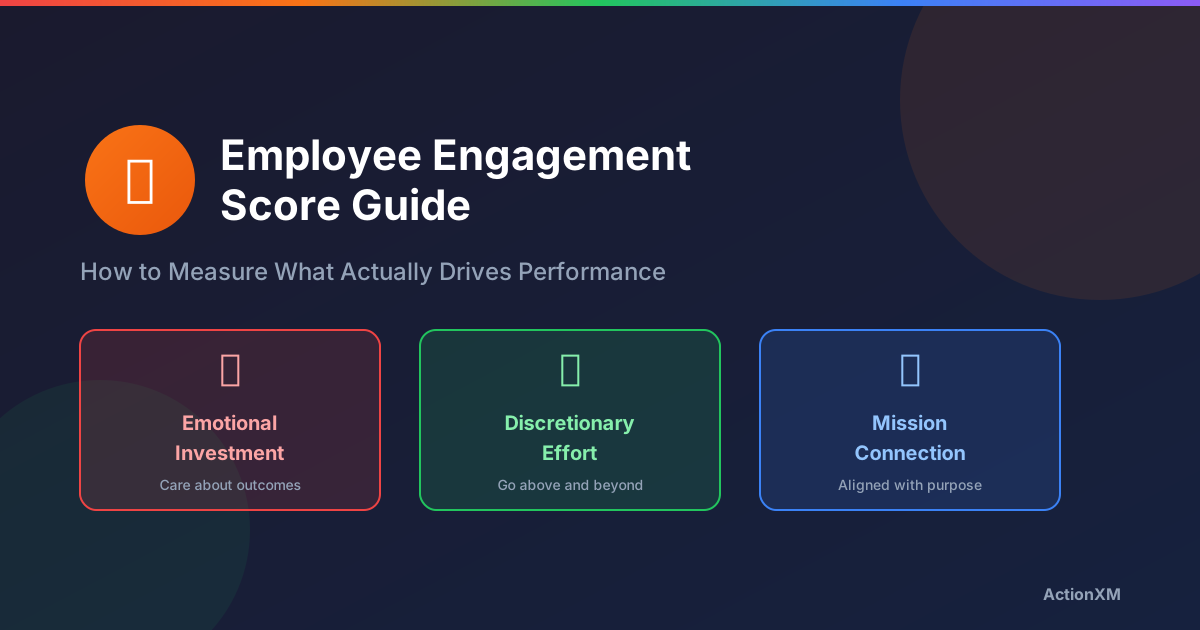
Satisfaction measures contentment with the current state—are employees happy with their job, environment, and conditions? Engagement measures emotional commitment and discretionary effort—are employees motivated to go above and beyond? An employee can be satisfied (content) but not engaged (not passionate), or engaged (believes in the mission) but not satisfied (frustrated with daily realities). The most successful organizations optimize for both.
How do I handle low ESI scores?
First, don’t panic. A low score is information, not a crisis. Second, gather qualitative data—add open-ended questions or conduct focus groups to understand the “why.” Third, prioritize. You can’t fix everything at once. Use an effort-impact matrix to identify high-impact, achievable improvements. Fourth, communicate. Share what you learned and what you’re doing about it. Finally, measure again in 60-90 days to track progress.
Can ESI be too high?
While not common, unusually high ESI scores (95+) can indicate problems: social desirability bias (employees saying what they think you want to hear), lack of survey anonymity concerns, or even organizational complacency. The most healthy organizations typically score in the 75-90 range—room for growth, but fundamentally positive.
How does remote work affect ESI measurement?
Remote and hybrid employees require adapted approaches. Use digital-first survey distribution, ensure technology accommodates all work arrangements, and segment results by work location to identify differences. Interestingly, Salesforce found that 92% of employees agree their team works effectively in flex environments—remote work doesn’t inherently hurt satisfaction.
Should I segment ESI by department or tenure?
Yes, absolutely. Aggregate scores mask important differences. New hires often have higher satisfaction (honeymoon effect) that declines around month 6-12. Different departments face different challenges. Long-tenured employees may have different concerns than recent hires. Segmentation reveals where to focus improvement efforts.
The Bottom Line
The Employee Satisfaction Index offers a simple, standardized way to measure what matters most: whether your employees are happy at work. Three questions, one score, and a clear picture of organizational health.
Key takeaways:
- Keep it simple: ESI’s three-question format minimizes survey fatigue while capturing multi-dimensional satisfaction
- Target 75+ scores: This indicates a healthy organizational culture with room for continuous improvement
- Measure regularly: Quarterly ESI surveys with monthly pulses catch trends before they become crises
- Close the loop: Survey data without action destroys trust. Always communicate results and your response
- Focus on managers: 70% of engagement variance comes from the manager—invest there first
- Connect to outcomes: Link ESI improvements to business results (turnover, productivity, customer satisfaction) to maintain executive support
The organizations that win the talent war in 2026 and beyond will be those that treat employee satisfaction not as a HR checkbox, but as a strategic priority. ESI gives you the measurement foundation to make that commitment real.
Build Your Employee Satisfaction Program
ActionXM makes measuring and improving employee satisfaction simple. Our unified platform combines ESI surveys with pulse checks, manager effectiveness assessments, and AI-powered action recommendations—all in one place.
Get started:
Questions about implementing ESI in your organization? Contact our team for a personalized consultation on building an employee listening program that drives real results.
Sources
- Gallup - State of the Global Workplace 2025
- BambooHR - Employee Happiness Index Q1 2025
- Hive HR - Employee Engagement Benchmarks Q1 2025
- MIT CISR - Employee Experience Research
- Netigate - How the Employee Satisfaction Index Works
- CultureMonkey - Employee Satisfaction Index Guide
- Leapsome - Employee Satisfaction Index
- Team Insights - ESI vs eNPS Comparison
- Salesforce - Employee Satisfaction Research
- SHRM - Turnover Cost Calculation
- Pew Research - Job Satisfaction 2024
- HR Cloud - Employee Engagement Case Studies