When a policyholder files a claim, the clock starts ticking on far more than a settlement. That single moment — often triggered by accident, illness, or disaster — defines whether a customer stays for life or leaves at renewal. Yet across the insurance industry, overall satisfaction remains stubbornly below the cross-industry average — with CSAT scores ranging from 70–76% depending on measurement methodology, versus a cross-industry benchmark of 77–79%. The gap between what policyholders expect and what carriers deliver has never been wider — or more consequential.
This guide maps every stage of the insurance customer journey, from quote through renewal, and arms you with the data, frameworks, and proven strategies that separate CX leaders generating 2–4x growth from the rest of the industry.
Why Insurance CX Is at a Breaking Point
The insurance sector faces a convergence of forces that make customer experience the decisive competitive lever. Premium rate increases, rising claims costs, and rapidly shifting customer expectations are reshaping the landscape.
Several forces are converging:
- Premium pressure: Auto insurance rates rose roughly 10% year-over-year through 2024, and half of all homeowners experienced insurer-initiated premium increases in the past 12 months.
- Demographic shift: Consumers aged 66+ are shopping and switching more than any other age group. Shopping among long-tenured customers (10+ years) surged 35% year-over-year.
- Experience as differentiator: U.S. consumers are now more likely to switch carriers due to poor CX than price alone, and 46% explicitly prioritize customer experience when selecting an insurer.
The math is unambiguous: carriers that fail to invest in CX are funding their competitors’ growth.
The Insurance Customer Journey: 8 Critical Touchpoints
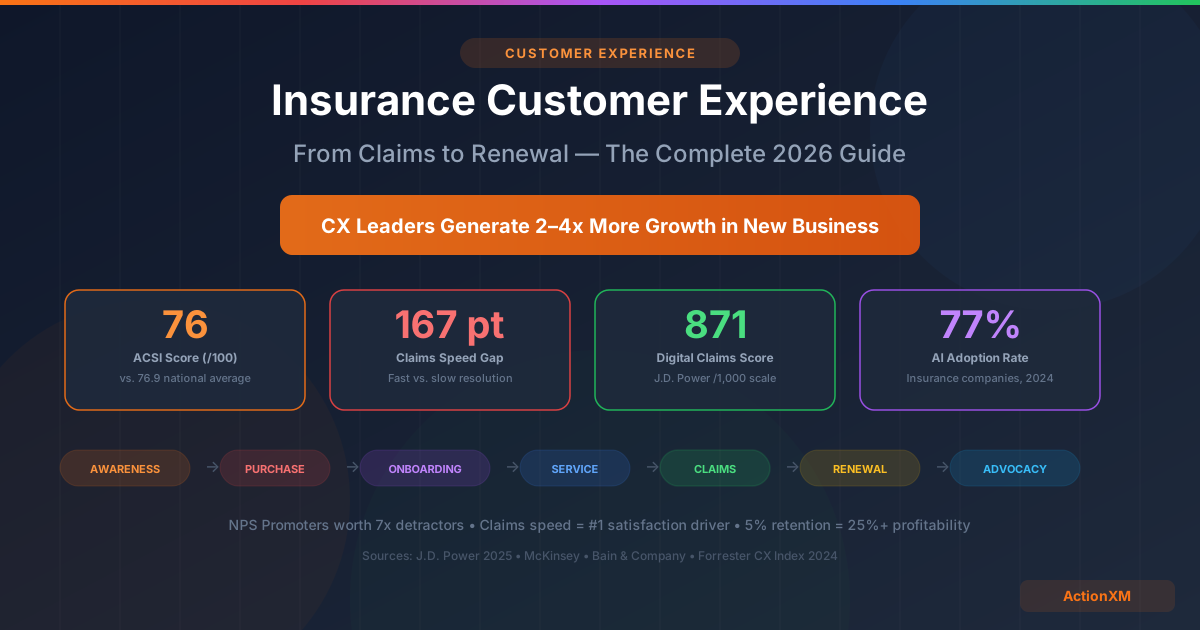
Unlike retail or SaaS, insurance relationships unfold over years — and the journey from first quote to fifth renewal is punctuated by infrequent but emotionally intense interactions. Understanding and optimizing each touchpoint is essential.
Each stage presents a distinct CX challenge — and a distinct opportunity to differentiate. The most impactful touchpoints are concentrated around claims and renewal, where emotions run highest and brand loyalty is either cemented or shattered.
Claims Experience: The 167-Point Satisfaction Gap
No single moment in the insurance journey matters more than the claims process. It’s the only time most policyholders truly “use” their insurance, and the experience defines their perception of value.
Speed Is the Single Biggest Driver
J.D. Power’s 2025 data reveals a staggering correlation between claims speed and satisfaction:
The average property claims cycle now stretches to 32.4 days from filing to finished repairs — the longest since J.D. Power began tracking in 2008. Time to final payment has grown to over 44 days. These delays are not just operational failures; they are experience failures with measurable consequences.
Communication Makes or Breaks Claims
The data on communication during claims is equally stark:
- Satisfaction is more than 2x higher (777 vs. 337 on J.D. Power’s 1,000-point scale) when communication is rated “very easy” compared to “very difficult”
- 42% of policyholders cite poor communication as their single biggest frustration
- 1 in 6 customers report receiving no follow-up after their initial claim inquiry
- Insurers deliver adequate digital status updates only 22% of the time
The Total Loss Problem
Total losses now account for 27% of all auto claims, up from 24%. Satisfaction among total-loss customers dropped 9 points, and only 58% say the total-loss valuation fully met their expectations. This is a growing CX challenge as vehicle values fluctuate and customers feel shortchanged.
Post-Claim Rate Shock
Perhaps the most destructive dynamic in the claims journey: 44% of auto insurance customers who filed a claim experienced a premium increase in the following 12 months. Satisfaction plummets by 104 points among these customers. The result? 7% of policyholders now avoid filing claims altogether for fear of rate increases — an alarming sign that the insurance promise itself is eroding.
Insurance NPS: Benchmarks and What Top Performers Do Differently
Net Promoter Score remains one of the clearest indicators of insurance CX health. The industry average tells a cautionary tale — but the top performers prove what’s possible.
Insurance NPS Landscape — 2025
Net Promoter Score by carrier
Sources: QuestionPro Q1 2025, Bain & Company, CustomerGauge, Lemonade Blog
The Economics of NPS in Insurance
Bain & Company’s research quantifies why NPS matters so much for insurers:
- Promoters are 3.5x more likely to renew than detractors
- Promoters are worth ~7x detractors in lifetime value — they stay longer, buy more products, generate more referrals, and cost less to serve
- CX-leading insurers generate 2–4x more growth in new business and 30% higher profitability than laggards
- Over a five-year period, a small cohort of CX leaders created 6.1x the total shareholder return compared to industry laggards
The 24-point NPS gap between USAA (54) and the industry average (30) isn’t merely a satisfaction statistic — it’s a revenue and growth chasm.
Satisfaction Benchmarks by Insurance Line
Performance varies significantly across insurance lines, and understanding these differences helps carriers prioritize CX investments.
| Insurance Line | Overall Score (J.D. Power, /1,000) | Top Performer | Top Score | Key Insight |
|---|---|---|---|---|
| Auto Insurance | 644 | — | — | Down 2 pts YoY; 38% in bottom segment |
| Auto Claims | 700 | Erie Insurance | 743 | Speed and communication are primary drivers |
| Property Claims | 682 | Chubb | 773 | Cycle times longest since 2008 |
| Life Insurance | Varies | Mutual of Omaha | 707 | 118-pt gap between best and worst |
| Digital Claims | 871 | — | — | 17 pts above prior year |
| Health Insurance (Forrester CX Index) | 66.6/100 | Humana | #1 rank | Third straight year of declines |
The digital claims satisfaction score of 871 — dramatically higher than traditional channels — underscores the business case for digital transformation. Carriers that invest in seamless digital claims experiences are capturing outsized satisfaction gains.
The 10 Biggest Customer Pain Points in Insurance
Understanding what drives dissatisfaction is as important as knowing what drives loyalty. Here are the ten most impactful friction points, ranked by their effect on switching behavior.
The takeaway: most insurance pain points are not about the product itself but about the experience surrounding it. Communication, speed, transparency, and digital convenience dominate the list.
Digital Transformation: The New Baseline for Insurance CX
Digital capabilities have shifted from competitive advantage to survival requirement. The data is unequivocal.
Adoption Is Accelerating
- 60% of insurance transactions were conducted via mobile devices by end of 2024
- 73% of customers expect to complete claims digitally
- 83% say they are more likely to renew with an insurer offering digital claims
- 85% digital insurance platform adoption rate in the U.S. (the highest globally)
- 74% of insurance executives worldwide identify digital transformation as their top strategic priority
Digital Claims Dramatically Outperform Traditional Channels
Digital claims satisfaction scored 871 out of 1,000 in J.D. Power’s 2024 U.S. Insurance Digital Experience Study — 17 points higher than the previous year and dramatically above overall claims satisfaction scores in the 680–700 range. Well-executed digital estimation alone boosts satisfaction by 66 points.
Yet carriers are not capitalizing: insurers deliver adequate digital status updates only 22% of the time. This gap between customer expectations and carrier execution represents the single largest CX improvement opportunity in the industry.
AI and Chatbots Are Reshaping Service
The insurance chatbot market reached $496 million in 2023 and is growing at a 26.6% CAGR through 2030. Across the industry, 77% of insurance companies adopted AI technologies in 2024, up from 61% in 2023. An estimated 70% of all insurance customer service interactions will be handled by AI chatbots by the end of 2025.
But the human-digital balance is delicate: 49% of customers still trust human advisors more than automated systems for policy and claims discussions, and 70% prefer in-person interactions for complex matters.
The winning formula? Digital convenience for routine interactions, human empathy for complex moments.
Case Studies: What CX Leaders Do Differently
USAA: The Gold Standard (NPS 54)
USAA consistently achieves the highest NPS in the insurance industry — scoring 54 in Q1 2025 per QuestionPro, well above the industry average of 23–36. Their approach:
- Claims satisfaction: 87% (highest of all carriers measured), with an auto claims J.D. Power score of 726 vs. the 697 industry average
- Ease of service: 93% satisfaction rate
- Agent philosophy: Agents prioritize education, helping members choose tailored policies rather than maximizing premium
- Emergency-first culture: Streamlined claims with empathetic support during crisis moments
USAA proves that sustained CX excellence drives extraordinary loyalty and growth — even without competing on price.
Lemonade: AI-First Disruption (NPS 75 for Pet Claims)
Lemonade’s AI claims bot “AI Jim” has redefined what’s possible:
- World record: Settled a genuine claim in 2 seconds — from submission to payment
- AI Jim processes 30%+ of claims without any human intervention (50%+ for pet insurance)
- Runs 18 anti-fraud algorithms simultaneously, including video analysis for non-verbal cues
- Collects 100x more data points than traditional insurers
- 25% improvement in claims processing speed since AI implementation
- Policyholder satisfaction rate: 90%+ for AI Jim interactions
Erie Insurance: Claims Excellence (J.D. Power #1 Auto Claims, 743)
Erie’s 43-point lead over the industry average in auto claims satisfaction demonstrates the power of operational excellence focused on speed, communication, and fair settlement practices.
Chubb: Property Claims Leadership (J.D. Power #1, 773)
Chubb’s 91-point advantage in property claims reflects a commitment to high-touch service for complex claims — proving that premium positioning and CX excellence can reinforce each other.
Retention and Renewal: The Economics That Should Change Every Carrier’s Strategy
The business case for retention over acquisition in insurance is overwhelming.
The Average Retention Rate: 83–84%
The industry average retention rate of 83–84% sounds reasonable — until you examine who’s leaving. J.D. Power’s 2025 data reveals that high-value lifetime customers have the lowest renewal likelihood: only 51% say they “definitely will” renew. These are the customers carriers can least afford to lose.
What Drives Renewal
The factors that drive renewal differ markedly from the factors that drive initial purchase:
| Factor | Role in Initial Purchase | Role in Renewal |
|---|---|---|
| Price competitiveness | Primary driver | Secondary |
| Claims experience | Not applicable (pre-claim) | Primary driver |
| Communication quality | Important | Critical |
| Agent relationship | Moderate impact | High impact (quarterly contact = ~50 CX score vs. 0 for infrequent) |
| Digital convenience | Expected | Differentiating (83% more likely to renew with digital claims) |
| Proactive outreach | Nice to have | Essential (coverage reviews, personalized reminders) |
This table reveals a fundamental strategic insight: carriers that optimize only for acquisition (competing on price) are systematically underinvesting in the drivers of renewal (service, communication, relationships).
AI and Personalization: The Transformation Accelerating Insurance CX
Artificial intelligence is no longer experimental in insurance — it’s operational and accelerating.
Adoption at Scale
- 77% of insurance companies adopted AI in 2024, up from 61% the year prior
- The AI-in-insurance market grew from $8.13 billion in 2024 to a projected $141 billion by 2034 (33% CAGR)
- 76% of insurance executives have implemented AI in at least one business function
- An estimated 60% of customer interactions will be AI-managed by 2027
Where AI Delivers the Most CX Value
| AI Application | CX Impact | Adoption Stage |
|---|---|---|
| Automated claims triage | Reduces handling time up to 50%, improves accuracy 30% | Mainstream |
| Predictive churn modeling | Identifies at-risk customers before renewal | Growing |
| Digital FNOL | Photo-based damage estimation; instant claim initiation | Mainstream |
| Chatbots and virtual agents | 24/7 service; estimated 70% of interactions by 2025 | Mature |
| Personalized pricing (UBI) | Usage-based premiums; safe-driver rewards | Growing |
| Fraud detection | Real-time analysis including video/behavioral cues | Mature |
| Proactive renewal outreach | Predictive analytics for timing and messaging | Emerging |
The McKinsey Growth Engine Finding
McKinsey’s research on U.S. auto insurers found that carriers with consistently best-in-class CX generated:
- 2–4x more growth in new business
- 30% higher profitability
- 65% higher total shareholder return for P&C insurers
- 20% higher total shareholder return for life insurers
- 4% higher revenue and EBIT growth annually
The implication: CX investment in insurance isn’t a cost center — it’s the primary growth lever.
Building an Insurance CX Measurement Framework
Effective insurance CX requires measurement at multiple levels and multiple touchpoints. Here’s a framework tailored to the industry.
Metric Architecture
Relationship Metrics (measured quarterly or annually):
- NPS: Overall brand loyalty; benchmark against industry average of 30
- Overall CSAT: Tracked against the 70% industry baseline
- Customer Effort Score (CES): Critical for self-service and digital interactions
- Renewal intent: The ultimate leading indicator
Transactional Metrics (measured after each interaction):
- Claims CSAT: Post-settlement survey; benchmark against J.D. Power scores
- Onboarding CSAT: First 30 days post-purchase
- Service interaction CSAT: After billing, endorsement, or inquiry contacts
- Digital experience score: App/portal usability after key tasks
Operational Metrics (monitored continuously):
- Claims cycle time: From FNOL to settlement; benchmark against 32.4-day average
- First-contact resolution rate: For service inquiries
- Digital FNOL adoption rate: Percentage using digital vs. traditional channels
- Agent contact frequency: Tracked against the “quarterly = optimal” benchmark
The Closed-Loop Imperative
Measurement without action is just surveillance. Insurance CX leaders implement closed-loop processes:
- Detect: Real-time satisfaction signals from post-interaction surveys, digital behavior, and operational metrics
- Route: Automatically flag at-risk accounts (low CSAT, long cycle times, rate increases) to retention teams
- Resolve: Empower frontline staff with authority to address issues — not just log them
- Learn: Aggregate patterns across touchpoints to identify systemic improvement opportunities
- Prevent: Use predictive models to intervene before problems occur (e.g., proactively communicating rate changes before renewal)
Regulatory and Compliance Considerations
Insurance CX operates within a regulatory framework that shapes — and sometimes constrains — what carriers can do.
State-Level Regulation
Insurance is regulated at the state level (not federal), creating a patchwork of requirements:
- Claims response timelines vary by state — some mandate acknowledgment within 15 days, others within 30
- Cancellation notice periods differ, affecting how carriers handle non-renewal communications
- Rate approval processes (prior approval vs. file-and-use) impact pricing agility
NAIC Standards
The National Association of Insurance Commissioners (NAIC) provides model laws and frameworks:
- Insurance Data Security Model Law: Establishes data protection requirements, cyber event investigation standards, and regulator notification obligations
- Insurance Information and Privacy Protection Model Act: Governs collection, use, and disclosure of personal information
- Consumer transparency standards: Mandate that policyholders receive sufficient information to compare products and understand coverage
Data Privacy in CX Programs
As carriers implement more data-intensive CX programs (telematics, AI, predictive analytics), privacy considerations intensify:
- ~70% of drivers express concern about data privacy in telematics programs
- 59% worry about accuracy of data collection in usage-based insurance
- Carriers must balance personalization with transparent data practices and regulatory compliance
7 Strategies for Insurance CX Transformation
Drawing from the data and case studies above, here are seven evidence-based strategies for carriers seeking to transform their customer experience.
1. Radically Accelerate Claims Processing
The 167-point satisfaction gap between fast and slow claims resolution is the single largest CX lever. Invest in:
- AI-powered claims triage to route simple claims for automated processing
- Digital FNOL with photo-based estimation
- Proactive status updates (the 22% adequacy rate is unacceptable)
- Dedicated teams for complex claims to prevent bottlenecks
2. Fix Post-Claim Communication
The 104-point satisfaction drop from post-claim rate increases can be mitigated through:
- Proactive rate-change communication before renewal, with clear explanations
- Transparency about pricing factors — customers accept increases better when they understand why
- Bundling and loyalty incentives to offset rate shock
3. Build a Seamless Digital Foundation
With 60% of transactions on mobile and 83% preferring digital claims, carriers need:
- Mobile-first claims filing with real-time status tracking
- Self-service portal for policy management, billing, and endorsements
- Digital ID cards and proof-of-insurance
- Chatbot-to-human escalation for complex inquiries
4. Invest in Agent Relationships (They Still Matter)
Despite digital trends, agent relationships remain a powerful retention lever:
- Life insurance customers who speak with their agent quarterly have CX scores of ~50 vs. 0 for infrequent contact
- 20% would switch insurers if their advisor left
- Equip agents with data and tools to have proactive, value-adding conversations
5. Deploy Predictive Retention Models
With 57% of customers shopping and only 51% of high-value customers sure they’ll renew:
- Use AI to identify at-risk accounts 60–90 days before renewal
- Trigger proactive outreach with personalized retention offers
- Monitor behavioral signals (reduced app usage, increased service contacts, complaint patterns)
6. Simplify Policy Language and Coverage Explanations
With only 29% strongly agreeing their insurer simplifies complex policies:
- Rewrite policy documents in plain language
- Create interactive coverage explanation tools
- Use video and visual aids for complex products (particularly life and health)
- Train agents on explaining coverage in jargon-free terms
7. Measure What Matters — and Close the Loop
Build a multi-level measurement framework (relationship, transactional, and operational metrics) with:
- Real-time dashboards for claims and service performance
- Automated alerts for at-risk accounts
- Regular closed-loop review cycles
- Executive-level CX reporting tied to business outcomes
Frequently Asked Questions
What is the average NPS for the insurance industry?
The average NPS for insurance ranges from 23 to 36 depending on the source and segment, making it one of the lowest-scoring industries. Top performers like USAA achieve NPS scores of 54 (Q1 2025), while Lemonade reaches 75 for pet insurance claims — demonstrating a significant gap between leaders and the average.
How does claims experience affect insurance customer retention?
Claims experience is the single most impactful driver of renewal decisions. J.D. Power data shows a 167-point satisfaction gap between claims resolved within 10 days versus those taking 31+ days. Satisfied claimants are 80% more likely to renew, and NPS promoters are 3.5x more likely to renew than detractors.
What are the biggest drivers of insurance customer churn?
Poor CX — not price — is the primary driver. 29% of customers will leave after just one negative experience. The top friction points are claims delays, unexpected rate increases, poor communication, and fragmented digital experiences. Notably, customers aged 66+ and those with 10+ year tenures are now shopping at record rates.
How is AI transforming insurance customer experience?
AI adoption in insurance reached 77% in 2024. Key applications include automated claims processing (reducing handling time up to 50%), chatbots handling an estimated 70% of service interactions, predictive churn modeling, photo-based damage estimation, and personalized pricing through telematics. Lemonade’s AI settled a claim in just 2 seconds — a world record.
What does a good insurance customer retention rate look like?
The industry average retention rate is 83–84%, with rates above 80% considered healthy. However, the critical insight is who you’re retaining: J.D. Power found that high lifetime value customers are the least likely to say they’ll “definitely renew” (only 51%), making targeted retention strategies essential.
How important is digital experience for insurance customers?
Digital experience is now a baseline expectation. 60% of insurance transactions are mobile, 73% expect digital claims, and 83% say digital claims capability makes them more likely to renew. Digital claims satisfaction (871/1,000) dramatically outperforms traditional channels — yet insurers deliver adequate digital updates only 22% of the time.
The Bottom Line
Insurance customer experience is simultaneously the industry’s greatest vulnerability and its largest untapped growth lever. The data tells a clear story:
- CX leaders generate 2–4x more growth and 30% higher profitability
- Claims speed and communication are the two most impactful levers — and both are underperforming industry-wide
- Digital claims satisfaction (871) dramatically outperforms traditional channels, but carriers are capturing only a fraction of the opportunity
- Retention is 5–25x more cost-effective than acquisition, yet high-value customers are the most at-risk
- AI is operational at 77% adoption, with proven ROI in claims processing, fraud detection, and personalized service
The carriers that will win the next decade are those that treat CX not as a department or initiative but as the organizing principle for their entire operation — from underwriting through renewal.
Transform Your Insurance CX with Data-Driven Insights
Understanding policyholder sentiment at every touchpoint — from first quote to fifth renewal — requires more than annual surveys. It demands real-time feedback, closed-loop processes, and predictive analytics.
Start building your insurance CX measurement program:
ActionXM helps insurance carriers measure and improve CX across the entire policyholder journey, from claims satisfaction to renewal prediction. Get in touch to see how.
Sources
- J.D. Power — 2025 U.S. Auto Insurance Study
- J.D. Power — 2025 U.S. Auto Claims Satisfaction Study
- J.D. Power — 2025 U.S. Property Claims Satisfaction Study
- J.D. Power — 2025 U.S. Individual Life Insurance Study
- J.D. Power — 2024 U.S. Insurance Digital Experience Study
- Forrester — 2024 U.S. Health Insurers Customer Experience Index
- McKinsey — The Growth Engine: Superior Customer Experience in Insurance
- Bain & Company — Customer Loyalty in P&C Insurance
- QuestionPro — Insurance NPS Benchmarks
- CustomerGauge — NPS Insurance Industry Benchmarks
- Accenture — Three Levers to Reinvent Insurance Customer Relationships
- CSG — Future CX Insurance: 8 Trends Shaping the Industry
- Carrier Management — Shopping Rates Hit 19-Year High
- Lemonade — AI Jim Claims Processing
- Stratoflow — AI in Insurance Statistics 2024
- NAIC — Model Laws and Consumer Protection