Net Promoter Score has become the most widely adopted customer experience metric in the world. But how many companies actually use it? What’s the real ROI? And what do the benchmarks look like in 2026?
We’ve compiled 75+ statistics from authoritative sources including Bain & Company, CustomerGauge, Qualtrics XM Institute, and Forrester to give you the definitive data on NPS adoption, impact, and benchmarks.
NPS Adoption Statistics
How widely is NPS used across industries and company sizes?
Global Adoption
Key adoption statistics:
- NPS has become the most widely adopted customer experience metric globally due to its simplicity and strong correlation with revenue growth
- NPS remained level in 16 of 39 industry-country combinations in Forrester’s 2025 analysis
- The metric was introduced by Fred Reichheld and Bain & Company in a 2003 Harvard Business Review article titled “The One Number You Need to Grow”
NPS and Revenue Impact
Does NPS actually predict business growth? The data is compelling.
Growth Correlation
Revenue Impact by the Numbers
| NPS Improvement | Business Impact | Source |
|---|---|---|
| +7 points | 1% revenue growth | London School of Economics |
| +10 points | 20% increase in sales | Bain & Company |
| +10 points | 3.2% increase in upsell revenue | CustomerGauge |
| Top NPS quartile | 25% higher revenue growth | CustomerGauge |
Real-World Revenue Impact
Customer Lifetime Value: Promoters vs. Detractors
The economic difference between promoters and detractors is substantial.
Lifetime Value Statistics
Word-of-Mouth and Referral Statistics
Promoters and detractors behave dramatically differently when it comes to recommendations.
The Dell Detractor Cost
NPS and Customer Retention
NPS is a powerful predictor of customer churn and retention.
than customer satisfaction
per 1-point NPS increase
Retention Impact Statistics
| Company | NPS Change | Retention Impact |
|---|---|---|
| PayPal | +5 points | 12% increase in retention |
| Vodafone | +10 points | 20% decrease in churn |
| B2B Average | Closed-loop feedback | 8.5% higher retention |
Survey Frequency and Retention
Survey Response Rate Statistics
Getting enough responses is critical for statistically valid NPS data.
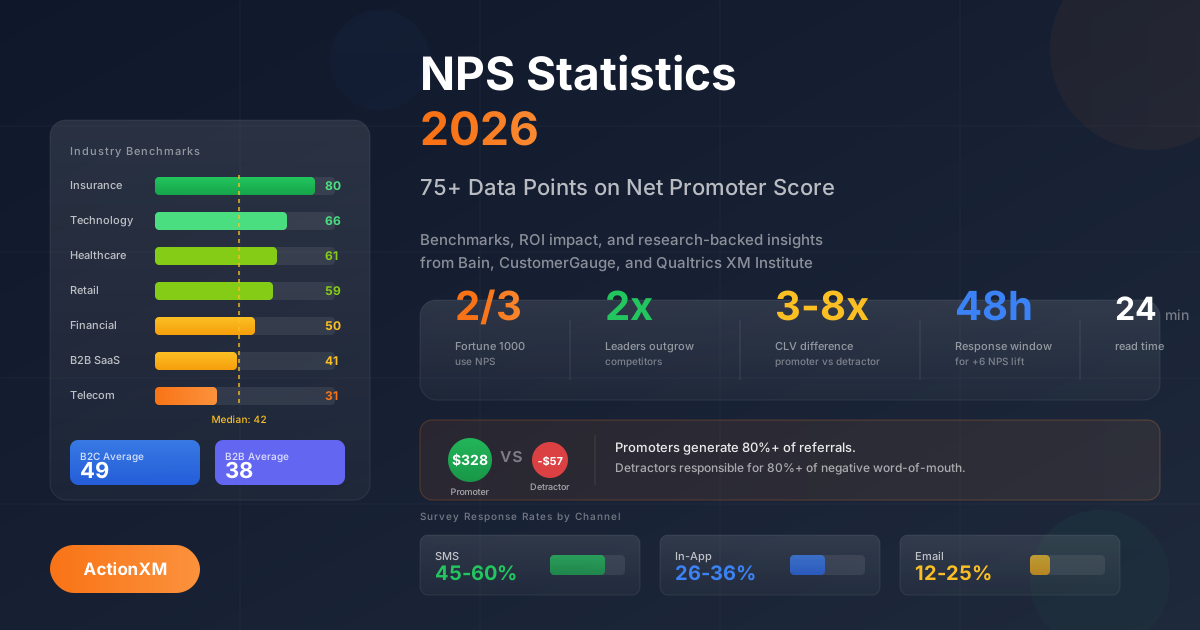
Response Rates by Channel
Key Response Rate Insights
- In-app surveys deliver 2x to 10x higher response rates than email
- SMS-collected NPS scores are 5-8 points higher than email surveys
- Strong NPS response rate in 2025: 30-40%
- B2B SaaS benchmark: 22% puts you ahead of 75% of peers
- Email completions dropped from 28% pre-pandemic to ~22% in 2025
Closed-Loop Feedback Impact
Acting on NPS feedback dramatically improves results.
Closed-Loop Statistics
| Metric | Impact |
|---|---|
| Companies prioritizing feedback | 85% report increased revenue |
| Closed-loop process retention lift | 10% increase |
| Customer satisfaction improvement | 15% from closed-loop feedback |
| Businesses following up with dissatisfied customers | Only 48% |
| 5% increase in retention | 25%+ profit increase |
Industry NPS Benchmarks 2026
How does your industry compare?
B2B vs. B2C Performance Gap
Regional and Cultural Differences
NPS scoring varies significantly by geography and culture.
Survey Methodology Statistics
Best practices for collecting reliable NPS data.
Survey Length Impact on Completion
Sample Size Requirements
| Confidence Level | Margin of Error | Required Sample |
|---|---|---|
| 95% | ±10% | 382 responses |
| 90% | ±15% | 118 responses |
Optimal Survey Timing
- Best days: Tuesday-Thursday
- Best time: 9-11 AM local time
- Peak open rates: 10 AM (21%) and 1 PM (22%)
- Transactional NPS: Within 0-24 hours of interaction
- Relational NPS: Quarterly
- Individual contact limit: No more than once per 90 days
Employee NPS (eNPS) Statistics
Employee Net Promoter Score provides insight into workforce engagement.
eNPS Statistics
| Industry | eNPS Score |
|---|---|
| Telecommunications | 27 (highest) |
| Healthcare | -6.5 (lowest) |
- High employee engagement leads to 23% more profit
- Every 1-point higher eNPS adds ~$940 per employee in financial growth
- Recommended eNPS survey frequency: Quarterly
NPS Leaders: Company Benchmarks
What scores do the top companies achieve?
What High-NPS Companies Have in Common
- Obsessive focus on reducing friction: Every touchpoint optimized for simplicity
- Personalization at scale: Using data to tailor experiences
- Proactive communication: Reaching out before problems escalate
- Empowered frontline teams: Staff can resolve issues without escalation
- Continuous feedback loops: Acting on customer input quickly
ROI of NPS Programs
Is investing in NPS measurement and improvement worth it?
ROI Statistics
| Metric | Impact |
|---|---|
| Brands acting on feedback | 25-95% increase in profitability |
| Each 1-point CX improvement | Tens to hundreds of millions in annual revenue (Forrester) |
| Health scoring implementation | 6-12 point NRR lift (mid-market SaaS) |
| Acquisition vs. retention cost | 5-25x more expensive to acquire |
| 5% retention increase | 25-95% profit increase |
Acquisition vs. Retention Economics
Why focusing on NPS-driven retention makes financial sense.
than retain
existing customers
existing vs. new customers
Conversion Probability
- New customer conversion rate: 5-20%
- Existing customer conversion rate: 60-70%
- Compensating for one lost customer requires acquiring three new customers
Key Takeaways
Start Measuring What Matters
Understanding NPS statistics is valuable, but acting on your own data is what drives results. ActionXM helps companies collect, analyze, and act on NPS feedback with AI-powered insights that identify exactly what’s driving your scores.
Ready to improve your NPS?
Sources
- Bain & Company - Net Promoter System
- CustomerGauge - NPS Impact on Revenue
- CustomerGauge - B2B NPS Benchmarks
- Qualtrics XM Institute - ROI of Customer Experience
- Survicate - NPS Benchmarks 2025
- Retently - Good Net Promoter Score 2026
- Forrester - Global NPS Rankings 2025
- London School of Economics - Advocacy Drives Growth (2005)
- McKinsey - Experience-Led Growth
- Harvard Business Review - The One Number You Need to Grow
- AIHR - Employee Net Promoter Score
- Genroe - NPS Churn Sensitivity
- Refiner - In-App Survey Response Rates
- HubSpot - International NPS Research
- Thematic - Close the Customer Feedback Loop
- Fortune - Net Promoter Score Analysis