The “Why” Gap in Every Survey Program
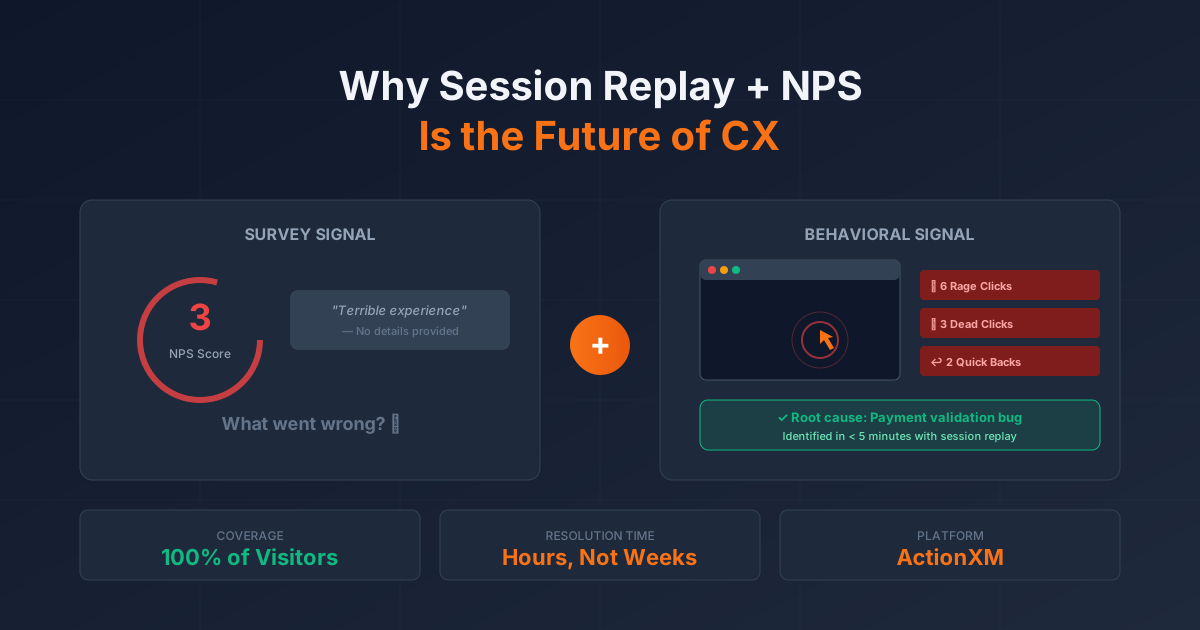
A customer scores your checkout experience a 3 out of 10. Your NPS dashboard lights up red. The CX team huddles around the screen, asking the same question they ask every week: why?
The survey told you what happened — a detractor. But it didn’t tell you why. Was it a confusing form field? A broken payment flow? A page that took 8 seconds to load on mobile? The survey can’t answer that. And the open-text comment — if one exists — says “terrible experience” with no specifics.
This is the “why” gap, and it sits at the center of every survey-only CX program.
Surveys Capture Sentiment. Behavior Captures Causation.
Traditional CX programs rely on a single signal: what customers tell you. NPS, CSAT, CES — these metrics are valuable, but they capture only one dimension of the experience.
What customers do tells a completely different story:
- Rage clicks on a button that doesn’t respond reveal a broken interaction
- Dead clicks on non-clickable elements expose confusing UI patterns
- Quick backs — navigating forward then immediately returning — signal content that doesn’t match expectations
- Excessive scrolling on a form page suggests fields are unclear or overwhelming
These behavioral signals happen whether or not a customer fills out a survey. They capture 100% of visitors, not just the 5-15% who respond to feedback requests.
The Survivorship Bias Problem
Survey-only programs suffer from a well-documented statistical flaw: survivorship bias. The customers who complete your survey are, by definition, the ones who stayed long enough to see it.
What about the visitors who:
- Abandoned checkout after a payment error and never came back
- Bounced from a landing page in under 3 seconds
- Tried to complete a form on mobile, hit a broken input, and left
- Experienced a JavaScript error that crashed the page
These visitors never fill out your survey. In a survey-only program, they don’t exist. But in a behavioral analytics program, every one of their sessions is captured, their frustration signals are detected, and their patterns contribute to your understanding of the experience.
A Tale of Two Approaches
The Survey-Only Workflow
Meet DataFlow, a fictional but realistic B2B SaaS company running a traditional CX program:
- Monday: Weekly NPS report shows mobile checkout NPS dropped from 54 to 42
- Tuesday: CX analyst exports survey responses to CSV, filters for detractors
- Wednesday: Cross-references with Google Analytics for session data — can’t match individual sessions to survey responses
- Thursday: Files a ticket to engineering: “Some customers are unhappy with mobile checkout”
- Week 2-3: Engineering asks for reproduction steps. No one has them.
- Week 4-6: After multiple back-and-forth exchanges, engineering finally investigates and finds a payment validation bug introduced 3 weeks ago
Time to resolution: 6 weeks. Hundreds of customers affected. Dozens churned.
The Behavioral + Survey Workflow
Now imagine DataFlow with session replay alongside their NPS program:
- 2:30 AM Saturday: CX Advisor detects NPS anomaly in mobile checkout segment
- Monday morning: CX analyst opens the insight, clicks into a detractor’s profile
- Same minute: Watches the 90-second session replay — sees the customer tap the “Place Order” button, nothing happens, taps again, taps 4 more times (rage click detected), navigates back, tries again, same result
- 10 minutes later: Creates a case directly from the profile with the session replay attached, routes to engineering
- That afternoon: Engineering watches the replay, identifies the payment validation bug, deploys a fix
- Next day: Follow-up micro-survey sent to affected customers — NPS recovers
Time to resolution: 1 business day. Root cause identified with video evidence.
The Frustration Score: A Behavioral Complement to NPS
While NPS measures what customers say about their experience, frustration scoring measures what they did during it. ActionXM’s frustration detection combines multiple behavioral signals into a single score:
- Rage clicks: Rapid repeated clicks on the same element (3+ clicks within 2 seconds)
- Dead clicks: Clicks on elements that produce no response or navigation
- Quick backs: Navigation to a page followed by an immediate return (within 3 seconds)
- Core Web Vitals degradation: Largest Contentful Paint, Cumulative Layout Shift, and Interaction to Next Paint exceeding thresholds
Each signal is weighted and combined into a frustration score per session. High-frustration sessions are automatically flagged, even if the visitor never sees a survey.
How Frustration Scoring Complements NPS
| Signal | NPS Captures | Frustration Score Captures |
|---|---|---|
| Customer sentiment | Yes | No |
| Specific UI failures | No | Yes |
| Non-respondent behavior | No | Yes |
| Root cause evidence | Rarely | Always (via replay) |
| Real-time detection | No (batch) | Yes (streaming) |
| 100% visitor coverage | No (5-15%) | Yes |
The most powerful insight comes from combining both: a customer who scored NPS 3 and had a frustration score of 87 in their checkout session. Now you have the sentiment and the video evidence of what went wrong.
Real-Time Behavioral Data vs. Weekly Survey Batches
Survey programs typically operate on batch cycles. Responses are collected over days or weeks, aggregated into reports, and reviewed in weekly or monthly meetings. By the time a trend surfaces, it’s already weeks old.
Behavioral analytics operates in real time. ActionXM’s session replay captures every interaction as it happens, and the frustration detection engine processes signals within seconds. When a deployment introduces a UI bug that causes rage clicks, the system detects it within minutes — not weeks.
This speed difference matters most during:
- Product launches: New features that break existing workflows
- Deploy rollouts: Code changes that introduce regressions
- Traffic spikes: Load-induced performance degradation
- Seasonal events: Black Friday, end-of-quarter, product launches
In each case, the behavioral signal arrives before the survey signal — often by days or weeks.
The Integration Problem (And Why “Single Platform” Matters)
Most enterprise CX programs today use separate tools for surveys and behavioral analytics. Qualtrics for NPS, Hotjar or FullStory for session replay, Google Analytics for traffic data. Each tool has its own data model, its own identity system, and its own dashboard.
The result is a fractured view of the customer:
- Survey tool knows customer sentiment but not what they did
- Session replay tool knows behavior but not who the customer is
- Analytics tool knows traffic patterns but not individual experiences
Stitching these together requires data exports, identity matching across platforms, and custom integrations. It’s expensive, fragile, and often incomplete.
ActionXM combines session replay, surveys, and identity resolution on a single platform. When a customer submits an NPS response, their entire behavioral history is one click away — same profile, same timeline, same identity graph. No CSV exports. No cross-platform matching. No integration middleware.
- • 3-5 vendor contracts
- • Custom identity stitching
- • CSV export/import cycles
- • Weeks to cross-reference
- • Single data model
- • Automatic identity resolution
- • One-click from survey to replay
- • Real-time correlation
Five Signals That Reveal What Surveys Can’t
1. The Silent Abandoner
A visitor spends 4 minutes filling out a multi-step form, reaches the payment page, encounters a validation error, and leaves. They never see a survey. In a survey-only program, this visitor doesn’t exist. With session replay, their frustration is captured in full detail.
2. The Mobile Struggle
A customer on an older Android device experiences layout shift that moves the “Submit” button just as they tap it. They accidentally hit “Cancel” instead. The survey (if they ever see one) might say “hard to use on mobile.” The session replay shows exactly why — with timestamps, device info, and the specific CSS rendering issue.
3. The Confused Navigator
A visitor lands on your pricing page, scrolls down, scrolls back up, clicks FAQ, returns to pricing, opens a chat widget, closes it, and eventually leaves. This pattern — high engagement but no conversion — suggests confusion about your offering. Surveys rarely capture “I didn’t understand your pricing page” because confused visitors don’t stick around for feedback.
4. The Error-Blind User
A JavaScript error crashes part of your page, but the rest still loads. The visitor doesn’t see the broken component, doesn’t know they’re missing functionality, and rates the experience as “fine.” Behavioral monitoring catches the error, the missing interaction, and the revenue impact of the hidden failure.
5. The Repeat Offender
A customer hits the same friction point across 5 visits over 2 weeks. Each visit they work around the issue. Their survey response says “mostly satisfied” because they’ve adapted. But the behavioral data shows 5 sessions of workaround behavior — a clear signal that the UX needs fixing even though the survey says everything is fine.
Building Your Combined CX Program
If you’re currently running a survey-only program and want to add behavioral analytics, here’s a practical roadmap:
Phase 1: Instrument (Week 1)
Deploy session replay alongside your existing survey program. ActionXM’s SDK is a single script tag — no manual event tagging required. The Application Genome automatically classifies page elements and starts tracking interactions from the first page load.
Phase 2: Correlate (Week 2-3)
Connect survey responses to behavioral sessions. When a customer submits NPS feedback, their session replay is automatically linked to the same profile through identity resolution. Start reviewing detractor sessions to understand the “why” behind low scores.
Phase 3: Detect (Week 4+)
Enable frustration detection to surface high-friction sessions proactively. Set up CX Advisor to monitor behavioral metrics on a heartbeat schedule. Start receiving insights before customers complain — or before they complete a survey.
Phase 4: Act (Ongoing)
Use the combined signal — sentiment from surveys, evidence from session replay — to create cases with full context. Route to the right team with the replay attached. Measure resolution time and track NPS recovery for affected segments.
The Data Behind the Approach
Organizations that combine behavioral analytics with traditional survey programs see measurable improvements:
The speed advantage alone justifies the investment. When you can watch a detractor’s session within seconds of receiving their survey response, the feedback loop shrinks from weeks to hours.
What This Means for Your CX Program
The future of customer experience isn’t surveys or behavioral analytics. It’s both, unified on a single platform, with identity resolution connecting every signal to a complete customer profile.
If you’re running NPS today without session replay, you’re seeing the what without the why. If you’re running session replay without surveys, you’re seeing the what happened without the how they feel. The combination — behavioral observation plus direct feedback — gives you the complete picture.
ActionXM is the only platform that provides both natively: DXA (session replay, heatmaps, frustration detection) and VoC (surveys, NPS, CSAT, CES) on the same infrastructure, with the same identity graph, in the same dashboard. No integration tax. No identity stitching. No data exports.
One click from a detractor score to their session replay. That’s the future of CX.