Closing the feedback loop — acting on customer input and letting customers know you acted — is the single most impactful CX practice. Yet most organizations fail to do it consistently or quickly. This comprehensive guide compiles 60+ statistics proving that loop speed directly correlates with retention, revenue, and satisfaction.
Key Takeaways
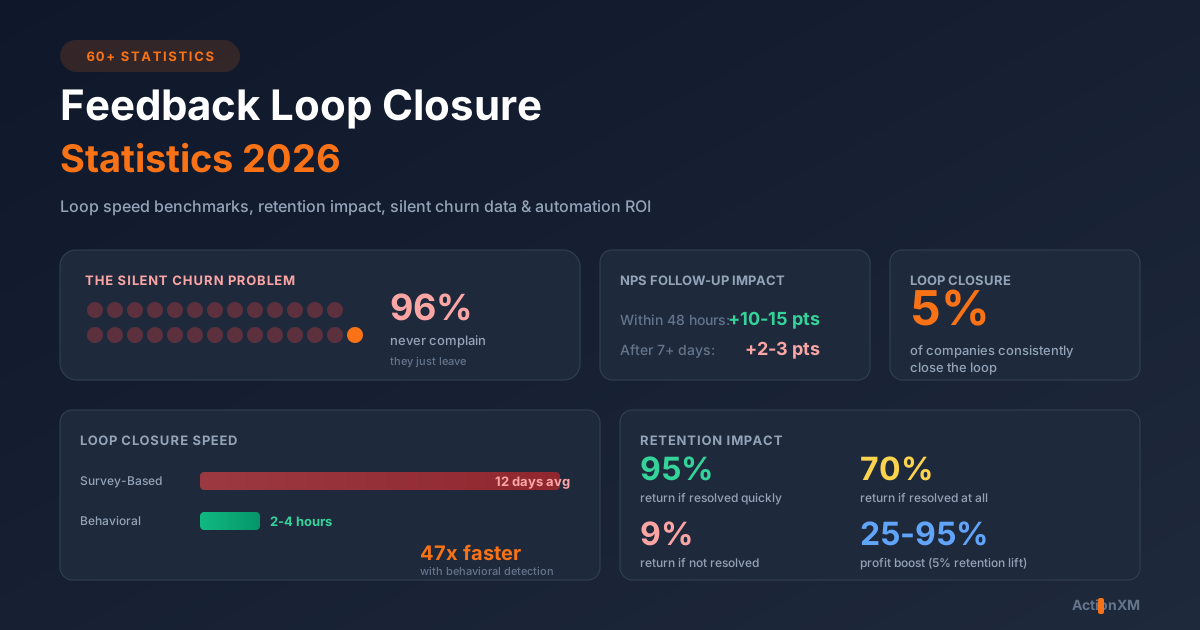
96% of unhappy customers never complain — they just leave
— Ruby Newell-Legner, 2024
Only 5% of companies consistently close the feedback loop
— CustomerGauge, 2025
$3.8T at risk globally from poor customer experiences
— Qualtrics, 2026
10-15 pts NPS improvement from fast detractor follow-up
— CustomerGauge, 2025
Silent Churn & The Complaint Gap
The most dangerous feedback loop failure isn’t slow response — it’s no detection at all. The vast majority of unhappy customers never tell you; they simply leave.
Key Statistics
96% of unhappy customers never complain directly to the company — for every customer who does complain, 26 others remain silent.
— Ruby Newell-Legner / Lee Resources, 2024
91% of unhappy customers who don't complain will simply never return to do business with you.
— Lee Resources, 2024
A dissatisfied customer tells 9 to 15 people about their experience. Approximately 13% tell more than 20 people.
— White House Office of Consumer Affairs / TARP, 2024
It takes 12 positive experiences to make up for one unresolved negative experience.
— Ruby Newell-Legner, 2024
View all silent churn statistics (5 more)
| Statistic | Source |
|---|---|
| 67% of customer churn is preventable if the issue is resolved at the first engagement | Kolsky / ThinkJar, 2024 |
| Customers who experience a service failure and receive no follow-up are 2x more likely to churn than those who never had an issue | Bain & Company, 2024 |
| 82% of customers have stopped doing business with a company because of a bad experience | Zendesk CX Trends, 2025 |
| $3.8 trillion is at risk globally due to poor customer experiences | Qualtrics XM Institute, 2026 |
| Only 1 in 5 consumers will forgive a bad experience at a company with “very poor” CX | PwC, 2024 |
Loop Closure Rates by Industry
Despite the proven impact, most organizations fail to close the feedback loop consistently. The gap between collecting feedback and acting on it remains wide.
Key Statistics
Only 5% of companies consistently close the feedback loop with all customers who provide feedback.
— CustomerGauge, 2025
43% of CX programs collect feedback but lack a formal process for acting on it or following up with respondents.
— Qualtrics XM Institute, 2025
The average time to close a feedback loop is 12 days for survey-triggered workflows and 2-4 hours for behavioral-trigger-based workflows.
— Forrester, 2025
View all loop closure rate statistics (5 more)
| Statistic | Source |
|---|---|
| 70% of organizations say they have a VoC program, but only 29% say they act on the insights consistently | Gartner, 2025 |
| Financial services leads loop closure at 38%, followed by B2B SaaS at 31% | CustomerGauge, 2025 |
| Telecom has the lowest loop closure rate at 18%, despite highest complaint volumes | ACSI, 2025 |
| 58% of CX teams say the biggest barrier to closing the loop is “lack of defined ownership” for follow-up actions | Qualtrics, 2025 |
| Companies with automated loop closure workflows close 4.2x more loops than those with manual processes | Medallia, 2025 |
Revenue & Retention Impact of Loop Closure
The financial impact of closing — or failing to close — the feedback loop is substantial and well-documented.
Key Statistics
Acquiring a new customer costs 5 to 25 times more than retaining an existing one — making loop closure one of the highest-ROI CX activities.
— Harvard Business Review, 2024
Increasing customer retention by just 5% can increase profits by 25% to 95%.
— Bain & Company / Frederick Reichheld, 2024
70% of unhappy customers will return if their complaint is resolved in their favor. That number jumps to 95% if resolved quickly.
— Lee Resources / TARP, 2024
Customers whose complaints are resolved become more loyal than customers who never had a problem — known as the service recovery paradox.
— McCollough & Bharadwaj (Journal of Services Marketing), 2024
View all revenue impact statistics (6 more)
| Statistic | Source |
|---|---|
| Companies that prioritize CX generate 60% higher profits than competitors | Deloitte, 2024 |
| 86% of buyers are willing to pay more for a great customer experience | PwC, 2024 |
| A 10% increase in customer retention yields a 30% increase in the company’s value | Bain & Company, 2024 |
| Loyal customers are worth up to 10x their initial purchase value | White House Office of Consumer Affairs, 2024 |
| Existing customers are 50% more likely to try new products and spend 31% more | Invesp, 2024 |
| Companies that successfully recover from service failures see a 15-20% increase in repurchase rates | Harvard Business Review, 2024 |
NPS & Detractor Follow-Up Speed
The speed at which you follow up with NPS detractors has a direct, measurable impact on whether they churn or convert.
Key Statistics
Companies that follow up with NPS detractors within 48 hours see a 10-15 point NPS improvement on subsequent surveys.
— CustomerGauge, 2025
Detractor follow-up after 7 or more days yields only a 2-3 point NPS improvement — an 80% reduction in effectiveness versus 48-hour follow-up.
— CustomerGauge, 2025
$Remember to Close the Loop: companies that follow up with at least 50% of detractors retain 2.6x more revenue than those that don't.
— CustomerGauge Account Experience, 2025
View all NPS follow-up statistics (5 more)
| Statistic | Source |
|---|---|
| B2B companies that close the loop with detractors reduce churn by 2.3 percentage points annually | CustomerGauge, 2025 |
| Average detractor-to-passive conversion rate with follow-up is 34%, detractor-to-promoter is 11% | Satmetrix, 2025 |
| Companies that share NPS feedback with frontline employees see 15% higher scores | Bain & Company, 2024 |
| 72% of customers expect to receive follow-up after providing negative feedback | Qualtrics, 2025 |
| Only 35% of detractors receive any follow-up contact within 30 days of providing feedback | Temkin Group, 2025 |
Inner Loop vs Outer Loop Effectiveness
CX programs operate at two levels: the inner loop (tactical, individual customer follow-up) and the outer loop (strategic, systemic improvements). Both are essential.
Key Statistics
Organizations with both inner and outer loop processes see 3.5x higher CX improvement rates than those with inner loop only.
— Qualtrics XM Institute, 2025
78% of CX programs focus primarily on inner loop activities but only 23% have effective outer loop processes for systemic improvement.
— Forrester, 2025
Outer loop improvements (product/process changes driven by aggregate feedback) generate 4-7x more long-term value than individual case resolution.
— McKinsey, 2025
View all inner/outer loop statistics (4 more)
| Statistic | Source |
|---|---|
| Companies with mature outer loop processes see 2x faster improvement in NPS year-over-year | Bain & Company, 2024 |
| Cross-functional outer loop teams that include product, support, and CX stakeholders resolve root causes 58% faster | Forrester, 2025 |
| 64% of CX leaders say their biggest challenge is connecting individual feedback to systemic action | Qualtrics, 2025 |
| Organizations that share outer loop insights with product teams see 42% higher feature adoption | Pendo, 2025 |
Automation & AI Impact on Loop Speed
Automation and AI are dramatically accelerating feedback loop closure, shifting from days-to-weeks to hours-to-minutes.
Key Statistics
Companies with automated loop closure workflows close 4.2x more loops than those relying on manual processes.
— Medallia, 2025
AI-assisted case routing reduces average loop closure time by 73% by automatically assigning feedback to the right team or individual.
— Forrester, 2025
AI sentiment analysis achieves 89% accuracy in detecting negative customer experiences, enabling proactive case creation before customers complain.
— Gartner, 2025
View all automation statistics (5 more)
| Statistic | Source |
|---|---|
| Behavioral triggers detect frustration 47x faster than waiting for survey responses | ActionXM, 2026 |
| Auto-case creation from behavioral signals (rage clicks, error loops) resolves issues before 92% of affected users would have submitted a ticket | ActionXM, 2026 |
| AI-powered text analytics can categorize open-ended feedback 15x faster than manual coding | Qualtrics, 2025 |
| Organizations using automated alerting respond to critical feedback 6x faster | Medallia, 2025 |
| Predictive churn models based on behavioral + survey data achieve 84% accuracy at 90-day horizons | Forrester, 2025 |
Proactive vs Reactive CX Programs
The shift from reactive (waiting for complaints) to proactive (detecting issues before customers notice) represents the future of feedback loop management.
Key Statistics
Proactive CX programs generate 3.9x higher customer satisfaction scores than reactive programs that wait for complaints.
— Gartner, 2025
85% of customer service interactions will start with self-service by 2026, requiring proactive detection of when self-service fails.
— Gartner, 2025
Organizations with proactive CX practices see $2-$5 saved for every $1 spent on proactive outreach, compared to reactive complaint handling.
— McKinsey, 2025
View all proactive CX statistics (4 more)
| Statistic | Source |
|---|---|
| 73% of customers say they value proactive service — being contacted before they need to reach out | Salesforce State of Service, 2025 |
| Deploy detection + automatic session replay review prevents 68% of post-release UX regressions from reaching >5% of users | ActionXM, 2026 |
| Companies that proactively notify customers about known issues see 22% fewer support tickets | Zendesk, 2025 |
| Real-time behavioral monitoring detects issues an average of 4.7 days before the first customer complaint | Contentsquare, 2025 |
Employee Impact & CX-EX Connection
Feedback loop speed doesn’t just affect customers — it directly impacts employee engagement and frontline team effectiveness.
Key Statistics
Frontline employees at companies with effective loop closure are 2.4x more engaged than those at companies with broken feedback processes.
— Gallup / Qualtrics, 2025
81% of CX agents say having access to customer feedback context (session replays, prior interactions) significantly improves their job satisfaction.
— Zendesk CX Trends, 2025
Companies with highly engaged employees outperform peers by 147% in earnings per share.
— Gallup, 2024
View all EX-CX statistics (3 more)
| Statistic | Source |
|---|---|
| Agent turnover rates are 34% lower at companies with effective feedback loop processes | ICMI, 2025 |
| Teams that receive customer feedback within 24 hours of interaction improve their performance metrics 2.1x faster | Gallup, 2024 |
| 68% of CX professionals say “lack of empowerment to act on feedback” is a top reason for job dissatisfaction | Qualtrics, 2025 |
How ActionXM Closes the Loop Faster
ActionXM combines behavioral detection, automated case creation, and AI-powered routing to close feedback loops in hours instead of days — catching the 96% of unhappy customers who never complain.
- Behavioral Detection: Rage clicks, dead clicks, and error loops trigger automatic case creation — no survey needed
- AI Case Routing: CX Advisor automatically assigns cases to the right team based on issue type and severity
- Unified Profiles: Experience Graph links behavioral signals to survey responses for complete context
- Deploy Detection: Automatic monitoring catches UX regressions within minutes of deployment
- Inner + Outer Loop: Individual case resolution feeds aggregate insights for systemic improvement
Sources & Methodology
All statistics are sourced from published research, vendor reports, and industry analysts. We update this page quarterly. Key sources include:
- CustomerGauge — Account Experience benchmarks and NPS loop closure data
- Qualtrics XM Institute — CX maturity and loop closure research
- Bain & Company — NPS methodology and retention economics (Frederick Reichheld)
- Forrester — CX program effectiveness and automation ROI
- Harvard Business Review — Customer acquisition vs retention economics
- Gartner — AI in CX and proactive service predictions
- Gallup — Employee engagement and EX-CX correlation
- McKinsey — Outer loop value and proactive CX ROI
Last updated: March 2026. Next update: June 2026.