Customer Effort Score (CES) has emerged as one of the most powerful predictors of customer loyalty. Unlike satisfaction metrics that measure how customers feel, CES measures what actually drives behavior—how easy it is to do business with you.
This comprehensive statistics page compiles 65+ impactful CES data points from Gartner, Forrester, McKinsey, and leading CX research firms. Every statistic is sourced, citable, and designed to help you build the business case for effort reduction.
Key Takeaways
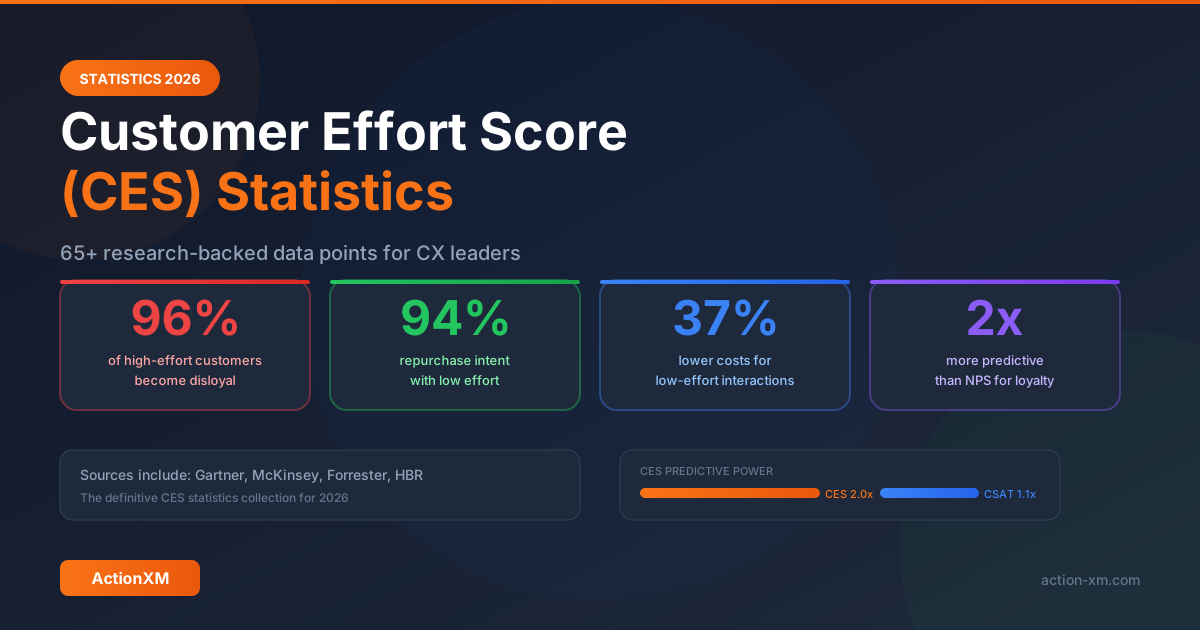
96% of high-effort customers become disloyal
— Gartner "Effortless Experience" Research
94% repurchase intent with low-effort experiences
— Gartner Research
37% lower costs for low-effort interactions
— Gartner
2x more predictive of loyalty than NPS
— Gartner Research
CES and Customer Loyalty
The foundational research from Gartner’s “Effortless Experience” study of 97,000 customers established effort as the primary driver of loyalty and disloyalty.
Key Statistics
96% of customers with high-effort service interactions become more disloyal, compared to only 9% with low-effort experiences.
— Gartner "Effortless Experience" Research
94% of customers with low-effort experiences intend to repurchase, compared to only 4% experiencing high effort.
— Gartner Research
88% of low-effort customers say they would increase their spending with the company.
— Harvard Business Review
View all loyalty statistics (3 more)
| Statistic | Source |
|---|---|
| Customer service interactions are 4x more likely to drive disloyalty than loyalty | CEB (97,000 customer study) |
| Customer effort is 40% more accurate at predicting customer loyalty than satisfaction scores | Gartner |
| Increasing CES from 1 to 5 creates a 22% increase in customer loyalty | CEB Original Study |
CES Predictive Power vs. Other Metrics
Understanding how CES compares to other experience metrics is crucial for deciding where to focus measurement efforts.
Source: Gartner Research
Key Statistics
CES is 1.8x more predictive of customer loyalty than CSAT and 2x more predictive than NPS.
— Zonka Feedback / Gartner Research
NPS is 65 points higher for low-effort companies than for high-effort companies.
— Gartner
Customer effort is 40% more accurate at predicting customer loyalty than customer satisfaction scores.
— Gartner
View all metric comparison statistics (3 more)
| Statistic | Source |
|---|---|
| Satisfaction with the entire customer journey is 32% more predictive of loyalty than satisfaction with a single touchpoint | McKinsey |
| For every 10-percentage-point increase in customer satisfaction, companies can achieve 2-3% higher revenue | McKinsey |
| Increasing CES from 1 to 5 creates a 22% increase in customer loyalty | CEB Original Study |
Cost and ROI of Effort Reduction
Reducing customer effort doesn’t just improve experience—it directly reduces operational costs and drives revenue growth.
Key Statistics
Low-effort interactions cost 37% less than high-effort interactions.
— Gartner
A midsize call center saves an average of $286,000 annually with just a 1% improvement in first contact resolution.
— SQM Group
Online retailers face $22 million in average unnecessary costs due to channel escalation from high-effort interactions.
— Forrester
View all cost & ROI statistics (5 more)
| Statistic | Source |
|---|---|
| 40% reduction in repeat calls when customer effort is minimized | Gartner |
| 50% fewer escalations when low-effort experiences are delivered | Gartner |
| Customers spend 42% less time resolving issues when effort is reduced | Sobot |
| $28,000/month savings by improving FCR from 50% to 75% in a 4,000 call/month environment | Giva |
| $6,000-$20,000 cost to replace a single call center agent | Nextiva |
Channel Switching and Omnichannel Statistics
Channel transitions represent one of the biggest sources of customer effort—and one of the most fixable.
Key Statistics
62% of customer service channel transitions are classified as "high-effort" by customers.
— Gartner, 2023
Low-effort experiences result in 54% less channel switching compared to high-effort experiences.
— Gartner
An average of 4 minutes of costly rep time is saved per customer journey with seamless channel transitions.
— Gartner
View all channel switching statistics (4 more)
| Statistic | Source |
|---|---|
| 73% of customers use multiple channels during their service journey | CX Today |
| 80% of consumers have switched brands due to poor customer experience | Qualtrics |
| 74% of customers who experience easy transitions will return to self-service next time | CX Today |
| 31% faster first resolution for companies with integrated omnichannel solutions | Plivo |
Word-of-Mouth and Referral Impact
High-effort experiences don’t just lose customers—they spread negative word-of-mouth that damages your brand at scale.
Key Statistics
81% of high-effort customers share negative feedback about their experience, compared to only 1% of low-effort customers.
— Zonka Feedback
Dissatisfied customers tell 9-15 people about their negative experiences on average.
— ReferralCandy
It takes 40 positive customer experiences to undo the damage of a single negative review.
— WebFX
View all word-of-mouth statistics (4 more)
| Statistic | Source |
|---|---|
| 45% of global customers tell family or friends about negative brand experiences | Digital Silk |
| 91% of unhappy customers will leave without complaining—they just churn silently | Help Scout |
| 33% of U.S. consumers consider switching companies after just a single poor service instance | Nextiva |
| U.S. companies lose an estimated $75 billion annually due to poor customer service | Qualtrics |
First Contact Resolution Statistics
First Contact Resolution (FCR) is directly correlated with customer effort—when issues resolve on the first contact, effort drops dramatically.
Source: Qualtrics, SQM Group
Key Statistics
30% of calls are repeat/callback calls due to first contact resolution failure.
— SQM Group
40% of customers defect to another company when first contact resolution doesn't occur.
— SQM Group
80% of service professionals now track FCR as a key metric, up from 51% in 2018.
— Salesforce
View all FCR statistics (2 more)
| Statistic | Source |
|---|---|
| 15% satisfaction drop for each callback a customer must make to a call center | SQM Group |
| 39% decrease in customer wait times with omnichannel integration | Plivo |
Self-Service and Proactive Support Statistics
Self-service represents a major opportunity to reduce effort—when done right. Customers overwhelmingly prefer finding answers themselves.
Key Statistics
Only 14% of customer service issues are fully resolved through self-service channels.
— Gartner, 2024
81% of customers attempt to resolve issues themselves before contacting support.
— Document360
Proactive customer service can deliver a 25% reduction in incoming call volume.
— NICE
View all self-service & proactive support statistics (4 more)
| Statistic | Source |
|---|---|
| 92% of consumers would use a knowledge base for self-support if available | Pylon |
| 40-60% query deflection with well-designed self-service portals | Document360 |
| 67% of customer churn can be prevented through proactive issue resolution | SparrowDesk |
| $5 million churn reduction opportunity identified by TELUS through proactive customer recovery | InMoment |
CES Benchmarks by Industry
Industry benchmarks help contextualize your CES performance against peers and identify where your organization stands.
Key Statistics
Gartner CES Benchmark: Scores below 70% indicate areas for improvement; above 90% indicates strong performance.
— Gartner
eCommerce leaders achieve CES scores of 5.8+ on a 7-point scale.
— Opensend
View all benchmark statistics (3 more)
| Statistic | Source |
|---|---|
| FCR benchmarks: Retail leads at 78%, Healthcare at 72%, Tech Support at 65%, Telecom at 61% | SQM Group |
| Banking leads CES scores at 4.4/5.0 on a 5-point scale | CEB / Temkin Group |
| Telecom industry trails at 3.6/5.0 average CES score | CEB / Advisory Board |
Employee Experience Connection
The link between employee experience and customer effort is well-documented—employees who are empowered and engaged deliver lower-effort experiences.
Key Statistics
83.4% of CX leaders agree that employee experience has a quantifiable impact on customer experience.
— CX Network
Employee retention increases by 17% when service reps consistently deliver low-effort customer experiences.
— Gartner
Contact centers experience 30-45% annual turnover, with each agent replacement costing $6,000-$20,000.
— Nextiva
Cost Per Contact Benchmarks
Understanding cost per contact helps quantify the ROI of effort reduction across different support channels.
Key Statistics
Human phone support costs an average of $6.00 per contact, while chatbot interactions cost just $0.50—a 12x difference.
— LiveChatAI, Klipfolio
Industry average cost per contact ranges from $2 to $15, depending on complexity and channel.
— Teneo
How to Use These Statistics
These CES statistics can support your business case for effort reduction initiatives:
For Executive Presentations: Lead with the 96% disloyalty statistic and the 37% cost reduction figure to establish both the risk of inaction and the financial opportunity.
For Budget Requests: Use the $286,000 annual savings and specific ROI figures to demonstrate return on investment. Click the “Copy” button on any statistic to copy the full citation including source.
For Team Training: Share the predictive power comparison (CES vs. CSAT vs. NPS) to help teams understand why effort matters more than satisfaction.
For Benchmarking: Use industry-specific benchmarks to contextualize your current performance and set improvement targets.
Methodology & Sources
This statistics compilation draws from leading research organizations, consulting firms, and industry reports including:
- Gartner - Effortless Experience research and CES best practices
- Harvard Business Review - Stop Trying to Delight Your Customers
- The Effortless Experience (CEB) - 97,000 customer study
- McKinsey & Company - Customer experience and loyalty research
- Forrester Research - CX Index rankings and channel research
- SQM Group - First call resolution research
- Zonka Feedback - CES methodology and benchmarks
- Qualtrics - Customer effort score guides
All statistics are verified against original sources and updated quarterly to ensure accuracy and relevance.
Related Resources
- Complete CES Guide - Everything you need to know about measuring CES
- Customer Experience Statistics 2026 - 60+ broader CX data points