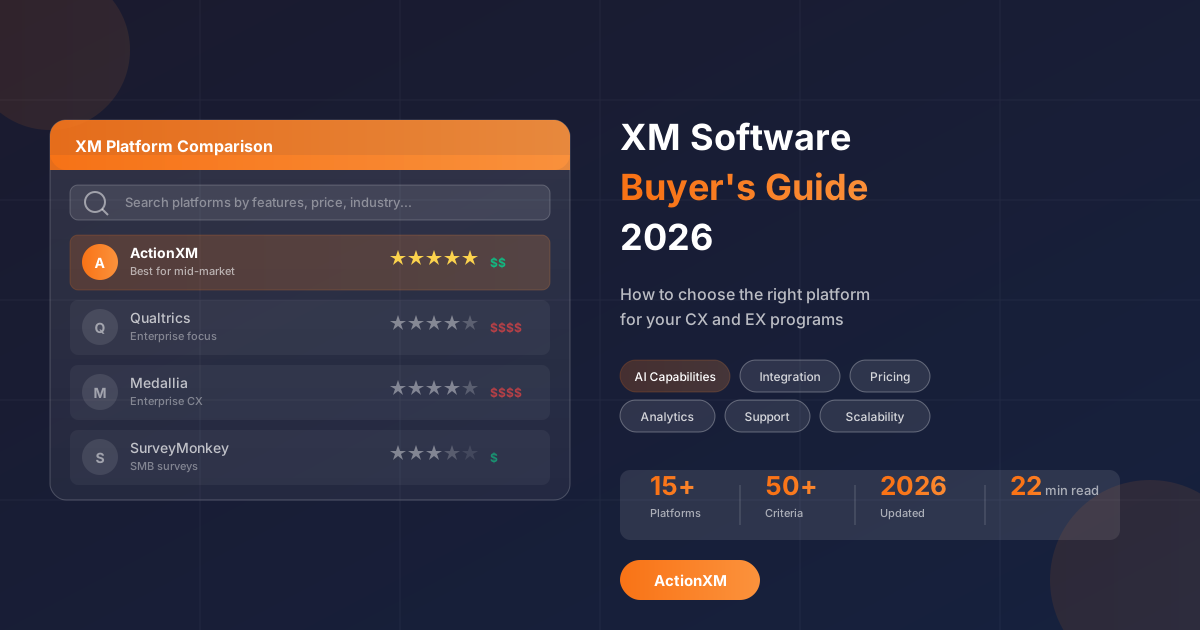
Choosing the right experience management (XM) software is one of the most consequential technology decisions your organization will make. Get it right, and you’ll unlock insights that drive revenue, retention, and employee engagement. Get it wrong, and you’ll spend years wrestling with complexity, hidden costs, and tools that collect data but don’t drive action.
This guide cuts through the marketing noise. Based on extensive market research, analyst reports, and real implementation data, we’ll help you navigate the XM landscape, understand what actually matters, and make a decision you won’t regret.
The Experience Management Market: 2026 Landscape
The XM software market has matured rapidly—and grown significantly. Understanding where it’s headed helps contextualize your investment.
Market Size and Growth
Sources: GM Insights, Gartner, industry analysis
The market isn’t just growing—it’s transforming. AI capabilities that were premium add-ons in 2024 are now table stakes. Cloud deployment has become the default. And the line between customer experience (CX) and employee experience (EX) platforms continues to blur.
Key Market Players
The XM market is dominated by a handful of enterprise vendors, but a long tail of specialized players serves specific use cases effectively.
| Tier | Players | Characteristics |
|---|---|---|
| Enterprise Leaders | Qualtrics, Medallia, SAP | Full-suite platforms, $100K+ implementations |
| Enterprise Challengers | InMoment, Forsta, Confirmit | Deep analytics, research methodology focus |
| Mid-Market Leaders | ActionXM, Alchemer, Culture Amp | Balance of capability and accessibility |
| Specialized Tools | AskNicely, Delighted, Hotjar | Focused excellence in specific use cases |
| Point Solutions | SurveyMonkey, Typeform, Nicereply | Survey-first, simpler requirements |
The XM Platform Decision Framework
Before evaluating specific vendors, establish your requirements framework. The most common mistake organizations make is starting with feature comparisons before understanding their actual needs.
Step 1: Identify Your Primary Use Case
Your dominant use case should drive platform selection. Trying to boil the ocean with a single platform often leads to mediocre results across all dimensions.
- NPS/CSAT/CES measurement
- Customer journey feedback
- Voice of Customer (VoC)
- Closed-loop follow-up
- Churn prediction
- Engagement surveys
- Pulse feedback
- 360-degree reviews
- Onboarding experience
- Exit interviews
- Concept testing
- Brand tracking
- Competitive analysis
- Pricing research
- Ad effectiveness
- In-app surveys
- Feature feedback
- Usability testing
- Beta feedback
- Roadmap input
Step 2: Assess Your Organizational Maturity
Your current XM maturity level determines which platform capabilities you’ll actually use versus which you’ll pay for but never leverage.
Key insight: Most organizations overestimate their maturity. A Level 2 organization buying a Level 4 platform will struggle to realize value—and pay for capabilities they can’t leverage.
Critical Evaluation Criteria
Once you’ve established your use case and maturity level, evaluate platforms against these criteria. Not all criteria matter equally for every organization—weight them according to your priorities.
1. Survey Capabilities
The foundation of any XM platform. But “survey capabilities” encompasses far more than question types.
| Capability | Why It Matters | Questions to Ask |
|---|---|---|
| Question types | Different research needs require different formats | How many question types? Do they include NPS, CSAT, CES, matrix, ranking, slider? |
| Logic and branching | Personalized surveys improve data quality | Can surveys branch based on responses? Can you pipe answers forward? |
| Distribution channels | Meet customers where they are | Email, SMS, in-app, web intercept, QR code, kiosk? |
| Survey design | Brand consistency and mobile experience | Can you fully customize design? Is mobile optimization automatic? |
| Multi-language | Global programs need localization | How many languages? Is translation management included? |
| Survey throttling | Prevent survey fatigue | Can you limit survey frequency per customer? |
Red flags to watch for:
- Per-response pricing that makes volume expensive
- Limited skip logic or branching
- Poor mobile experience
- No survey preview/testing capability
2. Analytics and Insights
Data collection without insight is just noise. Evaluate how the platform transforms responses into actionable intelligence.
| Capability | Why It Matters | Questions to Ask |
|---|---|---|
| Real-time dashboards | Speed enables action | How quickly do responses appear? Can you filter in real-time? |
| Trend analysis | Patterns matter more than snapshots | Can you track metrics over time? Compare periods? |
| Segmentation | Different customers have different needs | Can you segment by customer attributes, behaviors, responses? |
| Text analytics | Verbatim feedback holds insights | Is sentiment analysis included? Theme detection? |
| AI capabilities | Scale insight discovery | What AI features are native vs. add-on? What do they cost? |
| Benchmarking | Context for your scores | Are industry benchmarks available? How accurate and current? |
The AI question: Every vendor now claims “AI-powered insights.” Dig deeper:
Some platforms gate AI behind expensive tiers.
"AI" can mean keyword matching or genuine NLP.
Industry-specific language needs customization.
Non-English analysis is often limited.
Ask for validation data, not marketing claims.
3. Closed-Loop Action Management
Collecting feedback without acting on it is worse than not collecting it at all. Evaluate how the platform enables response.
| Capability | Why It Matters | Questions to Ask |
|---|---|---|
| Alerting | Timely notification enables rescue | Real-time alerts? Customizable thresholds? Channel options? |
| Case management | Track issues to resolution | Built-in ticketing? Integration with existing systems? |
| Workflow automation | Scale your response capacity | Rule-based routing? SLA tracking? Escalation paths? |
| Response templates | Consistency and efficiency | Pre-built responses? Customizable templates? |
| Resolution tracking | Measure closed-loop effectiveness | Can you track time-to-resolution? Outcome tracking? |
The closed-loop gap: This is where most organizations fail. According to research, fewer than 30% of organizations effectively close the loop on customer feedback. The platform should make this easier, not harder.
4. Integration Capabilities
XM platforms don’t operate in isolation. Integration with your existing tech stack determines practical value.
| Integration Type | Examples | Why It Matters |
|---|---|---|
| CRM | Salesforce, HubSpot, Dynamics | Link feedback to customer records and revenue |
| Support | Zendesk, Intercom, Freshdesk | Trigger surveys based on support interactions |
| Communication | Slack, Teams, Email | Deliver insights where teams work |
| Analytics | Tableau, Power BI, Looker | Combine with other business data |
| Data warehouse | Snowflake, BigQuery, Redshift | Enterprise data strategy alignment |
| Marketing automation | Marketo, Pardot, HubSpot | Close the loop through existing channels |
Integration depth matters: “Integrates with Salesforce” can mean anything from a basic data push to bi-directional sync with workflow triggers. Always verify:
- Is it native or via Zapier/third-party?
- One-way or bi-directional?
- Real-time or batch sync?
- What data fields transfer?
- Who maintains the integration?
5. Total Cost of Ownership
The sticker price is never the full cost. Build a comprehensive TCO model before committing.
Common cost surprises:
| Cost Category | What to Watch |
|---|---|
| Per-response fees | Can explode costs at scale; calculate for 2-3x current volume |
| User tiers | ”Admin” vs. “viewer” licenses often priced differently |
| Premium features | AI, advanced analytics, API access often gated |
| Support levels | Standard support may be limited; premium support adds cost |
| Contract terms | Multi-year discounts vs. flexibility trade-off |
| Price increases | What happens at renewal? Get it in writing |
Platform Comparison: 2026 Market Leaders
Based on market research, analyst reports, and user feedback, here’s how the leading platforms compare.
Enterprise Platforms Comparison
| Dimension | Qualtrics | Medallia | InMoment | ActionXM |
|---|---|---|---|---|
| Best for | Research methodology | Omnichannel CX | AI-driven insights | Mid-market + Enterprise |
| Deployment | Weeks to months | 3-6 months | Weeks to months | Days to weeks |
| Survey depth | 100+ question types | Comprehensive | Focused on key metrics | Comprehensive + simple |
| AI capabilities | Stats iQ, Predict iQ | Athena AI | Advanced NLP | Native AI included |
| Closed-loop | Configurable | Strong | Strong | Automated |
| Pricing model | Complex, volume-based | Unit-based | Custom | Transparent |
| Starting investment | $27K+/year | $100K+/year | Custom | Clear, fair |
| Training required | Extensive | Extensive | Moderate | Minimal |
| G2 Rating | 4.4/5 | 4.5/5 | 4.3/5 | — |
Mid-Market & Specialized Platforms
| Dimension | Culture Amp | Alchemer | Hotjar | AskNicely |
|---|---|---|---|---|
| Best for | Employee experience | Research flexibility | Product feedback | NPS + frontline |
| Primary focus | EX only | Survey methodology | Website/app | NPS programs |
| Deployment | Weeks | Days to weeks | Hours | Days |
| Survey depth | EX-focused | 43+ question types | Basic surveys | NPS-focused |
| AI capabilities | Text analytics | Basic | Sentiment | Limited |
| Closed-loop | Manager action plans | Basic | None | Strong |
| Pricing model | Per-employee | Per-user | Per-session | Per-user |
| Starting price | Custom | $55/user/mo | $99/mo | $199/mo |
| Training required | Moderate | Moderate | Minimal | Minimal |
The Buyer’s Journey: A Practical Roadmap
Selecting XM software should follow a structured process. Here’s a proven approach.
Phase 1: Discovery (2-4 Weeks)
Objective: Understand requirements, build stakeholder alignment, create shortlist.
Key activities:
- Stakeholder interviews: Who will use the platform? What are their priorities?
- Current state audit: What do you measure today? What’s working/not working?
- Requirements documentation: Must-have vs. nice-to-have capabilities
- Budget alignment: Get realistic budget parameters from finance
- Initial research: Create a long list of 8-12 potential platforms
Deliverable: Requirements document and initial vendor list.
Phase 2: Evaluation (3-6 Weeks)
Objective: Narrow to 2-3 finalists through structured comparison.
Key activities:
- RFI/RFP distribution: Send requirements to long list
- Demo scheduling: See platforms in action with your use cases
- Reference calls: Talk to similar organizations using each platform
- Proof of concept: Test 1-2 finalists with real scenarios
- TCO modeling: Build comprehensive cost comparison
- Send your specific use cases in advance
- Request they demo with your scenarios, not theirs
- Invite key stakeholders who will use the platform
- Prepare specific questions for each capability area
- Watch for "let me show you offline" responses
- Ask to see admin interfaces, not just dashboards
- Request they create a survey live, not pre-built
- Note what requires professional services
- Score immediately while fresh
- Document questions that weren't answered
- Request trial access if available
- Schedule reference calls with similar customers
Deliverable: Finalist shortlist (2-3 vendors) with comparative analysis.
Phase 3: Selection (2-3 Weeks)
Objective: Make final decision and negotiate contract.
Key activities:
- Final scoring: Complete evaluation scorecard
- Stakeholder consensus: Ensure buy-in from all parties
- Contract negotiation: Price, terms, SLAs, exit clauses
- Implementation planning: Timeline, resources, milestones
- Executive approval: Final sign-off
Deliverable: Signed contract and implementation plan.
Phase 4: Implementation (4-12 Weeks)
Objective: Deploy platform successfully and achieve initial value.
Key activities:
- Technical setup: Account configuration, integrations
- Survey migration: Recreate existing surveys in new platform
- User training: Enable core users, then broader team
- Pilot launch: Test with limited audience
- Full rollout: Expand to all survey programs
- Optimization: Refine based on initial learnings
Deliverable: Operational XM platform delivering insights.
Common Selection Mistakes to Avoid
Based on hundreds of XM implementations, these are the most costly mistakes organizations make.
Mistake 1: Buying for Features You Won’t Use
The pattern: Organizations select the platform with the longest feature list, assuming more is better.
The reality: Complexity kills adoption. Features you don’t use still add to training burden, interface clutter, and cost.
The fix: Map features to specific use cases. If you can’t name who will use a feature and when, it shouldn’t factor into your decision.
Mistake 2: Underestimating Implementation Effort
The pattern: Organizations assume software = plug and play.
The reality: Enterprise XM platforms often require 3-6 months to fully deploy. Training, integration, survey migration, and workflow setup take time.
The fix: Get detailed implementation plans with timelines before signing. Build internal resource allocation into your project plan.
Mistake 3: Ignoring the “Human in the Loop”
The pattern: Assuming the platform will run itself once configured.
The reality: XM success requires ongoing human effort—creating surveys, analyzing results, closing loops, and driving action.
The fix: Identify who will own the platform day-to-day. Ensure they have capacity and incentives to drive value.
Mistake 4: Optimizing for Today’s Needs Only
The pattern: Selecting a tool perfect for current state without considering growth.
The reality: Business needs evolve. Switching XM platforms is painful and expensive.
The fix: Evaluate platforms against your 3-year vision, not just current requirements. Ensure clear upgrade paths exist.
Mistake 5: Neglecting Data Security and Compliance
The pattern: Focusing on features while glossing over security.
The reality: XM platforms handle sensitive customer and employee data. Security incidents damage trust and create legal liability.
The fix: Require SOC 2 Type II certification minimum. Verify GDPR, CCPA, and industry-specific compliance. Review data residency options.
Making the Final Decision
After thorough evaluation, use this framework to make your final decision.
Weighted Scoring Model
Score each finalist on your key criteria, then calculate weighted totals.
| Criterion | Weight | Platform A | Platform B | Platform C |
|---|---|---|---|---|
| Survey capabilities | 15% | ___/10 | ___/10 | ___/10 |
| Analytics/AI | 20% | ___/10 | ___/10 | ___/10 |
| Closed-loop action | 15% | ___/10 | ___/10 | ___/10 |
| Integration depth | 15% | ___/10 | ___/10 | ___/10 |
| Ease of use | 15% | ___/10 | ___/10 | ___/10 |
| Total cost of ownership | 10% | ___/10 | ___/10 | ___/10 |
| Vendor viability | 5% | ___/10 | ___/10 | ___/10 |
| Support quality | 5% | ___/10 | ___/10 | ___/10 |
| Weighted Total | 100% | _____ | _____ | _____ |
The “Day 2” Test
Beyond scores, ask yourself: Which platform will your team actually use on Day 2, Day 30, and Day 365?
The best platform is the one that gets adopted and drives action—not the one that wins on paper but sits unused.
The ROI Opportunity
When implemented well, XM platforms deliver substantial returns. Set realistic expectations with these benchmarks.
Customer Experience ROI
Organizations with mature CX programs consistently outperform peers:
| Metric | Typical Improvement | Source |
|---|---|---|
| Customer satisfaction | +21% | Medallia customer data |
| Revenue growth vs. market | +4-8% | Forrester |
| Conversion rate improvement | +15-20% | Industry analysis |
| Customer lifetime value | Significant increase | Multiple studies |
| Productivity improvement | +90% | Medallia ROI study |
| 3-year ROI (enterprise) | 732% | Medallia Total Economic Impact |
Employee Experience ROI
| Metric | Typical Improvement | Source |
|---|---|---|
| Employee engagement | +10-20% | Culture Amp benchmarks |
| Voluntary turnover reduction | -25-50% | Industry analysis |
| Revenue per employee | +21% | Gallup |
| Customer ratings | +10% correlation | Gallup |
The ROI challenge: More than 50% of CX professionals report they cannot prove ROI of their projects. Choose a platform that makes measurement easy—or the budget for renewal will be hard to justify.
Frequently Asked Questions
How long does XM software implementation typically take?
Simple tools (SurveyMonkey, Typeform): Hours to days for basic setup.
Mid-market platforms (ActionXM, Alchemer): 2-4 weeks for full deployment with integrations.
Enterprise platforms (Qualtrics, Medallia): 3-6 months for comprehensive implementation with multiple programs and integrations.
Should we choose a unified CX/EX platform or best-of-breed tools?
Unified makes sense when:
- You want to correlate employee and customer experience
- You have limited admin resources
- Consistency across programs matters
- Budget favors consolidated vendors
Best-of-breed makes sense when:
- CX and EX teams operate independently
- You have specialized requirements in one area
- You’re willing to manage multiple vendors
- Specific features outweigh integration convenience
What’s the minimum budget for a real XM platform?
| Tier | Annual Budget | What You Get |
|---|---|---|
| Basic | $0-$5K | Survey tools with basic analytics |
| Growth | $5K-$25K | Full CX or EX capabilities for mid-size teams |
| Professional | $25K-$100K | Enterprise features, AI, multi-program |
| Enterprise | $100K+ | Full-suite XM with dedicated support |
How do we ensure user adoption after purchase?
- Executive sponsorship: Visible leadership support signals importance
- Early wins: Launch with high-visibility, quick-win programs first
- Training investment: Don’t skimp on enablement
- Integration: Deliver insights where people work (Slack, email, dashboards)
- Accountability: Tie XM metrics to performance goals
What questions should we ask vendor references?
- How long did implementation actually take vs. what was promised?
- What surprised you most (positive and negative) after going live?
- How responsive is support when you have issues?
- What would you do differently if starting over?
- Has pricing changed at renewal? By how much?
Your Next Step
Selecting experience management software is a significant decision—but it doesn’t have to be overwhelming. Start with clear requirements, evaluate systematically, and choose a platform your team will actually use.
ActionXM helps organizations capture and act on customer and employee feedback with powerful AI-driven insights and the simplicity that ensures adoption. Whether you’re starting your first XM program or replacing an underperforming platform, we’re built to deliver value fast.
Ready to see how ActionXM compares?
- Request a personalized demo →
- Explore our platform capabilities →
- Talk to our team about your requirements →
Have questions about evaluating XM platforms? Contact us—we’re happy to help, even if ActionXM isn’t the right fit for you.
Sources
- GM Insights - Employee Experience Management Market Size, Forecasts 2035
- Gartner Magic Quadrant for Digital Experience Platforms 2025
- CX Dive - 6 Customer Experience Trends to Watch in 2026
- G2 - Best Enterprise Experience Management Software 2025
- Capterra - Best Customer Experience Software 2026
- Sprinklr - Customer Experience ROI: CFO-Approved Techniques
- InMoment - Customer Experience ROI: How to Calculate
- Nextiva - State of Customer Experience 2025
- Vendr - Qualtrics Pricing Data
- Gartner Peer Insights - Voice of the Customer Platforms
- Forrester - CX Maturity Model
- McKinsey - The State of AI in 2025