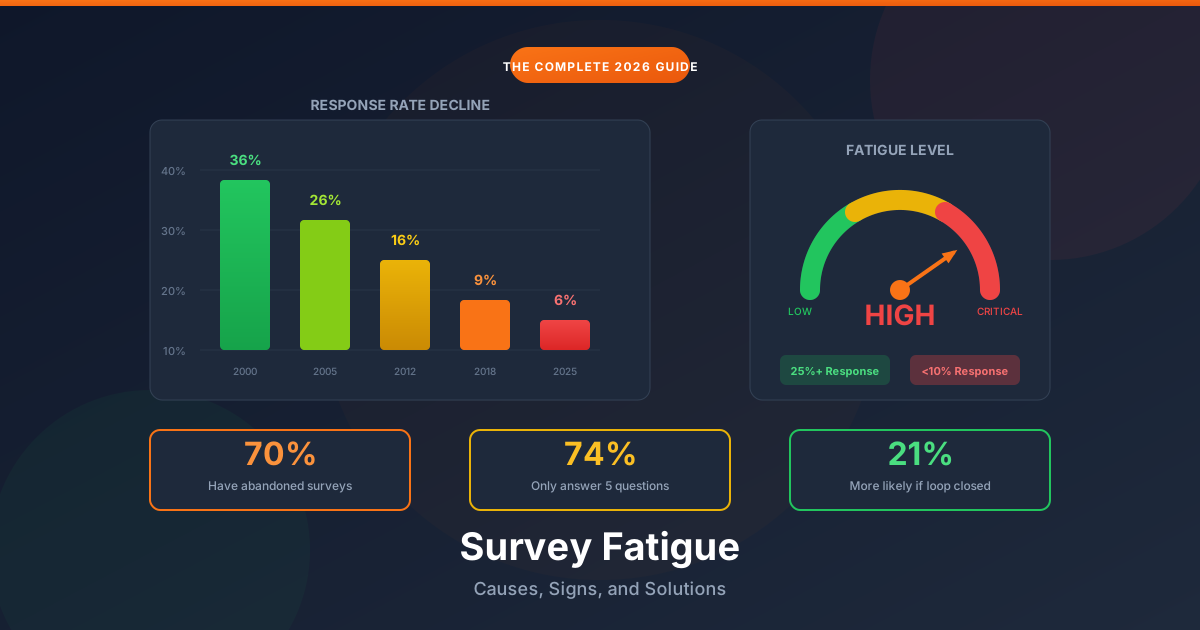
70% of respondents have abandoned a survey due to fatigue. Response rates that once hit 40% now struggle to reach 10%. Your customers are drowning in feedback requests—and your data quality is paying the price.
Survey fatigue isn’t just an inconvenience. It’s a systematic threat to the customer insights your organization depends on. Understanding what causes it, recognizing the warning signs, and implementing evidence-based solutions is now essential for any company serious about voice of customer programs.
This guide consolidates the latest research on survey fatigue—drawing from academic studies, industry benchmarks, and analysis of millions of survey responses—to give you a complete framework for diagnosis and recovery.
What Is Survey Fatigue?
Survey fatigue occurs when respondents become tired, disinterested, or overwhelmed by survey requests, leading them to provide lower-quality responses, abandon surveys prematurely, or stop participating altogether.
The academic definition is precise: “A phenomenon where individuals become tired and uninterested in answering survey questions, lose their motivation to complete surveys, provide less thoughtful answers, or prematurely terminate participation.”
But survey fatigue isn’t monolithic. Research identifies four distinct types:
Each type requires different interventions. A company suffering from over-surveying needs to reduce frequency. One experiencing taking fatigue needs to redesign their questionnaire structure. Understanding which type afflicts your program is the first step toward recovery.
The Scale of the Problem
Survey fatigue has reached epidemic proportions. The data tells a stark story:
The 30-Year Decline
Key Statistics
The paradox is clear: companies are investing more in feedback collection while getting less in return. Survey volume has exploded while response quality has collapsed.
The Root Causes of Survey Fatigue
Understanding why fatigue occurs is essential to preventing it. Our analysis identifies six primary causes:
Cause #1: Over-Surveying
The most common cause. People receive 2-3 times more surveys than they did five years ago, and 70% ignore frequent survey requests when they feel bombarded.
- Customer success teams (quarterly check-ins)
- Support teams (post-ticket surveys)
- Product teams (feature feedback)
- Marketing teams (satisfaction surveys)
- Sales teams (NPS requests)
Cause #2: Survey Length
The data is unambiguous: longer surveys destroy completion rates.
The drop from 3 questions to 4 questions alone reduces completion by 18%. Surveys over 25 minutes lose more than 3x as many respondents as those under 5 minutes.
Cause #3: Poor Timing
40% of customers ignore surveys that arrive at the wrong time. The moment of delivery matters as much as the content.
| Timing Mistake | Impact | Better Alternative |
|---|---|---|
| Immediately after negative experience | Amplifies frustration | Wait 24-48 hours |
| During business hours (B2B) | Interrupts workflow | Early morning or end of day |
| Multiple teams sending same week | Survey collision | Coordinate across teams |
| After customer already opted out | Erodes trust | Respect 30+ day cooldowns |
| Friday distribution | 8% lower participation | Monday (36%) or Tuesday-Thursday |
Research from Grokipedia confirms that Monday survey invitations yield up to 36% participation, declining linearly to 28% by Friday as weekly fatigue accumulates.
Cause #4: Irrelevant Questions
Generic surveys feel like spam. When customers see questions that don’t apply to their experience, they lose trust that their time will be valued.
• No specific context
• Feels mass-produced
• Shows you know the customer
• Feels like a conversation
Personalized surveys improve response rates by 8-25% depending on the level of customization applied.
Cause #5: No Visible Action on Feedback
This is the hidden killer. According to McKinsey research, the top cause of survey fatigue isn’t length or frequency—it’s believing feedback doesn’t lead to real change.
When customers never see results from their input, they learn that providing feedback is a waste of time. The consequence? They stop responding entirely.
Cause #6: Mobile UX Failures
60% of surveys are now opened on mobile devices—but most are still designed on desktop screens. The friction of pinching, zooming, and fighting tiny buttons drives abandonment.
| UX Problem | Impact | Solution |
|---|---|---|
| Matrix questions on mobile | Spike abandonment | Use individual rating questions |
| Mandatory open-text fields | 6% lower completion | Make optional with prompts |
| No progress indicator | Uncertainty causes exits | Show clear progress bar |
| Small tap targets | Frustration and errors | Large, thumb-friendly buttons |
| Too many response options | Cognitive overload | Limit closed-ended questions to 4-5 options |
| Poor questionnaire flow | 20-30% higher dropout | Logical progression, no abrupt jumps |
Recognizing the Warning Signs
Survey fatigue rarely announces itself. Instead, it shows up as subtle changes in your data that compound over time. Here’s what to watch for:
The Survey Fatigue Diagnostic
Sign #1: Declining Response Rates
The most visible indicator. Compare your response rates to these 2026 benchmarks:
| Survey Channel | Average Response Rate | ”Healthy” Threshold |
|---|---|---|
| Email (general) | 24.8% | 25%+ |
| In-app/mobile | 36% | 30%+ |
| SMS/Text | 45-60% | 40%+ |
| B2B relationship | 32% | 30%+ |
| B2C relationship | 13% | 15%+ |
| B2B transactional | 23% | 20%+ |
If your rates are declining quarter-over-quarter or significantly below these benchmarks, fatigue is likely contributing.
Sign #2: Straight-Lining Patterns
Straight-lining occurs when respondents select the same answer repeatedly—a clear sign they’ve stopped thinking about their responses.
Sign #3: Increased Abandonment
Track where respondents drop off within your survey:
- Abandonment rate above 10-15% indicates loss of interest
- An 18% drop in completion occurs when moving from 3 to 4 questions
- Surveys starting with open-ended questions see 6% lower completion than those beginning with multiple choice
Sign #4: Lower Quality Responses
Watch for degraded response quality:
- Shorter, less insightful free-text answers
- Increased “N/A” or skipped questions
- Response times that are unusually fast (not reading) or slow (disengaged)
- Generic responses that could apply to any company
Sign #5: Time-Per-Question Decay
Respondents naturally spend less time on later questions—but extreme decay signals fatigue.
The B2B vs. B2C Divide
Survey fatigue manifests differently across business models. Understanding these differences is crucial for tailored interventions.
Employee Surveys: A Special Case
Employee survey fatigue deserves specific attention. While 77% of employees want to provide feedback more than once per year, the primary driver of employee survey fatigue isn’t frequency—it’s lack of visible action on their input.
Evidence-Based Solutions
Now for what works. These strategies are backed by research and proven across industries.
Solution #1: Optimize Survey Length
The ideal survey hits the “sweet spot” of 7-10 questions or 10-14 minutes.
Pro tip: Skip logic can increase completion likelihood by 100-200% by removing irrelevant questions for each respondent.
Solution #2: Get the Frequency Right
| Audience Type | Recommended Frequency | Rationale |
|---|---|---|
| B2B customers | Quarterly relationship surveys | Respect professional time constraints |
| B2C customers | Tied to interaction frequency | Survey after significant touchpoints only |
| NPS per customer | No more than every 90 days | Avoid recency bias, give time for change |
| Employee engagement | Annual + quarterly pulse | Build trust through action between surveys |
| Post-support | Immediately after resolution | Capture experience while fresh |
Solution #3: Personalize Ruthlessly
Personalization isn’t just addressing customers by name—it’s making every question feel relevant.
Solution #4: Close the Feedback Loop
The single highest-impact intervention. Companies that close the loop within 48 hours see:
- 6-point NPS increase
- 2.3% decrease in annual churn (vs. 2.1% increase for those who don’t)
- 10% improvement in retention rates
- 21% higher response rate on subsequent surveys
- 41% higher revenue growth for customer-obsessed brands that systematically act on feedback (per Grokipedia research)
Solution #5: Use Incentives Strategically
Incentives work—when used correctly:
| Incentive Type | Response Rate Lift | Best For |
|---|---|---|
| $2-5 gift card | +100-300% | Consumer surveys |
| $20-25 guaranteed reward | +25-30% | B2B, longer surveys |
| Sweepstakes entry | +12% (less effective) | Large-scale B2C |
| Charity donation | +22% completion | B2B professionals |
| Early access/exclusive content | Variable | Engaged user base |
Key insight: Prepaid rewards outperform promised rewards. A $5 gift card included with the invitation beats a $10 card promised upon completion.
Solution #6: Explore Alternatives
When survey fatigue is severe, consider complementary feedback methods:
Building a Survey Health Program
Preventing fatigue requires ongoing monitoring, not one-time fixes.
Your Survey Health Dashboard
Track these metrics monthly:
The Quarterly Audit
Every quarter, review:
- Cross-team coordination: Are multiple teams surveying the same customers? Implement a survey governance process.
- Question relevance: Review each question—if you can’t articulate how you’ll act on the answer, cut it.
- Loop closure rate: What percentage of actionable feedback received follow-up? Target 100% for detractors.
- Channel optimization: Are you using the right channel for each survey type? Test alternatives.
Frequently Asked Questions
What’s the ideal survey frequency?
There’s no universal answer—it depends on your relationship with the audience:
- Customer relationship surveys: Quarterly for B2B, tied to interaction frequency for B2C
- NPS per individual customer: No more than every 90 days
- Transactional surveys: Immediately after significant touchpoints
- Employee engagement: Annual comprehensive + quarterly pulse
The key principle: survey frequency should match the rate at which experiences actually change.
How long should my survey be?
Transactional (NPS, CSAT): 1-4 questions, under 2 minutes Relationship surveys: 7-10 questions, 5-7 minutes Employee engagement: 12-20 questions, 8-12 minutes Research studies: 15-25 questions maximum, under 15 minutes
The 18% completion drop from 3 to 4 questions is real—every question must earn its place.
Can incentives backfire?
Yes, in three scenarios:
- Wrong audience: Incentives attract respondents motivated by the reward, not by providing thoughtful feedback
- Wrong amount: Too small feels insulting; too large attracts professional survey-takers
- Wrong type: Cash isn’t always best—some audiences prefer charitable donations or exclusive access
Test different incentive structures with your specific audience before scaling.
How do I convince leadership to reduce survey frequency?
Frame it in business terms:
- Show the response rate trend and what it means for data reliability
- Calculate the cost of low-quality data (bad decisions, wasted survey spend)
- Present a coordinated survey strategy that maintains coverage while reducing customer burden
- Propose a pilot: reduce frequency for one segment, measure impact on both response rates and customer satisfaction
What about employee survey fatigue?
The primary driver is different: employees tire of surveys when they don’t see action taken on their feedback. Focus on:
- Sharing results within 2-4 weeks of survey close
- Creating and communicating action plans
- Referencing previous feedback in subsequent survey invitations
- Celebrating changes made based on employee input
Most employees actually want to provide feedback more often—they just want it to matter.
When is survey fatigue beyond recovery?
If response rates have dropped below 5% with no improvement from tactical fixes, consider:
- A “feedback holiday”—announce a pause in surveys while you redesign your program
- Switching entirely to passive feedback methods for 6-12 months
- Rebuilding trust through visible action on existing feedback before asking for more
Take Action on Survey Fatigue
Survey fatigue isn’t inevitable—it’s the result of misaligned survey programs that ask too much while giving too little in return. The organizations avoiding fatigue share common practices:
- They survey with purpose, not habit
- They personalize every interaction to make it feel relevant
- They close the loop visibly so customers see their feedback matters
- They measure survey health as rigorously as they measure survey results
- They coordinate across teams to respect customer time
The goal isn’t more data—it’s better data from engaged respondents who trust that their time will be valued.
Ready to diagnose and treat survey fatigue in your organization?
- Request a demo to see ActionXM’s survey health analytics →
- Explore our survey design best practices →
- Talk to our research team about your specific challenges →
ActionXM’s intelligent survey platform automatically monitors for fatigue signals and recommends optimizations—so you can focus on acting on insights, not managing survey logistics.
Sources
- Grokipedia: Response Rate (Survey)
- Grokipedia: Voice of the Customer
- Grokipedia: Questionnaire Construction
- PMC - Journal of Caring Sciences: Survey Fatigue Research
- San Francisco Federal Reserve: Survey Response Rate Analysis
- Pew Research Center: Survey Response Rate Trends
- Qualtrics: Avoiding Survey Fatigue
- HubSpot: Survey Fatigue Statistics
- SurveyMonkey: State of Surveys 2024
- CustomerGauge: Close the Loop Impact
- Survicate: Survey Completion Rate Research
- Kantar: Survey Length Best Practices
- Fortune: Customer Survey Overload 2025
- Great Place To Work: Employee Survey Frequency
- McKinsey: Employee Experience Research
- Refiner: In-App Survey Response Rates
- Sprinklr: Survey Fatigue Analysis