“Should we offer gift cards to boost our survey response rates?”
It’s one of the most common questions in customer research—and one of the most poorly answered. The conventional wisdom swings between extremes: either “incentives are essential” or “incentives corrupt your data.” Neither is right.
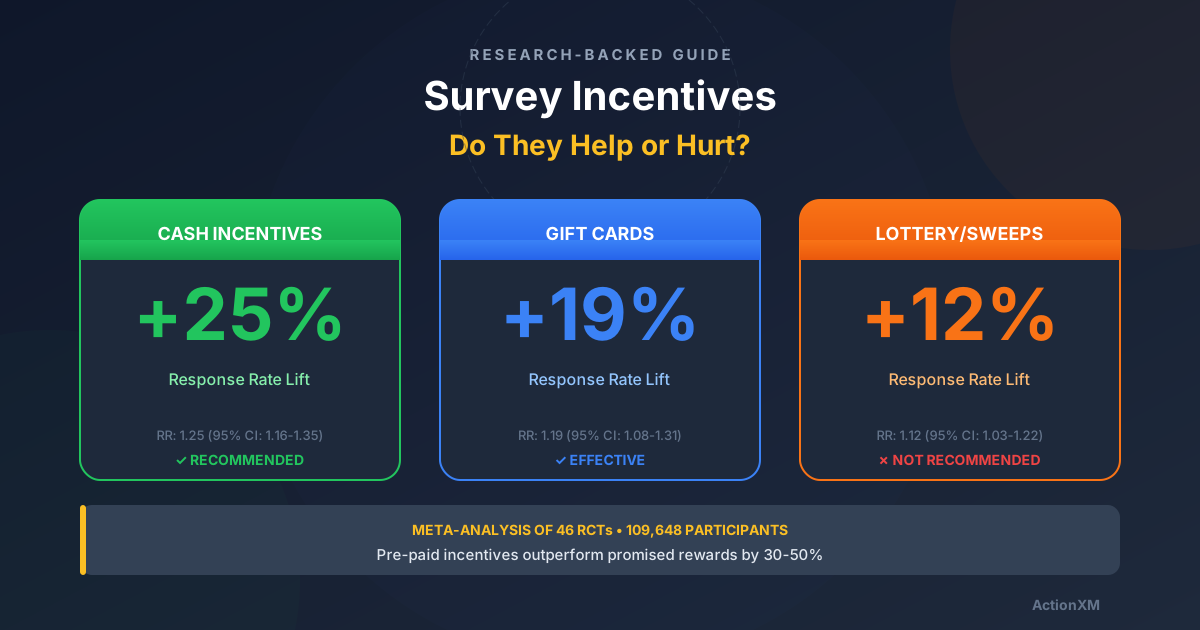
The research tells a more nuanced story. A meta-analysis of 46 randomized controlled trials with over 109,000 participants reveals that incentives can increase response rates by 19-30%—but only when designed correctly. Poorly implemented incentives can introduce bias, attract the wrong respondents, and actually degrade data quality.
This guide cuts through the conflicting advice with evidence-based answers: when incentives help, when they hurt, and exactly how to implement them for maximum impact without compromising data integrity.
The Great Incentive Debate: What the Data Actually Shows
Let’s start with what large-scale research tells us about incentive effectiveness.
The Bottom Line on Effectiveness
The research is clear: incentives work—but not all incentives work equally well. Here’s what the data tells us:
| Incentive Type | Average Response Lift | Cost Efficiency | Best Use Case |
|---|---|---|---|
| Pre-paid Cash | +25-30% | Moderate | Professional research, mail surveys |
| Digital Gift Cards | +19-25% | High | Online surveys, B2B and B2C |
| Vouchers/Discounts | +15-20% | High | Customer feedback, retention |
| Lottery/Sweepstakes | +10-12% | Very High | Not recommended (see below) |
| Non-monetary | +8-10% | Very High | Engaged audiences, B2B |
Pre-Paid vs. Promised: The Timing That Changes Everything
Perhaps the most important finding in incentive research: when you deliver the incentive matters as much as what you offer.
The Reciprocity Principle
The effectiveness of pre-paid incentives stems from a fundamental psychological principle: reciprocity. When people receive something first—even something small—they feel obligated to reciprocate.
Robert Cialdini’s research on influence demonstrates that pre-paid incentives create a “psychological debt” that survey completion satisfies. A $2 bill enclosed with a mail survey triggers the same reciprocity response as a larger promised reward—often with better results.
2024 Gallup Research Finding: Pre-incentives in mail and mail push-to-web surveys significantly improve response rates and reduce overall survey costs despite the upfront investment.
The Lottery Trap: Why Sweepstakes Underperform
One of the most counterintuitive findings: lottery-based incentives are statistically equivalent to offering no incentive at all for most survey types.
- Lower response rates
- Higher drop-off rates
- More skipped questions
- Lower completion rates
- Low perceived value
- "Probably won't win anyway"
- Doesn't trigger reciprocity
- Feels like marketing gimmick
The math doesn’t favor lotteries: A $500 prize with 1,000 respondents gives each person a $0.50 expected value. A guaranteed $5 gift card provides 10× the perceived value per person—and the psychological impact is even larger because certainty is valued over probability.
The Dark Side: When Incentives Backfire
Incentives aren’t universally positive. Research reveals several scenarios where they can actually harm your data quality and response rates.
The Satisficing Problem
Research from PMC reveals a troubling pattern: 81% of incentivized respondents engage in at least one form of satisficing behavior—speeding through questions, skipping items, or selecting the same answer repeatedly. 41% engage in at least two forms.
satisficing behavior
satisficing behaviors
due to fraud
The implication: More responses don’t automatically mean better data. Incentives that optimize for volume without quality controls can actually reduce the value of your research.
Optimal Incentive Amounts: The Research-Based Guidelines
How much should you offer? The research provides clear guidance.
Critical Thresholds
Audience-Specific Adjustments
| Audience | Adjustment | Rationale |
|---|---|---|
| Students | -20% from standard | More price-sensitive, time-flexible |
| High earners ($200K+) | +46% premium | Opportunity cost higher |
| Physicians/Executives | $50-500 | Extremely limited time |
| B2B decision makers | $80-100/hour | Professional rates expected |
| General consumers | $50-80/hour | Standard market rate |
Payment method matters: Gift cards require approximately $35 more than cash equivalents to achieve the same perceived value. When possible, offer direct payment options.
Incentives by Industry: Best Practices
Different contexts require different approaches.
Real-World Results: Case Studies
Shell CX Program
SMG client Shell implemented strategic incentives that encouraged repeat visits (discount vouchers and loyalty points).
Electronics Manufacturer
A major electronics manufacturer struggling with 20-minute survey abandonment implemented tiered rewards.
The Decision Framework: When to Incentivize
Use this framework to determine whether incentives make sense for your survey.
- Targeting hard-to-reach populations
- Survey length exceeds 10 minutes
- Response rates below industry benchmarks
- Budget allows guaranteed rewards
- Research requires representative sampling
- Cold outreach or market research
- Intrinsic motivation is high
- Survey is very short (1-5 questions)
- Authentic feedback is paramount
- Employee engagement measurement
- Loyal customer feedback programs
- Budget only allows lottery format
Quick Implementation Checklist
If you decide to use incentives, follow these research-backed practices:
- Choose guaranteed over lottery — 2× more effective, better data quality
- Pre-pay when possible — Triggers reciprocity, improves completion
- Start at $5 minimum — Below $5 shows no measurable impact
- Match compensation to time — $1.76/minute as baseline
- Offer payment choice — Cash/PayPal preferred over gift cards
- Include quality controls — Attention checks, speeding detection
- Segment your approach — Different audiences need different incentives
- Test and measure — A/B test incentive structures against controls
Frequently Asked Questions
Do incentives bias survey results?
Yes, but not always negatively. Incentives can attract respondents who wouldn’t otherwise participate, potentially improving representativeness. However, they can also attract “professional survey takers” motivated solely by rewards. The key is implementing quality controls (attention checks, speeding detection) and designing incentives that don’t favor particular response patterns.
What’s the minimum effective incentive amount?
$5 is the research-backed minimum. Studies consistently show that incentives below $5 produce no statistically significant improvement in response rates. A $2 incentive often performs no better than no incentive at all.
Are lottery-based incentives ever appropriate?
Rarely. Sweepstakes-style incentives are statistically equivalent to no incentive in most contexts. The only scenario where they might work is when you have a highly engaged audience (like existing customers) and want to minimize cost while providing a token gesture. Even then, a smaller guaranteed reward typically outperforms a larger lottery prize.
How do I prevent fraud with incentivized surveys?
Multiple quality control layers. Research shows online survey fraud has dramatically reduced usable responses (75%→10% in some studies). Implement: speeding detection (flag responses under 30-50% of median time), attention check questions, captcha/Turing tests, consistency checks, and IP/device fingerprinting.
Should I offer incentives for NPS surveys?
Usually not for standard NPS. One-question NPS surveys require minimal effort—non-response is typically about timing and relevance, not motivation. However, if you’re asking follow-up questions that extend the survey to 5+ minutes, modest incentives may help. Focus optimization efforts on survey timing and channel selection instead.
Do non-monetary incentives work?
Yes, in specific contexts. Non-monetary incentives (exclusive content, early access, charitable donations) produce about +8% response rate improvement on average—less than monetary incentives but meaningful. They work best with engaged audiences who have intrinsic motivation. 90% of consumers would provide feedback in exchange for redeemable loyalty points.
How do cultural differences affect incentive effectiveness?
Significantly. Research shows monetary incentives are more motivating in the US and UK compared to China, India, Mexico, and South Africa. In India, respondents are equally responsive to altruistic incentives (charitable donations) as to personal rewards. Always consider cultural context when designing global survey programs.
The Bottom Line
Survey incentives are neither universally helpful nor universally harmful. The research is clear about what works:
The most effective survey programs don’t rely on incentives alone. They combine appropriate incentives with optimized timing, relevant questions, mobile-friendly design, and visible action on feedback. Incentives can boost response rates by 30%—but only as part of a well-designed research program.
Design Better Survey Programs
ActionXM helps you design, distribute, and analyze surveys that balance response rates with data quality. With multi-channel distribution, intelligent timing, skip logic, and built-in quality controls, you can implement the incentive strategies that work—without compromising your insights.
Ready to optimize your survey program?
Need help designing an incentive strategy for your specific audience? Contact our team for guidance based on your industry and survey goals.
Sources
- PLOS ONE/PMC - Meta-Analysis of Survey Incentives (46 RCTs)
- Gallup - Cash Incentives and Survey Response Rates (2025)
- Survey Practice - Pre-Paid vs Post-Paid Incentive Study
- JMIR Formative Research - Optimal Incentive Amounts (2024)
- PMC - Satisficing Behavior in Incentivized Surveys
- Frontiers - Survey Fraud and Data Quality
- Tremendous - Research Incentive Rate Study (2024)
- User Interviews - Survey Incentive Best Practices
- BHN Rewards - Customer Feedback Survey Incentives
- SAGE Journals - Healthcare Survey Incentives
- Genroe - Customer Feedback Survey Incentives
- Energage - Risks of Incentivizing Engagement Surveys
- Academy of Business Research - When Financial Incentives Backfire
- Nature Human Behaviour - Reciprocity and Survey Response
- SurveyMonkey - Using Survey Incentives
- CustomerSure - Survey Incentives Guide
- SMG - Feedback Incentives and CX Outcomes
- Tango Card - Survey Incentive Ideas
- BMC Medical Research Methodology - Longitudinal Survey Incentives