“How many survey responses do I need?” It’s the most common question in survey research—and getting it wrong costs organizations either credibility (too few responses) or resources (too many).
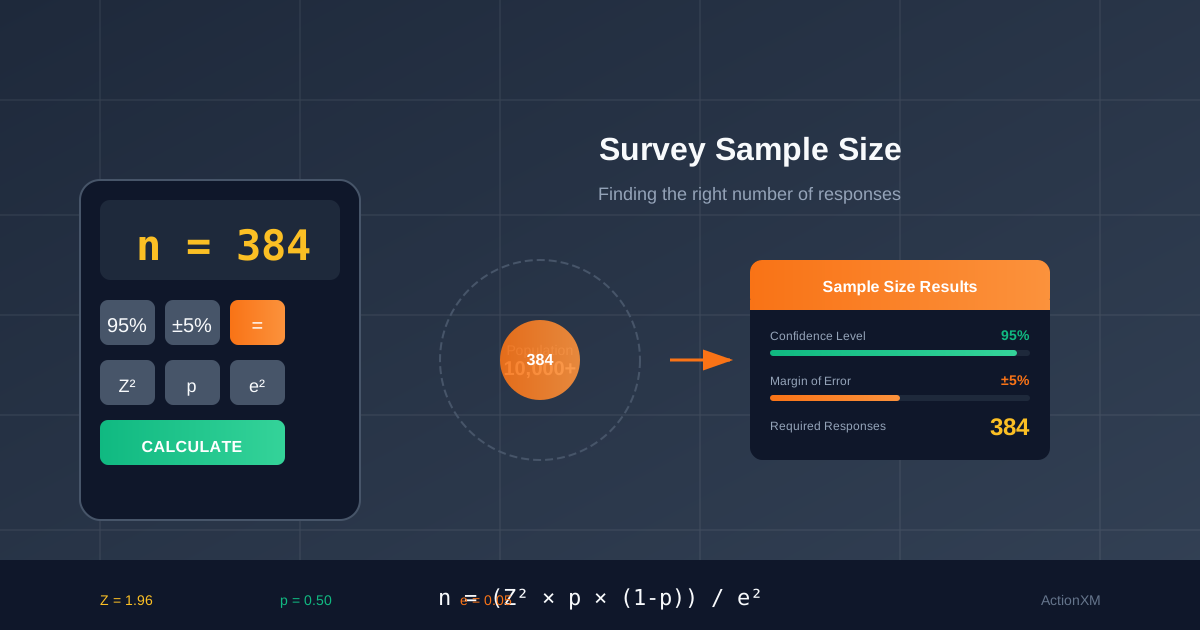
Here’s the reality: a well-designed sample of 384 people can accurately represent 300 million with only a ±5% margin of error at 95% confidence. That’s not magic—it’s statistics. And understanding how it works transforms how you plan every survey.
This guide gives you everything needed to calculate sample size correctly: the formulas explained simply, quick reference tables for common scenarios, and practical guidance for real-world survey programs.
Why Sample Size Matters More Than You Think
Sample size determines whether your survey results are:
- Statistically valid: Large enough to represent your population
- Actionable: Precise enough to make confident decisions
- Efficient: Not wasting resources on unnecessary responses
Get it wrong, and you face two costly outcomes:
- Wide margin of error (±15%+)
- Results may be random noise
- Can't analyze subgroups
- Decisions lack confidence
- Stakeholders question validity
- Survey fatigue for customers
- Wasted incentive budget
- Diminishing precision returns
- Extended data collection time
- Analysis paralysis from over-data
The goal: enough responses for statistical validity, but not so many that you waste resources or annoy your audience.
The Sample Size Formula Explained
Let’s demystify the math. The standard formula for calculating survey sample size is:
e²
For known, finite populations, add a correction factor:
Don’t want to do math? Use our quick reference tables below—or platforms like ActionXM calculate this automatically based on your survey parameters.
Understanding the Key Variables
Confidence Level: How Sure Do You Want to Be?
The confidence level indicates the probability that your results fall within the margin of error if you repeated the survey.
Recommendation: Use 95% confidence for most business surveys. Reserve 99% for decisions with significant financial or safety implications.
Margin of Error: How Precise Do You Need to Be?
The margin of error defines the range within which the true population value likely falls.
| Margin of Error | Typical Use Case | Sample Size Impact |
|---|---|---|
| ±3% | High-precision research, regulatory compliance, academic studies | Largest sample needed |
| ±5% | Standard business surveys, NPS programs, customer satisfaction | Most common choice |
| ±7% | Internal surveys, preliminary research | Moderate sample |
| ±10% | Exploratory studies, quick pulse surveys | Smallest sample |
Rule of thumb: Halving the margin of error requires quadrupling the sample size. Choose precision that matches your decision stakes.
Population Size: Does It Really Matter?
Here’s a counterintuitive truth: for populations over 10,000, population size barely affects required sample size.
Surveying 10,000,000 customers? You need 384 responses.
Same 95% confidence, ±5% margin. The difference is only 14 responses.
Population size only matters when you’re surveying a significant portion of a small population (typically over 5%). This is called the Finite Population Correction.
Quick Reference: Sample Size Tables
Standard Sample Size by Population
Use this table for 95% confidence level (the industry standard):
| Population Size | ±3% Margin | ±5% Margin | ±7% Margin | ±10% Margin |
|---|---|---|---|---|
| 100 | 92 | 80 | 67 | 49 |
| 250 | 203 | 152 | 110 | 70 |
| 500 | 341 | 217 | 145 | 81 |
| 1,000 | 516 | 278 | 169 | 88 |
| 2,500 | 748 | 333 | 190 | 93 |
| 5,000 | 879 | 357 | 196 | 95 |
| 10,000 | 964 | 370 | 200 | 96 |
| 25,000 | 1,023 | 378 | 202 | 96 |
| 50,000 | 1,045 | 381 | 203 | 96 |
| 100,000+ | 1,067 | 384 | 204 | 97 |
Sample Size by Confidence Level
For a population of 10,000+:
| Confidence Level | ±3% Margin | ±5% Margin | ±10% Margin |
|---|---|---|---|
| 90% | 752 | 271 | 68 |
| 95% | 1,067 | 384 | 97 |
| 99% | 1,849 | 666 | 167 |
Sample Size by Survey Type
| Survey Type | Typical Margin | Typical Confidence | Recommended Sample |
|---|---|---|---|
| NPS Survey | ±5% | 95% | 380-400 |
| Customer Satisfaction (CSAT) | ±5% | 95% | 380-400 |
| Employee Engagement | ±5% | 95% | 380+ or census |
| Market Research | ±3-5% | 95% | 400-1,100 |
| Quick Pulse Survey | ±10% | 90% | 70-100 |
| Product Feedback | ±5-7% | 95% | 200-400 |
The Response Rate Factor
Here’s what many guides miss: sample size is responses, not invitations. You need to account for response rates.
Typical Response Rates by Channel
The Invitation Formula
400 ÷ 0.20 = 2,000 invitations
Invitations Needed by Response Rate
| Responses Needed | 10% Rate | 20% Rate | 30% Rate | 40% Rate | 50% Rate |
|---|---|---|---|---|---|
| 100 | 1,000 | 500 | 334 | 250 | 200 |
| 200 | 2,000 | 1,000 | 667 | 500 | 400 |
| 400 | 4,000 | 2,000 | 1,334 | 1,000 | 800 |
| 600 | 6,000 | 3,000 | 2,000 | 1,500 | 1,200 |
| 1,000 | 10,000 | 5,000 | 3,334 | 2,500 | 2,000 |
When to Use Larger Samples
Subgroup Analysis Requirements
If you plan to analyze segments separately, each subgroup needs its own sufficient sample size.
Rule of thumb: Multiply your base sample size by the number of subgroups you need to analyze separately.
Detecting Small Differences
Smaller effect sizes require larger samples to detect:
| Difference to Detect | Approximate Sample Needed |
|---|---|
| 15+ point NPS change | 100-200 per group |
| 10 point NPS change | 200-400 per group |
| 5 point NPS change | 600-800 per group |
| 3 point NPS change | 1,500+ per group |
Tracking Trends Over Time
Consistent longitudinal measurement requires stable sample sizes across periods:
- Monthly tracking: Aim for 200-400 responses per month
- Quarterly tracking: Aim for 400-600 responses per quarter
- Annual studies: Aim for 1,000+ responses for detailed breakdowns
When Smaller Samples Work
Not every survey needs hundreds of responses. Smaller samples are appropriate for:
Qualitative Research
| Method | Typical Sample | Why It Works |
|---|---|---|
| Usability testing | 5-6 participants | Identifies ~85% of issues |
| User interviews | 6-12 participants | Reaches thematic saturation |
| Card sorting | 15-30 participants | Sufficient for pattern detection |
| Focus groups | 6-10 per group | Group dynamics reveal insights |
Homogeneous Populations
When your audience is highly similar, less variation means smaller samples capture the pattern:
- Internal employee surveys at small companies
- Niche B2B customer segments
- Specialized professional groups
Exploratory Research
When you’re testing hypotheses before larger investment:
- Concept testing with 30-50 respondents
- Initial feature feedback with 50-100 users
- Quick directional pulse with 100 responses
Sample Size by Survey Type: Detailed Recommendations
NPS (Net Promoter Score) Surveys
NPS presents a unique challenge: you’re categorizing respondents into promoters, passives, and detractors, then calculating the difference.
- Minimum viable: 200 responses (gives rough directional insight)
- Recommended: 400+ responses (solid statistical validity)
- B2B context: 50-100 responses may be significant given smaller populations
- Tracking trends: Consistent sample sizes matter more than absolute numbers
Customer Satisfaction (CSAT) Surveys
CSAT is typically measured at specific touchpoints with clearer expectations:
| Touchpoint | Recommended Sample | Notes |
|---|---|---|
| Post-purchase | 300-500 monthly | Higher volume, continuous measurement |
| Support interaction | 200-400 monthly | Tied to ticket volume |
| Onboarding completion | 100-200 | Smaller population, higher stakes |
| Renewal/annual | 400+ | Strategic importance justifies investment |
Employee Engagement Surveys
| Company Size | Recommended Approach |
|---|---|
| 1-50 employees | Census (survey everyone) |
| 51-200 employees | Census or 70%+ sample |
| 201-500 employees | 300-400 minimum, ideally 60%+ |
| 500+ employees | 400+ responses, ensure department representation |
For employee surveys, response rate signals engagement as much as scores do. Aim for 60%+ participation.
Market Research Studies
| Study Type | Minimum Sample | Ideal Sample |
|---|---|---|
| Descriptive/exploratory | 200-400 | 500-1,000 |
| Comparative (2 segments) | 200 per segment | 400+ per segment |
| Conjoint analysis | 300 | 500-1,000 |
| MaxDiff studies | 200 | 400+ |
Common Sample Size Mistakes
1. Not Calculating Upfront
Mistake: Starting surveys without determining needed responses.
Solution: Define sample size requirements before deploying. Calculate based on your confidence level, margin of error, and analysis plans.
2. Forgetting Subgroup Needs
Mistake: Planning for 400 overall responses, then wanting to analyze 5 segments separately.
Solution: Identify all planned breakdowns upfront. Each subgroup needs sufficient responses.
3. Ignoring Response Rates
Mistake: Assuming everyone invited will respond.
Solution: Calculate invitations needed based on realistic response rate estimates. Build in buffer for lower-than-expected rates.
4. Conflating Precision with Validity
Mistake: Believing more responses always mean better data.
Solution: A biased sample of 10,000 is worse than a representative sample of 400. Focus on who responds, not just how many.
5. One-Size-Fits-All Thinking
Mistake: Using the same sample size for every survey type.
Solution: Match sample size to stakes, analysis needs, and available population.
Real-World Examples
Example 1: E-Commerce Company CSAT
Scenario: Online retailer with 50,000 monthly customers wants to measure satisfaction.
Calculation:
- Population: 50,000 monthly customers
- Desired confidence: 95%
- Acceptable margin: ±5%
- Expected response rate: 15% (email survey)
Result: Need 381 responses → Invite 2,540 customers
Recommendation: Survey a rotating sample of customers post-purchase, targeting 400 responses monthly.
Example 2: B2B SaaS NPS Program
Scenario: SaaS company with 800 enterprise accounts wants quarterly NPS.
Calculation:
- Population: 800 accounts
- Desired confidence: 95%
- Acceptable margin: ±5%
- Multiple contacts per account: 2-3
Result: Need 260 responses → Target 1-2 contacts per account, aim for 40% response rate
Recommendation: Survey all accounts quarterly with 2 contacts per account maximum. With 40% response rate from 1,600 contacts, expect ~640 responses—more than sufficient.
Example 3: Employee Engagement by Department
Scenario: Company with 1,200 employees across 6 departments wants engagement scores by department.
Calculation:
- Population: ~200 per department
- Need: Statistical validity per department
- Each department: ~130 responses needed (95% confidence, ±5%)
Result: Need 780 total responses (130 × 6) → Aim for 65%+ response rate company-wide
Recommendation: Survey all employees, target 70% response rate minimum. Communicate importance to drive participation.
Tools and Automation
Modern survey platforms eliminate manual sample size calculations. Here’s what to look for:
Essential Calculation Features
- Automatic sample size recommendations based on your parameters
- Response rate tracking with alerts when falling short
- Subgroup sufficiency warnings for segment analysis
- Statistical significance testing on comparisons
How ActionXM Handles Sample Size
ActionXM automatically:
- Calculates required sample sizes based on your confidence and margin settings
- Tracks response rates in real-time against targets
- Alerts you when subgroups lack statistical validity
- Provides significance testing on all comparisons
- Recommends optimal survey timing based on population and response patterns
Stop guessing at sample sizes. Request a demo to see how ActionXM automates statistical validity into every survey.
FAQ: Sample Size Questions Answered
What’s the minimum sample size for a survey?
For quantitative surveys, 100 responses is generally the minimum for meaningful analysis. For 95% confidence with ±5% margin, you need 384 responses from large populations. For smaller populations, fewer responses may suffice—see our reference tables.
Does my population size affect sample size?
For populations over 10,000, barely. A population of 10,000 needs 370 responses; 10,000,000 needs 384. Population size only significantly affects calculations when you’re sampling more than 5% of a finite, smaller population.
How do I calculate sample size for subgroups?
Each subgroup you want to analyze separately needs its own sufficient sample. If you want to compare 4 customer segments, multiply your base sample by 4. Planning subgroup analysis upfront prevents underpowered comparisons.
What response rate should I plan for?
Email surveys typically achieve 15-25%, SMS surveys 45-60%, and in-app surveys 10-15%. Employee surveys range 30-50% depending on culture and communication. Always calculate invitations needed based on conservative response rate estimates.
Is 30 responses enough?
For qualitative insights or exploratory research, possibly. For statistically valid quantitative findings, no. 30 responses gives you a rough directional sense but carries a ±18% margin of error at 95% confidence—too imprecise for most business decisions.
How do I know if my sample is representative?
Compare your respondent demographics to your population. Check for response bias by analyzing early vs. late responders. Use weighting if certain segments are underrepresented. A representative sample of 400 beats a biased sample of 4,000.
Key Takeaways
Build Statistically Valid Surveys Automatically
Calculating sample sizes manually introduces room for error. ActionXM builds statistical validity into every survey with automatic sample size recommendations, real-time response tracking, and significance testing on all comparisons.
Make data-driven decisions with confidence:
Questions about sample size for your specific use case? Contact our team—we help organizations design statistically valid survey programs every day.
Sources
- Qualtrics - Sample Size Calculator
- SurveyMonkey - Sample Size Calculator
- Calculator.net - Sample Size Calculator
- MeasuringU - Finite Population Correction
- Gallup - How Polling Works
- Pew Research - Survey Methodology
- SurveySparrow - Response Rate Benchmarks
- NN/g - Quantitative UX Sample Sizes
- Sawtooth Software - Survey Sample Size
- CloudResearch - Determining Sample Size
- PMC/NIH - Sample Size Calculation